
There is something almost defiant about a postcard in 2026.
Your phone knows what you searched for. Meta knows what you watched. Google knows what you need. Algorithms follow homeowners from website to website with an efficiency that would have seemed impossible a generation ago.
And then there is the mailbox.
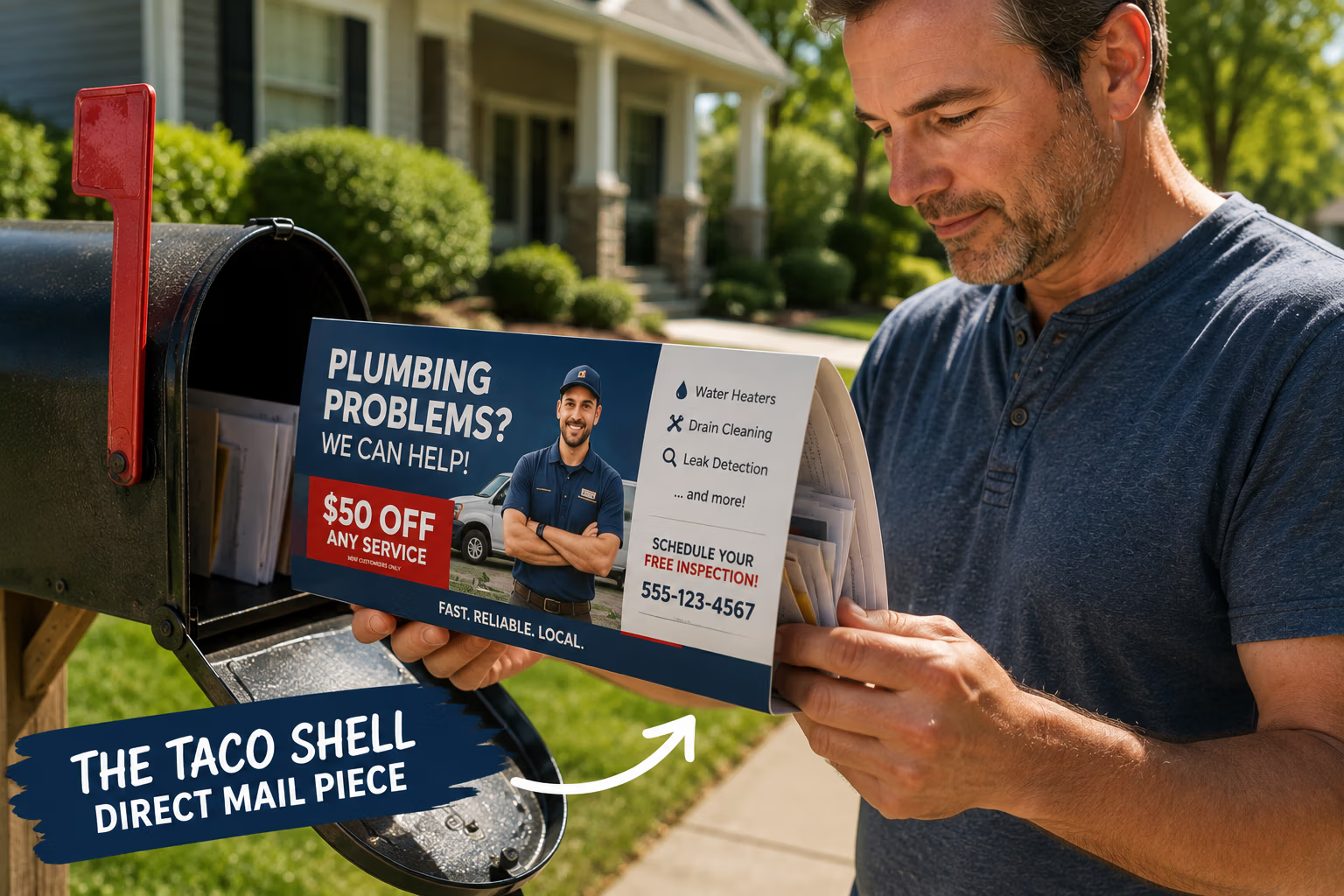
You walk outside. Open it. Pull out a handful of physical objects. And for a few seconds, someone has placed an advertisement directly in your hand.
Gary Pizzati thinks that moment still matters.
Pizzati is the Founder and CEO of We Mail America, a direct mail company that has earned back-to-back recognition on the Inc. 5000, including a #953 ranking in 2026. Before starting the company, he spent decades in media and advertising, eventually overseeing hundreds of millions of dollars in advertising sales across major markets for Cumulus Media.
When Gary joined me on the Plumber Marketing Success Podcast, I wanted to answer a deceptively simple question:
Does direct mail still make sense for a plumbing company?
His answer was yes—but not the direct mail many plumbers remember.
Today’s best campaigns combine old-school physical media with sophisticated targeting, compelling offers, CRM data and even artificial intelligence.

Direct Mail Is the Grandfather of Targeted Media
Gary calls direct mail the “grandfather of targeted media.”
Before digital algorithms existed, marketers already had the ability to put an advertisement into the hands of someone living in a particular household or neighborhood.
What has changed is the precision.
Suppose you’re a plumber trying to sell water heater replacements.
You probably don’t want to spend money reaching apartment buildings, renters or homeowners living in brand-new houses. Gary explains that today’s campaigns can identify variables including home age, owner occupancy, income and housing type.
A campaign can concentrate on older single-family homes where the likelihood of aging plumbing equipment may be greater.
Gary’s team can then use carrier-route data to reach a desired neighborhood without necessarily paying the higher postage associated with individually jumping from one selected address to another.
As he explained, targeting has become substantially more sophisticated.
And that leads to his first major principle:
If the data is wrong, beautiful creative doesn’t matter.
You can design the greatest postcard in America. Send it to the wrong households and you’ve created an expensive piece of recycling.
The Four Things That Determine Whether Direct Mail Works
During our conversation, I broke a direct mail campaign into four variables:
Mailing list. Offer. Creative. Frequency.
I asked Gary which deserved the most attention.
His answer?
All of them.
That sounds simple, but it’s an important marketing lesson.
There is a tendency to search for the one lever that determines success. Maybe it’s targeting. Maybe it’s the headline. Maybe it’s the offer.
Gary’s argument is that a successful campaign is a system.
The right offer delivered to the wrong household doesn’t work.
The right household receiving a weak offer doesn’t work.
Great data combined with terrible creative doesn’t work.
And an effective campaign that isn’t given enough opportunity to produce results may be abandoned prematurely.
Gary simplifies his own philosophy into what We Mail America calls the Three Ds: Data, Design and Delivery.
For plumbing companies accustomed to thinking about marketing channel by channel, that’s a useful framework.
Direct Mail Isn’t Primarily a Branding Medium
This was one of my favorite distinctions from our conversation.
Direct mail can certainly increase awareness, but Gary doesn’t primarily think of it as a branding medium.
Branding is about earning real estate in someone’s mind through repetition.
Think radio. Television. Video. Podcasts.
You hear or see a company enough times that when a need finally appears, the name is already sitting somewhere in your memory.
Direct mail is different.
Direct mail is at its best when it asks for action.
The homeowner receives something. There is a relevant need. The offer is compelling enough. They respond.
That makes the offer extraordinarily important.
What Is a Good Direct Mail Offer for a Plumber?
Gary likes inspection-based offers for service businesses.
He gave an example of an HVAC company that mailed 58,000 homes with a free, no-obligation inspection and generated significant response.
For a plumbing company, the principle could be applied to an appropriate plumbing inspection or other low-friction entry offer.
The goal isn’t necessarily to make money on the first interaction.
The goal is to create a compelling enough reason for the homeowner to invite you into the house.
Once you’re there, do a great job.
Look at the plumbing system. Build trust. Identify legitimate issues. And if everything looks great, tell the homeowner everything looks great.
Then leave behind your information and earn the right to be remembered when something eventually breaks.
Gary’s advice is to make the offer compelling without turning the mailer into a catalog.
Simple. Compelling. Eye-catching. Credible.
That’s his formula.
Your Postcard Doesn’t Need to Explain Everything
Marketing people have a strange instinct.
Give us an 8.5-by-11-inch piece of paper and we immediately try to fill every square inch.
Logo.
Phone number.
Seven services.
Three coupons.
Financing.
Awards.
Reviews.
QR code.
Family photograph.
Six trucks.
American flag.
Gary argues for restraint.
A homeowner sorting the mail isn’t sitting down to study your corporate brochure. You’re competing for seconds of attention.
The job of the piece isn’t to explain everything your plumbing company has ever done.
The job is to make someone stop long enough to understand:
Who is this for?
Why should I care?
What should I do next?
Gary discusses 6-by-11 postcards and 8.5-by-11 solo letters as formats his company uses with service businesses.
But size won’t save a weak message.
How Much Should a Plumbing Company Spend on Direct Mail?
This is where the conversation became especially practical.
I asked Gary what a five-to-10-truck plumbing company should realistically expect to invest.
For a smaller advertiser, he gave an example of approximately $1,800 per month to reach around 2,000 homes.
Larger service businesses, he said, may spend approximately $5,000 to $7,000 per month on direct mail as part of their overall marketing mix.
Gary also described a concept his company calls “10 by 10”—10,000 homes over 10 straight months.
Importantly, that doesn’t necessarily mean blindly hitting the same 10,000 houses ten times.
His team studies performance. Some routes perform better than others. Those areas can be revisited.
That changes the conversation from:
“Did the postcard work?”
to:
“What did we learn from the campaign, and where should the next dollar go?”
That’s a much more sophisticated question.
The Attribution Problem: Did Google Really Generate That Lead?
This may be the most important idea in the entire episode.
Imagine this:
A homeowner walks to the mailbox.
They receive your postcard.
They look at it for ten seconds.
They need a plumber, but they don’t call the number printed on the card.
Instead, they throw the postcard away, walk inside, pull out their phone and Google your company.
They click.
They call.
Your attribution report says:
Google generated the customer.
But did it?
Google may have captured the demand.
The postcard may have created it.
Gary says his company addresses this through matchback reporting.
They take the households that received the mailing and compare those addresses with subsequent activity in the plumbing company’s CRM. AI can help normalize address variations—such as “N. Main Street” versus “North Main Street”—and perform a process Gary says once required substantial manual effort in seconds.
Suddenly, the plumber can see customers who received the mail but converted through another path.
That doesn’t mean Google deserves no credit.
It means marketing attribution is more complicated than the last click.
Stop Making Your Marketing Channels Fight Each Other
This is a problem I see throughout digital marketing.
Businesses want every channel to stand in front of the judge and prove that it alone generated the sale.
Google versus Meta.
SEO versus LSA.
Yelp versus Google.
Direct mail versus digital.
But homeowners don’t behave according to our attribution reports.
They see things.
They hear things.
They forget things.
They remember things.
They ask friends.
They read reviews.
They receive a postcard.
They search Google.
They encounter the company again.
And eventually they call.
Gary and I agreed on an important point during the episode: direct mail should be part of an integrated marketing system.
A plumber shouldn’t say, “Google didn’t work last month, so this month I’m turning it off and trying postcards.”
The channels can reinforce each other.
Direct mail can introduce you.
Google can help the homeowner find you.
Your Google Business Profile can establish credibility.
Reviews can reduce uncertainty.
Your website can reinforce the decision.
And your call handling ultimately determines whether the marketing becomes revenue.
What Should Your First 90 Days Look Like?
Interestingly, Gary doesn’t begin with postcards.
He begins with questions.
Where have you marketed before?
Where are your customers?
Where have you been successful?
Where do you want to grow?
What service are you trying to sell?
What’s the offer?
Is the geography you want to penetrate actually practical?
Only after answering those questions does his team begin building the campaign.
Gary says We Mail America doesn’t simply pull a template off the shelf. The process starts with understanding the business and then developing the targeting, offer and creative around the market.
That’s perhaps the cleanest lesson from the entire conversation.
Don’t Start With the Postcard
Plumbing companies don’t need more marketing tactics.
They need better systems for deciding who they want to reach, what they want those people to do and how they’ll know whether it worked.
Direct mail is simply another instrument for accomplishing that.
And when it’s treated as an isolated tactic—buy a list, print a postcard, mail it once and wait—it can be very easy to conclude that direct mail doesn’t work.
But Gary Pizzati’s version of direct mail is something different.
It’s targeted.
It’s offer-driven.
It’s measurable.
It’s informed by CRM data.
It’s increasingly assisted by AI.
And most importantly, it doesn’t pretend the physical and digital worlds are separate.
The homeowner holding your postcard is the same homeowner who will be searching Google five minutes later.
Smart marketing understands both moments.
Learn with PipeWrench.