
For years, plumbing companies have asked a familiar question about their marketing:
“Do we rank on Google?”
Roger Wakefield believes that question is changing.
Today, homeowners can still search Google for a plumber. But they can also ask ChatGPT and other AI tools who they should call, which companies are reputable, or who provides a particular plumbing service in their area.
That creates a new question for plumbing contractors:
When a homeowner asks AI who to call, does your company come up?
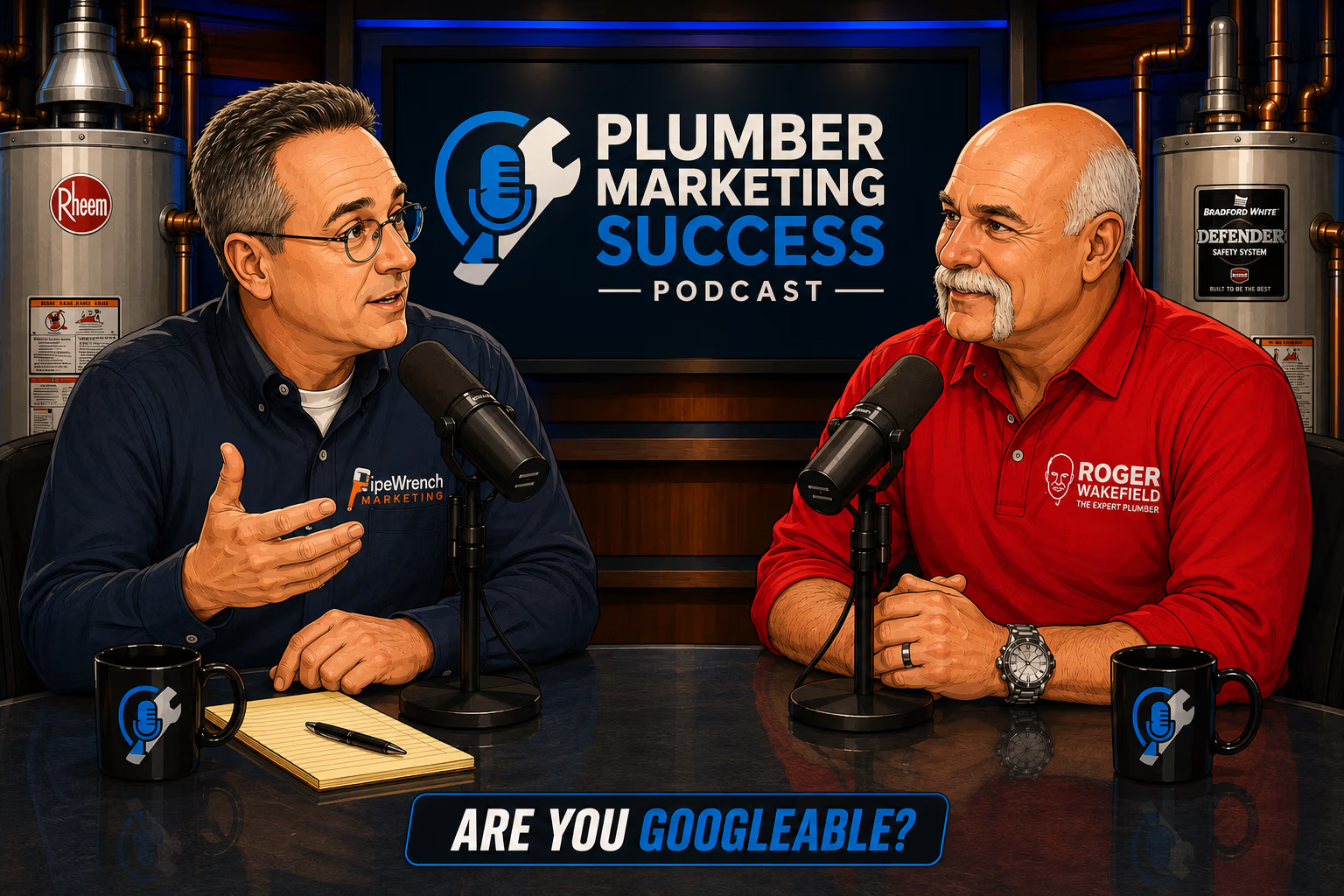
I recently sat down with Roger Wakefield on the Plumber Marketing Success Podcast to discuss this changing search landscape, his new venture Are You Googleable?, and what plumbing companies should be doing to make themselves easier to find, understand and trust online.
Roger also shared lessons from building his plumbing company, selling it, experiencing private equity ownership and creating an enormous social media following.
Several themes kept coming back to the same idea: visibility isn’t something a plumbing company can simply assume it has.
What Does It Mean to Be “Googleable”?
Roger’s idea for Are You Googleable? actually predates the current AI boom.
It grew out of his frustration as a plumbing company owner spending significant amounts of money on marketing without having a good way to independently determine whether his website had been built correctly.
He described imagining himself driving down the road throwing $47,000 in cash out the window—knowing he could arrive at his office and still not have the phones ringing.
The problem wasn’t simply spending money.
It was accountability.
A plumber can look at a plumbing installation and recognize whether something has been installed correctly. Most plumbers can’t look at the technical structure of a webpage and determine whether the SEO, content and other elements have been implemented properly.
Roger wanted to change that.
He describes Are You Googleable? almost like a CARFAX report for a website. Just as CARFAX can reveal problems with a vehicle that aren’t apparent from looking at the exterior, his system analyzes webpages for structural and content issues that may affect their ability to be found.
And AI has made that idea more important.
As Roger put it during our conversation:
“The question isn’t anymore, do you rank? It’s when a homeowner asks ChatGPT who to call, does your name come up?”
That’s an important distinction.
Your Website Needs to Be Understandable to Machines
Are You Googleable? focuses specifically on what is happening within the website.
Roger emphasized that the test isn’t measuring everything that might influence search visibility. It doesn’t attempt to incorporate every backlink, citation or social media signal.
Instead, it examines the website itself—including elements related to SEO, AEO and GEO, as well as whether AI crawlers can properly access and understand the content.
That makes it both a baseline and an accountability tool.
If your marketing company tells you it has created an outstanding service page, you have another way to evaluate the work.
Roger’s own standard is relatively high. When I asked what score would make him comfortable, he said he’d probably be happy around 95.
But he also made a more important point: the number shouldn’t necessarily be considered in isolation.
Look at your competitors.
If an important competitor’s page scores 92 and yours scores 95, you’re moving in the right direction. And not every page has equal business value.
Your Contact page probably doesn’t need the same attention as a page targeting a highly valuable service such as water heater installation.
Roger said he’d want an important Water Heater page scoring 98, 99 or even 100 if possible.
That is a useful way for plumbing companies to think about optimization: prioritize the pages connected to revenue.
A Website Isn’t “Finished”
Another misconception Roger challenged is the idea that you build a website once and you’re done.
Websites change. Links break. Pages develop problems. Search technology evolves.
Roger compared a website to a building. You don’t rebuild the building every day, but you do have to maintain it.
That means plumbing companies should expect their agencies to continue looking at the website after launch.
Roger’s broader frustration is that contractors often don’t know what questions to ask their marketing providers. If you’re told a website has been “SEO’d,” how do you independently verify that?
His goal with Are You Googleable? is to give the business owner another layer of visibility into the work.
For plumbing company owners who aren’t marketers—and don’t want to become marketers—that accountability may be as important as the technical score itself.
Roger’s Simplest Marketing Advice: Start Making Videos
The conversation eventually shifted from search to something Roger knows extraordinarily well: social media.
His advice for a plumber starting with virtually no marketing budget was surprisingly simple.
Start where you already are.
For many plumbers, that’s Facebook.
And don’t overthink the content.
If you’re replacing a water heater, explain what you’re doing. If you’re repairing a sewer line, show something interesting about the job. If a garbage disposal is jammed, demonstrate how a homeowner might reset it themselves.
Roger told the story of a plumber who posted a simple video about his work. His wife shared it. Someone from church saw it, realized he was a plumber and subsequently hired him to install a water heater.
That was a job he likely never would have received without the video.
The lesson is that social media doesn’t always need to generate millions of views.
Sometimes it simply needs to remind the right person:
“That’s who I should call.”
Every Plumbing Job Can Become Content
One of Roger’s most practical suggestions was to stop treating content creation as an entirely separate job.
A five-truck plumbing company already has people doing interesting things every day.
One technician might install a tankless water heater.
Another might repair a sewer line.
Another might diagnose a disposal.
Those are three potential pieces of content without inventing a single topic.
A helper can record a technician explaining the job for a minute and send the video back to the office for posting.
The objective isn’t Hollywood production.
It’s demonstrating expertise consistently.
Roger summed up the relationship-building power of social media by modifying the traditional marketing phrase “know, like and trust.”
His version is:
Know, love, trust and be connected to.
Video helps create that connection because customers begin to feel as though they actually know the person behind the company.
How to Get Comfortable on Camera
Many plumbing owners immediately respond to this advice with the same objection:
“I’m not good on camera.”
Roger believes it’s a learnable skill.
He gave three particularly useful pieces of advice.
First, look directly into the camera lens. That’s the video equivalent of making eye contact.
Second, use the word “you.”
Even if a video eventually reaches thousands of people, only one person is watching it at any particular moment. Talk to that individual.
Third, talk like you’re speaking to your best friend.
Don’t preach. Don’t turn every video into a sales pitch. Explain the problem naturally.
That’s a very different style from traditional advertising—and probably one reason it can be so effective.
Why Roger Ultimately Points Plumbers Toward YouTube
Roger has audiences across multiple platforms, but one platform stands apart for him:
YouTube.
His reasoning is straightforward. YouTube isn’t merely a social network. It’s also a search engine, and it’s owned by Google.
Roger told me that anyone can go to YouTube and search “plumbing” and find him. Search plumbing on Google and select video results, and you’ll find him there as well.
That didn’t happen overnight.
It came from years of consistency.
Roger said social media and making videos was the number-one marketing decision that helped grow his plumbing business. What started as a strategy for Texas Green Plumbing eventually helped create the Roger Wakefield brand and opportunities he couldn’t have imagined when he started.
One More Lesson: Build a Company Worth Buying Before You Want to Sell
Our conversation also went beyond marketing.
Roger shared his experience selling his plumbing business and subsequently watching the combined organization move into private equity ownership.
His advice for contractors dreaming about a PE exit was memorable:
Build your company as though you never want to sell it.
Get your attorneys, CPAs, documentation, financials and systems right now—not six months before approaching a buyer.
Buyers can look back years.
If you think a sale might happen in four or five years, start preparing today.
Roger also offered a warning owners need to understand before accepting the check: once private equity buys the company, it isn’t your company anymore.
The organization may change dramatically because the new owners have different financial objectives.
That doesn’t automatically make a transaction good or bad. But owners should understand exactly what they’re agreeing to.
The Bigger Lesson for Plumbing Companies
What struck me about my conversation with Roger is that his advice about websites, AI, social media and even private equity shares a common thread:
Build the business deliberately instead of assuming someone else is taking care of it.
Don’t assume your website is optimized because someone says it is.
Don’t assume customers will find you because they always have.
Don’t assume social media is only for influencers.
And don’t wait until you’re ready to sell before building the systems a sophisticated buyer will expect.
Search is changing rapidly. AI is creating another layer between a homeowner’s question and the company they eventually call.
That makes Roger’s original question increasingly relevant.
Are you Googleable? Find Out: https://areyougoogleable.com/
And perhaps the more important question for the next several years is:
When Google, ChatGPT or another AI system is helping a homeowner decide who to trust, have you given it enough reasons to recommend you?