
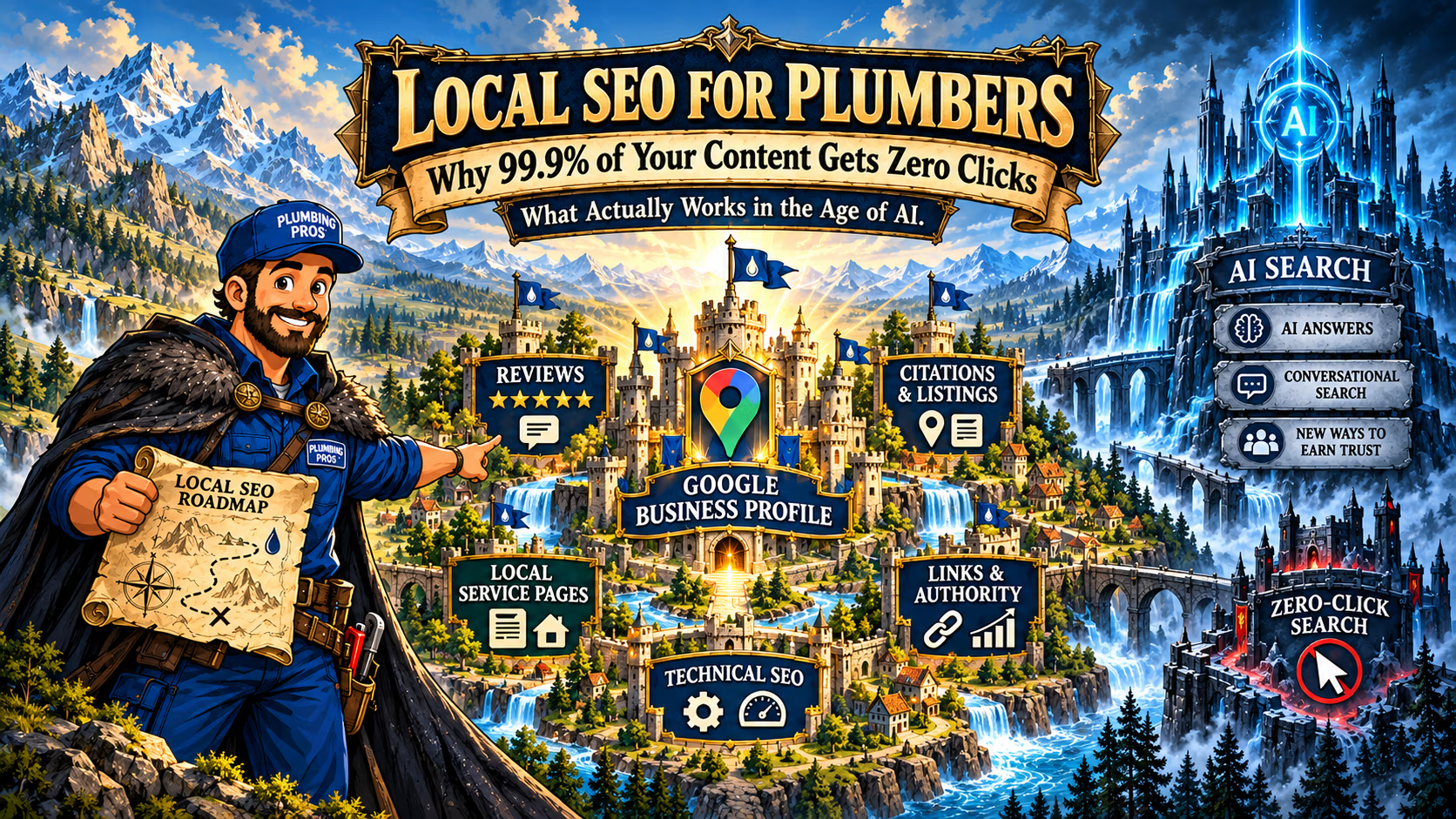
For years, plumbing companies have battled for the Iron Throne of local search.
Google ruled the Seven Kingdoms. The Google Business Profile guarded the gates to the Map Pack. Reviews built trust with the people. Service pages defended each company’s territory. Links, listings and local content helped determine which businesses rose to the top and which disappeared from view.
Now, a new kingdom has emerged beyond the Wall: AI search.
ChatGPT, Claude and other answer engines are changing how homeowners discover, evaluate and choose local businesses. But the arrival of this new kingdom does not mean plumbing companies should abandon Google or send their entire marketing army chasing the latest SEO trend.
The greater danger may already be inside the castle: spending the marketing treasury on hundreds of generic articles that nobody reads.
Most plumbing companies do not need more content. They need the right content, supported by the right local signals, in the places where Google and AI platforms are looking for answers.
That was one of my biggest takeaways from my conversation with Andrew Shotland, founder and CEO of Local SEO Guide, on the Plumber Marketing Success Podcast.
Andrew has spent nearly two decades studying local search. He has worked with local businesses and major brands, including Walmart.com and AutoNation. More importantly, he approaches SEO as a data problem. He tests ideas, studies what happens and is willing to challenge conventional wisdom when the results do not support it.
His conclusion about the way many local businesses approach content was blunt: companies frequently invest in hundreds of generic blog posts, and 99.9% of them get zero clicks.
For plumbing company owners, that should be a wake-up call.
Why Generic Plumbing Content Often Fails
Imagine paying an SEO agency to write an article titled “How to Unclog a Toilet.”
There is nothing inherently wrong with the subject. Customers certainly want to know how to unclog toilets. The problem is that your local plumbing company must compete against Angie, HomeAdvisor, Thumbtack, national publishers, home-improvement websites and thousands of YouTube videos.
Even if your article somehow ranks first, the person reading it could be in Alaska, New York or Bangladesh. A visitor outside your service area is unlikely to become a customer.
That does not mean plumbers should stop publishing educational content. It means every piece of content should have a clear business purpose.
A hundred articles that generate no local visibility, qualified traffic or calls are not an SEO strategy. They are an expense disguised as productivity.
Before publishing another blog post, ask:
- Is this relevant to a service we want to sell?
- Will it reach people in our service area?
- Does it answer a question that affects the decision to hire us?
- Can this topic strengthen an existing service or location page?
- Is there a better format, such as video, for answering this question?
The objective is not to publish the most words. It is to become the most useful, relevant and trustworthy answer for the customers you can actually serve.
Your Most Valuable Content May Already Exist
When people hear “content marketing,” they often think of blogging. Andrew reminded me that almost everything on a website is content.
Your homepage is content. Your service pages are content. Your location pages are content. Your photographs, videos, pricing explanations, FAQs and customer testimonials are content.
These pages usually align more closely with how a homeowner chooses a plumber.
As Andrew put it, most visitors are trying to answer three basic questions:
“Do you do what I need you to do? How much do you cost? Are you any good?”
A strong plumbing website should answer those questions quickly.
A water heater repair page should explain what problems you solve, where you provide the service, what the customer should expect, what affects the price and why your company is qualified.
A location page should demonstrate a real relationship with the community. It should not be the same generic paragraph with a different city name inserted into it.
Before commissioning another 50 blog posts, strengthen the pages directly connected to the services and markets that generate revenue.
How Andrew Would Invest a $100,000 SEO Budget
I asked Andrew how he would allocate $100,000 for a local company’s annual SEO program.
His answer was revealing. He said he might invest half of it in local PR and local marketing.
That may not sound like traditional SEO, but the boundaries between SEO, public relations and brand marketing are disappearing.
Andrew and his team are seeing evidence that online media mentions, especially on local websites, can have an outsized influence on whether a company appears in ChatGPT.
A plumbing company does not necessarily need coverage in The Wall Street Journal. It needs to be mentioned where its customers and community already spend time.
That might include:
- A local newspaper
- A community organization
- A chamber of commerce
- A youth sports organization
- A local charity
- A neighborhood website
- A regional business publication
- A home-services association
Suppose your company supports a local food bank. The organization might publish an article explaining why your team became involved. That story does not need to be about water heaters. It establishes a legitimate connection between your company, your community and your service area.
It can create awareness, authority, a valuable link and a local mention that AI platforms can discover.
The best SEO investment may no longer look like SEO.
Reviews Remain Essential
Andrew would also invest in generating and managing customer reviews.
Reviews do more than persuade homeowners. They create evidence.
They help platforms understand whether a company is established, active and trusted. Andrew sees a correlation between positive reviews and AI visibility, although Google and ChatGPT do not use exactly the same sources.
Google can rely heavily on Google Business Profile information and Google reviews. ChatGPT may look to Yelp, BBB, Bing, Brave Search, local directories, media websites and other third-party sources.
That means reputation management can no longer focus on one platform alone.
Google reviews remain critically important, but plumbing companies should also pay attention to how their reputations appear across the broader internet. The goal is to present a consistent and credible picture wherever a consumer or AI system investigates the business.
YouTube Is an SEO Platform
Andrew also highlighted YouTube as a valuable investment.
YouTube is one of the world’s largest search engines. According to Andrew, it is also one of the most frequently cited domains in local AI results.
That creates an interesting opportunity for plumbers.
A written “How to Clean Your Water Heater” article may never outrank the major national websites. A helpful video showing the process, however, may reach consumers through YouTube, Google and AI-powered results.
Video also allows a plumbing company to demonstrate something that written content cannot easily communicate: the people behind the business.
A homeowner can see your expertise, communication style and professionalism before making contact. That makes video both a visibility tool and a trust-building tool.
Google Does Not Necessarily Reject AI-Assisted Content
Another important part of our conversation concerned AI-generated content.
Does Google care whether Claude or ChatGPT helped write a page?
Andrew’s view is that Google probably has effective ways to identify AI-generated content, but authorship is not the only issue. The more important question is whether the page is useful.
There is a major difference between using AI to help organize and communicate genuine expertise and publishing hundreds of unedited pages simply because the technology makes it inexpensive.
At Local SEO Guide, Andrew’s team uses Claude to support content creation. But they build detailed prompts, review the output, edit it and add their own knowledge.
That is the right lesson for plumbing companies.
AI can help an expert communicate. It should not be used to simulate expertise that the company does not have.
If your plumbers provide the knowledge, examples, cautions and local experience, AI can help turn those ideas into readable content. A human still needs to verify every technical claim and ensure that the page reflects how the company actually works.
Your Google Business Profile Is Still the Iron Throne
With so much attention on ChatGPT, I asked Andrew whether a plumber should worry more about AI or the Google Business Profile.
His answer was clear: prioritize the GBP.
The new kingdom of AI may be rising, but Google still occupies the Iron Throne of local search.
Your Google Business Profile remains one of the most important assets in local marketing. Categories, location, reviews and the page linked from the profile can all affect visibility.
The primary category is especially important. If an HVAC company wants to rank for electrical searches but uses “HVAC contractor” as its primary category and “electrician” as a secondary category, it may struggle to compete against businesses using “electrician” as their primary category.
Distance also remains a powerful factor. Sometimes a company does not rank in a desired market because its office is simply too far away.
There is rarely one universal “smoking gun.” Local ranking problems can involve categories, proximity, website relevance, technical issues, reviews or competitors with stronger signals.
That is why local SEO requires diagnosis, not just a checklist.
Test the Page Linked From Your GBP
One of Andrew’s favorite discoveries involves the page linked from a Google Business Profile.
Many companies automatically link the profile to their homepage. But the homepage may not be the page Google considers most relevant for the search you want to win.
Andrew recommends using Google’s Programmable Search Engine to search only the pages on your website. Enter an important keyword and see which page Google places first.
That result can reveal which page Google believes is most relevant to the topic. It may be worth testing that page as the destination connected to the GBP.
This is a simple idea, but it illustrates Andrew’s broader philosophy: find the signal that matters and test it.
Business Listings Could Influence ChatGPT Visibility
One of Andrew’s most compelling recent experiments involved local business listings.
His team updated the descriptions across directory listings for 20 of a client’s 160 locations. The descriptions included services and keywords for which the client wanted greater visibility.
The changes produced only a brief movement in Google. When Andrew later examined ChatGPT visibility, however, the 20 updated locations had increased dramatically. The other 140 locations had not experienced the same increase.
This does not prove that every company will get the same result. It does suggest that listings are becoming more valuable in the age of AI.
Each listing is another page that describes your business. When those pages contain accurate, consistent and useful information, they help AI platforms understand what you do and where you do it.
For plumbing companies, citation management should no longer mean checking only the company’s name, address and phone number. Businesses should take control of their listings and improve the services, descriptions, hours and other information they contain.
What Plumbing Companies Should Do Next
The future of local SEO is not about abandoning one kingdom for another. It is about strengthening the foundations that can help a business become visible across all of them.
A practical starting plan includes:
- Strengthen your main service pages.
- Build useful, original location pages for priority markets.
- Confirm that your Google Business Profile uses the best primary category.
- Review the website page linked from your GBP.
- Develop a consistent process for requesting honest customer reviews.
- Claim and improve your listings across major directories.
- Pursue legitimate local media and community mentions.
- Create videos that demonstrate your expertise.
- Use AI to support real knowledge, not replace it.
- Monitor how your company appears in Google, ChatGPT and other AI platforms.
The plumbing companies that win will not necessarily publish the most content. They will create the clearest and most consistent evidence that they are qualified, trusted and relevant to the customer’s location and problem.
In the new kingdoms of local SEO, visibility will belong to the companies that are easiest to find, easiest to trust and easiest to choose.
That is what actually works in local SEO.