Call or Text
Host: Paul Benton
Guest: Gary Pizzati
Questions?
About Guest: Gary Pizzati
Founder/CEO
We Mail America
Gary Pizzati is the founder and CEO of We Mail America, a direct-mail marketing company helping businesses reach the right households through targeted mail and integrated digital advertising. He brings decades of media and advertising experience, including senior leadership roles at Modern Luxury and Cumulus Media. For plumbing and HVAC business owners, Gary makes direct mail practical: who to target, what to send, and how to measure results. His approach centers on three essentials -- Data, Design, and Delivery -- to help businesses turn mailbox visibility into customer conversations and lasting relationships.
About Host: Paul Benton
President
PipeWrench Marketing
Paul Benton is the founder of PipeWrench Marketing, a marketing agency dedicated exclusively to helping family-owned plumbing companies grow through better lead generation, local search visibility, artificial intelligence, and customer acquisition systems. Through the Plumber Marketing Success Podcast, Paul interviews leading experts from inside and outside the plumbing industry to uncover practical strategies that help contractors generate more calls, book more jobs, and build more valuable businesses.
Connect on LinkedIn
Direct mail is one of the oldest forms of targeted advertising—but the way sophisticated plumbing companies use it today looks very different from simply picking a ZIP code and sending postcards.
In this episode of the Plumber Marketing Success Podcast, Paul Benton sits down with Gary Pizzati, Founder and CEO of We Mail America, to discuss where direct mail belongs in a modern plumbing company’s marketing strategy and, more importantly, how to determine whether it’s actually producing a return.
Gary brings decades of media and advertising experience to the conversation. Before founding We Mail America, he worked in radio and advertising leadership, eventually overseeing major markets for Cumulus Media and hundreds of millions of dollars in advertising sales. He later launched We Mail America, which has earned back-to-back recognition on the Inc. 5000, including a #953 ranking in 2026.
The conversation goes beyond postcards. Gary explains how data, targeting, offers, creative, frequency, AI and CRM matchback reporting are changing what effective direct mail looks like for plumbing and other home-service companies.
Gary describes We Mail America’s approach using three words:
Data. Design. Delivery.
Data comes first. Instead of simply choosing a ZIP code, a plumbing company can identify carrier routes and households using factors such as home age, owner occupancy and income.
For a water heater campaign, for example, Gary discusses identifying older single-family homes while excluding apartments and condos. He also explains how carrier-route targeting can help a plumber concentrate around desirable neighborhoods while maintaining more favorable postage economics.
The lesson is simple: great creative delivered to the wrong homes is still bad marketing.
During the conversation, Paul and Gary identify four fundamental components of a successful direct mail campaign:
Mailing List + Offer + Creative + Frequency
Gary’s point is that these aren’t independent variables where you can afford to get three right and ignore the fourth. They work together.
The right homeowner needs to receive the right offer, presented through effective creative, with an appropriate mailing strategy.
Gary distinguishes direct mail from pure branding channels.
While repeated exposure through television, radio and other media can establish mental availability for a brand, Gary sees direct mail at its best when it gives a homeowner a compelling reason to act.
For service businesses, he particularly likes inspection-based offers. The objective is to create an attractive, low-friction reason for a homeowner to invite the company into the home, where the contractor can build trust and potentially develop a longer-term customer relationship.
More isn’t necessarily better.
Gary recommends avoiding overcrowded pieces filled with excessive information. His preferred approach is straightforward: make the piece simple, compelling, eye-catching and credible, and pair it with a strong offer.
For service businesses, he discusses postcard sizes beginning around 6 x 11 inches as well as 8.5 x 11-inch solo letters.
The homeowner doesn’t need your entire company history. The piece needs to earn attention and communicate why someone should take the next step.
Gary provides useful benchmarks for plumbing companies considering direct mail.
For a smaller advertiser, he says a campaign might begin around $1,800 per month, which could reach roughly 2,000 homes under the example discussed in the episode.
Larger service businesses may spend approximately $5,000–$7,000 per month on mail as part of a broader marketing mix.
The larger lesson is that direct mail should be approached as a campaign—not as an isolated experiment where a company mails once and decides the channel doesn’t work.
One of the most interesting parts of the conversation is Gary’s explanation of matchback reporting.
A homeowner might receive a postcard, become aware of the plumbing company and later search for that company on Google rather than calling the phone number printed on the card.
Traditional attribution could give Google all the credit.
We Mail America instead compares addresses from the mailing with CRM activity following the campaign. Gary explains that AI has dramatically accelerated this process, allowing the company to identify customers or leads whose addresses correspond with households receiving the mail.
That provides plumbers with a more complete picture of what may have influenced the customer journey.
Perhaps the most important strategic takeaway from the episode is that plumbers shouldn’t think:
“Google didn’t work, so now I’ll try direct mail.”
The channels can work together.
Direct mail can create awareness. Google can capture subsequent intent. Reviews can establish trust. The website can reinforce credibility. The phone call can ultimately convert the opportunity.
Evaluating those channels entirely in isolation can miss how the homeowner actually made the decision.
Gary recommends beginning with strategy rather than printing.
His team starts by understanding where the plumbing company has marketed previously, where it has been successful, where it wants to grow, what it wants to promote and what kind of offer makes sense.
Only then do they build the campaign and determine the geography, creative and mailing schedule.
For plumbing companies considering direct mail, that’s an important distinction:
Don’t start with the postcard. Start with the market you want to penetrate and the customer you want to acquire.
Gary’s position is yes, particularly when direct mail is targeted and used as part of a broader marketing mix. Modern direct mail can use household and geographic data to reach homeowners who are more likely to need particular plumbing services rather than simply blanketing random addresses.
The episode identifies four: the mailing list, the offer, the creative and frequency. Gary emphasizes that all four matter. Excellent creative won’t rescue a campaign being delivered to the wrong households.
Targeting can include factors such as home age, owner occupancy, income, housing type and geography. For a water heater campaign, for example, older single-family homes may be more relevant than newer properties, apartments or condominiums.
Gary favors compelling offers that give homeowners a low-risk reason to respond. One example discussed is a free, no-obligation inspection. The initial service can create an opportunity for the plumber to establish trust and identify legitimate needs inside the home.
Gary gives approximately $1,800 per month as an example of a smaller starting campaign. He says larger service companies may invest roughly $5,000–$7,000 per month as part of their overall marketing mix. Actual budgets depend on mailing volume, postage, format and campaign strategy.
There isn’t one universal frequency. Gary discusses a “10 by 10” concept involving 10,000 homes over 10 months, while also emphasizing analyzing individual routes and potentially returning to areas producing stronger responses. The objective isn’t simply mailing the same household repeatedly; it’s learning from the results and adjusting the campaign.
One method is matchback reporting. Mailing addresses can be compared with subsequent CRM records to identify customers or leads who received the campaign—even when they didn’t use the phone number or tracking mechanism printed on the mail piece.
Yes. Gary describes situations where a homeowner receives a postcard and then searches for the company online. Google may appear to have generated the lead even though direct mail helped initiate the customer journey. Matchback reporting can help uncover that relationship.
No. One of the central themes of the episode is that direct mail should generally be considered part of an integrated marketing system, rather than a replacement for every digital channel. Mail can generate awareness or demand while search and other channels capture the homeowner later in the buying journey.
Treating it as a printing transaction instead of a marketing strategy. Gary argues that the process should begin by understanding where the company has been successful, where it wants to grow, whom it wants to reach and what it wants the homeowner to do. Only then should the campaign, targeting and creative be developed.
Paul Benton: If you’re a plumber or friend in the trades, you’re in the right place today. Gary Pezzati is at the table. He is the founder and CEO of WeMail America, a direct mail marketing company that in 2026 landed at 953 on the Inc. 5000 list of fastest growing companies in America. That’s a big honor. Gary spent decades in media and advertising, holding senior leadership roles with companies like Modern Luxury and Cumulus Media.
Paul Benton: On today’s episode, we’re gonna find out where direct mail fits in pl- in a plumbing company’s marketing strategy, what makes a campaign actually work, and how plumbers can determine whether they’re getting real returns on their investment. Gary, welcome today. Good to be with you.
Gary Pizzati: Thank you. It’s good to be here.
Paul Benton: So Gary, before we get into direct mail, uh, tell us a little bit about your background beyond the introduction and how you came to start WeMa- WeMail America. Uh, you’ve since grown the company to an Inc. 5000 and w- business, and we’re gonna learn a little bit more about that process. Um, but what did you see in direct mail of all businesses that you could have started that made you believe there was an opportunity to build one of the fastest growing companies in America around it?
Gary Pizzati: Well, you know, it’s pretty interesting. Um, my career started in broadcast radio. So I was, um, I was on the air, uh, for, gosh, a little bit over a decade. Worked in, uh, Miami, Oklahoma City, Detroit, Michigan. A lot of major markets, all rock formats. Um, I was in Detroit for about five years. Um, and then I decided that what I didn’t wanna be is, um, a disc jockey that aged out.
Gary Pizzati: So I wanted to go into sales, so I left, uh, the Detroit radio market. I sat down with my general manager, who believe it or not, I still, I still communicate with today. He just finished- Yeah … a really great book about radio. Um, and I, uh, I, I quit. And I sat down and he says, “Gary, you’re a major market afternoon drive disc jockey and you’re quitting.”
Gary Pizzati: I’m like, “I’m quitting. I’ve gotta go.” So I went to, I went to Youngstown, Ohio to learn how to sell radio. Um, I moved all my stuff to Youngstown. Went to Youngstown, uh, did very well in sales. Moved to Akron, Ohio. From Akron, Ohio went to Des Moines, Iowa as a director of sales. From Des Moines, Iowa, um, I, uh, turned around and, uh, after that I went to, uh, Cumulus Media in Augusta, Georgia.
Gary Pizzati: And from there I worked my way up to, uh, the, uh, senior vice president of all their major markets. So I was over about, I don’t know, given year, about 400 million, uh, half a billion in ad sales. Um, I was over in New York, LA, Chicago, DC, Detroit, San Francisco. Um, all, all, all the great brands when radio was in its heyday.
Gary Pizzati: Spent, um, spent a little bit over 20 years there. Left in 2016. Um, took some time off to heal, um, after being, you know, after living my life in airports and hotels. Um, and I, uh, I’ve always been a big fan of direct mail. Um, I’ve always said g- direct mail is the grandfather of targeted media. It really was.
Gary Pizzati: If you wanted to place something somewhere to someone way before algorithms and way before all that s- all that technology, you could actually take a piece of advertising and put it in someone’s hands in a specific household in a specific neighborhood. So I was like, “Ah, you know…” So I sat down one night, it’s the old adage, you know, 3:00 in the morning you wake up and you say, “I’m looking for a name.”
Gary Pizzati: And I typed in all these weird names- Went to GoDaddy and I typed in We Mail America, and it was available, and I bought it for $16. So from… And I couldn’t believe it was available, and I went to a graphic designer and, um, and I had the logo made, and then fr- the logo’s sitting on my chest, uh, right there.
Gary Pizzati: And then after the, um, after I started with a, a mobile phone in the height of COVID, uh, with no customers. And, uh, we worked our way up. In 2025 we were the Inc. 5000, uh, number 450, number 407, and 2026 we got on the list again, uh, number 953. So we were back to back winners. I guess it’s not really a winning, it’s not a winning strategy.
Gary Pizzati: It’s more of a you’re selected, uh, by their group of people. I mean, Inc. Magazine is a very, very well respected, uh, magazine in, in the world and, and, and to be… And they’re such great people. Uh, you know, they treat you like royalty when they find out you, when you’ve made the list. Uh, a- and they give you all the accolades, and you have all the access to all the clients, and everyone’s cheering everybody on.
Gary Pizzati: And there’s a big event that goes on this year in, in Phoenix. I think it’s Phoenix or Dallas, that everybody gets together and kind of networks and, you know, the networking begins. And so, you know, it’s been a great story. It’s been a great winning story, um, um, for We Mail America. Again, started off with, uh, a website and a mobile phone and no customers.
Gary Pizzati: And, uh, you know, this year we’re, we’re a very successful company
Paul Benton: So Gary, before we get into the main topic, I wanna, uh, one, mention that you also have a digital marketing agency, and in fact, uh, I’m evidence that, uh, you know SEO because I remember looking for a client years ago. They were particular about wanting a giant postcard, and I typed up giant postcard and you, you came up first.
Paul Benton: And refreshingly, the phone number, you dialed it, it, it got you at the time, which is very unusual in today’s, um, in today’s phone culture. And that’s how we got connected several years ago.
Gary Pizzati: Yes. I answer all the leads that come in. I mean, I… One thing that I hate in business, two… There’s two things I hate in business that we don’t do, and it’s our policy in our company.
Gary Pizzati: Number one, we talk to our customers directly. Now, a lot of customers today like to text. They re- they don’t have time to talk, they just wanna text, which is fine, but they’ll… can be communicating with us. But if anybody calls in, um, it rings right here, and I, I answer the phone and talk to the customer and see what they want.
Gary Pizzati: And they say, “Well, that’s great,” uh, you know, and I tell them I own the company, and they’re like, “Oh, this is wonderful,” you know? And, uh, but yeah, a lot of customers will call, and we have a very, very, very good lead flow system. The second thing I hate is when businesses, uh, charge your credit card, uh, without your knowledge for something.
Gary Pizzati: And so we, we have a policy of not charging customers’ credit cards uh, without their, uh, written authorization, and we always answer the phone, so. And you know, I, I, I always say this and I, and I’ve said this to customers, and this has really been a game-changing scenario. Regardless of anything to do with technology, AI, IA, Facebook, Instagram, TikTok, whatever, everyone in America has a mail moment still several times a week
Paul Benton: Well, Gary, let me, let’s hold and jump into that in a minute.
Paul Benton: I wanna, l- uh, because it’s an opportunity to learn about the Inc. 5000 process, and you’ve won it twice. I wonder if you can drill down a little bit and explain, uh, in a sort of talk to me like I’m 12, what is the Inc. 5000, and how does a business get selected? What is the… Where, what door do you knock on to be considered?
Gary Pizzati: Well, you know, uh, Inc. 5000 is the 5,000 fastest growing privately held companies in America. Um, to make that list, you have to apply. You have to supply your tax returns, uh, three years. Um, and I guess they have a team of people that looks at the return and see your year over year growth in top line revenue.
Gary Pizzati: Um, you’ve gotta be honest and upfront with your tax returns, which we are. Um, and once you submit it, um, they, they, their team looks at the numbers, and it’s straight, it’s a straight numbers game. And then, and then I think they look at your, your website, and they look to make sure you’re, you’re a real company.
Gary Pizzati: You know, we’re, we’re A+ rated with the Business, Better Business Bureau, and so, you know, you have to be a real company. And then they call you, and they interview you, and, you know, they wanna make sure that you’re legit. And then you just sit and wait, and you get a nice email from their publisher saying, “Congratulations, you’re in.”
Gary Pizzati: And the first year that, that it happened, I just sat back and I couldn’t believe, I just couldn’t believe it. And that plaque from that last year is right behind me, um, in, in… And I hang, it hangs proudly in my office. I’m very grateful to the folks at Inc. Magazine. They’ve, they’ve done an amazing job with this award, and we’re, we’re honored to be award not only once, but twice.
Gary Pizzati: Goodness gracious. You know, it’s been great.
Paul Benton: Let’s jump into the main event here. Uh, Gary, let’s start with the, the elephant at the table. In 2026, there’s Google, LSA, Meta, and so many other digital channels that plumbers can use and are using. Why should a plumbing company be thinking about direct mail, and where should that be in the, in the mix?
Gary Pizzati: Well, you know, when I sit down and talk to a plumber, and we do, we do a lot of plumbing business at WeMailAmerica. A plumber will call us when they feel their ads are too saturated, there’s too many of them online. Because once you like something, we all know once you like something, you get inundated with that same brand of, uh, of, uh, that same sector of business.
Gary Pizzati: Once you like a plumber, you’ll get a lot of ads or, you know, content from plumbing companies. A- and there’s a, there’s a place for it. Um, but when you get that tangible piece of mail in your mailbox, and you take it out and there’s a great offer … Now, a lot of people say, “Ah, it’s junk mail.” Okay, I understand, but still, direct mail is a multi-billion dollar industry and businesses are still using it.
Gary Pizzati: And now what we’re seeing is we’re seeing a shift We’re seeing a shift away from Google, people that will do Google ads, because more people now are just asking the question on AI, and c- ChatGPT, Claude, Perplexity, any one of those platforms don’t have an ad service along with it. They’re just pure fact.
Gary Pizzati: So, you know, there’s a lot of ways to kind of s- you know, find your way into those platforms. But needless to say, when someone gets a tangible piece of mail in their hands, they take action, and it, it, it’s known to be a very credible source. It’s known to be a credible company, and a lot of our customers are questioning, “Is the ad I’m looking at, is it a, is it a, is it a real person?
Gary Pizzati: Is it an AI-generated person? I mean, what is it?” So there’s a lot of uneasiness now, and I think it’s gonna calm down, I think, but there’s a big influx of, you know, people using ChatGPT, and Claude, and what have you to find things online. And at the, the stats haven’t come out from Google yet. I haven’t seen if there’s a decrease in their search volume globally, uh, but I’m sure that it’s take- it’s taken a hit.
Gary Pizzati: Um, I, I think I saw one of, uh, g- one of the motivational speakers, uh, get online and say that, uh, you know, Google is now the Yellow Pages, uh, uh, because of, because of the on- you know, the onset of AI. But, you know, I’m not really here to pass that judgment. But I think that once, once a consumer still gets that mail, not bundled…
Gary Pizzati: We’re not a bundled service, so we don’t, we don’t put any- everything in an envelope where there’s, where there’s multiple coupons. We’re a solo direct mail program, so that postcard comes, uh, solo inside the mail or that eight and a half by 11 solo letter or whatever size may be.
Paul Benton: And there’s a, uh, a tactile component, a physicality to it.
Paul Benton: I always, um, chuckle when I go to my mailbox and I find direct mail. I open my brain, ’cause I was a fan of The Sopranos, goes to The Sopranos walk, where he goes down to pick up his paper down his driveway, and there’s a moment in time where you are physically connected to the object that is in your hand that doesn’t exist quite the same way in, in the click world.
Paul Benton: So from a pure branding perspective, a relational perspective, direct mail occupies a space that, um, digital cannot, and that is the touch and feel component-
Gary Pizzati: Yeah.
Paul Benton: Oh, yeah … um, of it. Of course, the ch- the, the challenge with direct mail is the cost, so you have to have a larger budget. It’s, uh, I think, what is a good starting cost?
Paul Benton: 92 cents deli- I mean, when all is in, roughly speaking, um, when I’ve looked at… When I did my own direct mail with my own Steam and my own printer, the, the least expensive I could get it mailed was 92 cents for a letter that I mailed
Gary Pizzati: You way overpaid. You overpaid. I was- We, we, be- well, the, the, there’s a difference, and, and, and this is where the conversations with our customers come in play.
Gary Pizzati: So if a plumber calls me up and says, “Hey, Gary, we wanna do a direct mail campaign,” that, that’s all they say to us, “We, we wanna do some, some postcards,” or flyers, whatever they call them. We’re like, “Okay.” Mm-hmm. The, we have, we, we have something at WeMail America called the three Ds. Very, very important. Data, design, delivery.
Gary Pizzati: Number one is data. We go in and we ask them, “What do you wanna do?” “I wanna replace water heaters.” “I wanna, I wanna be able to do an inspection.” Whatever, whatever they wanna do, we c- there’s two different types of postage. There’s saturation postage, where you get a zip code and you saturate it, and then there’s targeted.
Gary Pizzati: Customer sends us a list, we mail the list. It jumps from house to house, three blocks, five blocks. Well, the post office is gonna penalize you for that. If you mail this house and then mail five, 10 houses down, they’re gonna penalize you. However, with saturation postage, we can blanket a zip code, we can filter down to age of home, owner occupancy percentage, um, income, um, children in the home.
Gary Pizzati: Whatever it may be, we can turn around and we can pull the carrier routes that really would make the difference for what a homeowner, what a plumber would want. So w- hot water heaters maybe have a life expectancy of 10 years, maybe 12 years before they start rusting out. Well, we could turn around and find single-family homes, no condos, no apartments Um, and we can find them 15 years or older.
Gary Pizzati: We could still skip, but normally in a, in a, in a city block or a, a rural area, if the house number one, uh, is 15 years old, the rest will follow suit, ’cause they’ve all been built in, like, in the same timeframe. So we can find all of that. And then what we use AI for is we use AI to find, through Google Maps, the specific neighborhoods that they wanna target.
Gary Pizzati: So a plumber will come to us and say, “I want… Gary, I want that subdivision. That’s the one I want right there.” Okay, if I just mail that subdivision, your postage is gonna go from 22 cents to 36 cents. However, if I mail the carrier route that serves that subdivision, I’ll keep your postage at 22, and you may be outside a little bit because the carrier route will serve maybe within a quarter-mile radius, but you’ll s- you’ll hit that neighborhood.
Gary Pizzati: Perfect. So our ability to target is a lot greater today than it was, um, m- more than five years ago. It really has gotten a little bit more sophisticated, and we’re right on top of everything, uh, targetability, because that’s one of our Ds, data. And we’ll get into the other two Ds in a moment, but, uh, but data’s very important.
Gary Pizzati: We spend a lot of time with our customers pulling the right data, because if that’s incorrect, you could have a direct mail piece that’s gorgeous, but if it’s going to the wrong homes, it’s not going to work.
Paul Benton: But Gary, let’s drill down a little bit a- and do some teaching here. As I understand it, there are four essential components in direct mail.
Paul Benton: We’ve got the mailing list, that’s speaks to the data you mentioned. Then it’s the offer. We think of Alex Hormozi, what’s a compelling offer? Th- then it’s the creative. Does it look visually appealing? That’s design. And then there’s the frequency. So mailing list, offer, creative, and frequency. Have I missed something, or are those basically the four variables that make for a great campaign?
Gary Pizzati: Yeah, you hit it on the head.
Paul Benton: So which of those, mailing list, offer, creative, and frequency, should w- uh, a direct mail team together with a client burn the most calories? Where is basically the value, uh, implanted? Which of those four should e- they be spending the most time on?
Gary Pizzati: Uh, all of the above. Y- you can’t spend more time on design and less time on data.
Gary Pizzati: You have to spend… It, it, you hit the nail on the head with the four. You know, we have three, data, design, delivery, but, but basically, uh, my, my design, the offer is inside my design. So when we sit down with a client, they say, “Well, I wanna give $2 off a hot water heater installation.” They never say that, but, you know, something of that, you know, on a realistic, on a realistic note, that’s what we wanna do.
Gary Pizzati: You know, what is, what is the, the, the offer going to be, um, for, for the campaign?
Paul Benton: So, and, um, is it fair to say that direct mail is offer-driven and not primarily an instrument of branding? So you wouldn’t do direct mail, uh, to do your branding. That’s perhaps better the domain of radio and TV, um, YouTube. Am I correct about this?
Paul Benton: But direct mail is, you get a postcard, it needs to look great, but it has to hook you in. You, you have to, you have to be compelled to take action, and that’s the offer. So is it a correct statement to say you do direct mail for direct response that’s offer-driven. If you don’t have an offer, don’t do it, whereas you would do other media for strictly branding.
Paul Benton: Tell me about how to think about offer versus branding in direct mail.
Gary Pizzati: Well, you know, direct mail is not a branded, a branding medium. I mean, if, if you want a brand, you’ve gotta get real estate in someone’s mind, and that’s audio or visual, you know, repetition. You know what I mean? If you wanna brand your business, be on TV, be on radio, be a, be a podcast client, what have you.
Gary Pizzati: That is more of, you know, when you think of a need, you know, you all of a sudden remember what you’ve heard over and over and over and over and over again, or seen over and over. That’s why personal injury attorneys are nonstop on television. Every newscast, every day, all the time, there’s four or five of them.
Gary Pizzati: That’s why when it’s a political season, you know, you see nonstop political ads, because repetition equals retention. Something that’s offer-based comes in, you see it, you recognize it, you have a need. The offer’s compelling enough for you to pick up the phone and just inquire. That’s what direct mail does best.
Paul Benton: So what I heard you say is, it’s not that one is more important than the other. A good campaign is a function of doing well on all four of those components. But let’s understand the most im- uh, the, the biggest one on cost, which is frequency. So how, how… What is your frequency that, that, uh, you can report you need to have before you start really, uh, enjoying the results from the campaign?
Paul Benton: What’s the ideal frequency? And frequency mean… And, and explain what frequency is, too.
Gary Pizzati: Yeah, I mean, look, frequency is the number of times that you show up in someone’s home, you know, with a, with a postcard or a, or an 8.5 by 11 letter or a flyer, and that, and that person has a need, and they remember you from that.
Gary Pizzati: If you s- if you turn around and do a, a tree service company and someone has a need to cut down some trees or one tree looks a little weird in the backyard, you, you’re afraid it’s gonna fall on your home, you know, you’ll think of that tree service company because you’ve seen their postcard a couple times.
Gary Pizzati: However, from a plumbing perspective, you know, you need a combination of, I think, branding from a brand perspective to get your name out there, um, and be on that, you know, get that real estate in someone’s mind all of a sudden if, if a pipe breaks or, you know, something leaks or what have you. So, so when you do direct mail with plumbers, it’s gotta be a very targeted piece that deals with, um, um, something of the hot water heater nature or what have you.
Gary Pizzati: One of the things that, uh, that, that works very well is when you send hot water magnets through the mail, um, for a plumber. You turn around and you do a, you do a campaign. It’s expensive, but it works. Um, you send a, a nice 8.5 by 11 letter folded nicely, addressed, uh, and then inside that fold is a little magnet that says, “If your hot water heater stops working, don’t touch it.
Gary Pizzati: Don’t… Especially if it’s gas, leave it alone. Leave it up to us.” And people, you know, call this number at 24/7, and they slap it on the hot water heater, and it may be up there for four months or four years, but eventually someone’s gonna need it ’cause they see a big puddle of water underneath their hot water heater.
Gary Pizzati: And what are they gonna do? They’re gonna look up and call that number. So the plumber’s gonna tell you, “Ah, you know, I mailed 5,000 of them, and I got 16 calls. That’s all I got.” Well, give it some time because there’s a hot water heater blowing up every day, uh, you know, leaking out the bottom. So you’ll be able to, uh, to, to, uh, take advantage of that.
Paul Benton: So that’s a great answer. Um, but how many? How, how… I- if, if a plumber comes aboard, how many pieces should they mail? Uh, how many mailings should they do, uh, in a year? So you… Uh, for example, you… We would not advise a client to come in and do a postcard campaign and do a single shot. It’s more than one. When…
Paul Benton: How many mailings should they be doing
Gary Pizzati: We call it the 10 by 10. 10,000 homes, 10 straight months. Let us, let us… And, but, then don’t mail the same homes twice. You know, mail, i- i- if your territory… ‘Cause a lot of plumbers will, you know, their territory is massive. You know, they’ll go a- anywhere, you know, 25 miles, 20, you know, in a radius.
Gary Pizzati: So we like to start at the origin where they begin their day, where all their trucks and all their people are, and maybe their home office, and then pull, pull 20 miles around that, and then start drilling down home age, home value, income. And then we just pick certain ZIP Codes and carrier routes, and we just start mailing.
Gary Pizzati: And then if the response rate comes back from a s- a set mailing, ’cause we look at all of them all the time with our customers, we’ll go back and hit that route again. Some routes are hot, some routes are not. Uh, so we, we, we work with our customers. Because there’s, there’s a big advantage of a direct mail company working with their customer on post-mailing analysis.
Gary Pizzati: Today, it’s very easy. Um, we have, we have something called a matchback report that we do for every one of our clients. Now, thanks to AI, that matchback report used to take us about a day and a, and an individual, and now it takes us less than 30 seconds. What we do is we ask the customer for their CRM data for the time the mail dropped until about 30 days afterwards, and then we put both the, both addresses, give all the rules to AI and say, “Okay, match these addresses up to make sure that North Main Street, if yours says N.
Gary Pizzati: Main Street and mine is spelled out north, make sure that you match them as a match.” Claude will do that for you in less than 30 seconds. So we give our clients a real, real dose of ROI, saying, “Wow, you know, 41 homes that we mailed to called you, and, uh, and you went out there and had an appointment with them,” or whatever.
Gary Pizzati: So we do matchback reporting for all of our clients. We also use AI for, for, uh, enrichment of ZIP Codes to make sure that we have the strong reporting data to show the client where they’ve mailed to, you know, before the postcard goes out. “Here’s what it looks like. Here’s ZIP code 12345. Here’s the number of homes.
Gary Pizzati: So as you begin to get your leads in, let’s see where they really came from and how much penetration into that ZIP Code that you’ve had.” And now, what we do for a lot of our customers is we go back historically with them in their CRM and say, “Look, here’s all the ZIP Codes you mailed in 2025. Here is your penetration- In the, inside those zip codes.
Gary Pizzati: Now we know inside zip code 12345, there’s, there’s y- you- that’s your target. These are 20-year-old homes, they’re all single family. You’ve got 1.5% penetration into that zip code. Let’s go there again. Let’s go there. The high penetration zip codes, you’re doing fine. You know, we’ll get around, we’ll get there when we gotta get there.
Gary Pizzati: If you wanna grow your business, you know, you’re gonna retain- Mm-hmm … the customers you’ve alr- you’ve already been at because of how you run your business and how you run your company. However, if you wanna get into a zip code or grow your business that you have very y- it’s a, it’s a big target, but the penetration is very low, then we start, we start, you know, carpet bombing into that, um, into that zip code with postcards and great offers.
Gary Pizzati: So there’s a science behind it. There’s no longer, “Hey, pick a zip code. We’ll mail a postcard and see you later.” Y- y- not anymore.
Paul Benton: What’s the ROI you’re seeing, Gary? For example, in, uh, in PPC, you might be three or five times in, in… Same thing for Yelp. Little higher on LSA. What are you seeing in the, uh, return on ad spend, dollars spent on a campaign with what your plumbers are getting back?
Gary Pizzati: Well, you know, I mean, there, it all depends on, on, on the offer. It all depends on, on, on, on the, uh, the zip code we’re mailing into. We’re seeing about, you know, you mail into 10,000 homes, you’ll get 50 leads, 1.5 to 1%.
Paul Benton: Okay. So, uh, o- one half to 1%, you’ll get a positive response rate from a mailing, is what you’re seeing as a benchmark?
Gary Pizzati: But a lot of our clients, uh, you know, went over and thought that, that, uh, a lot of our clients thought that, uh, Google and pay-per-click was driving all their traffic. And what we found from our matchback report is, yes, maybe that c- that customer did click on your ad, but they looked at the post- they got the postcard, they had a need, and they went to Google or wherever and they searched for you, filled out a form, and now you have a lead.
Gary Pizzati: So they didn’t call the number on the postcard. They decided not to. They just went to, to, um, to, um, a, uh, a, a, a mo- a, a, a, a, a Yelp search or a Google search, and they found, uh, they found the number. You know, they, they, they found you. So Google would get credit for that. But meanwhile, with our matchback reporting, we’re able to show the credit back to us, because, because the, the origin of, “Hey, there’s a great company here,” originated with that mail drop.
Paul Benton: Gary, would, would you agree, it, it’s important that direct mail is used as part of an integrated system. It’s not a standalone. So, uh- Correct … in an ideal setting, y- uh, the plumber would have, be firing on all pistons. Direct mail belongs in the mix, but you wouldn’t say, “I did Google last month, and now I’m gonna try direct mail this month.”
Gary Pizzati: That, that’s usually the pattern, but we try to shy them away from that. That’s usually the pattern. “Hey, Google didn’t work, but I’m gonna try direct mail.” No. No, keep, consistency is important. Yeah.
Paul Benton: And it, and they all work together, because for the reasons you said, if you’re coming up from your driveway with the Soprano walk and you see your, your favorite plumber, uh, you’re probably gonna throw the card away, uh, in the trash can outside, and then you’re gonna go to Google and look up the phone number.
Paul Benton: You’re not necessarily gonna- Right … dial the number on that postcard. Let me take one more bite at the apple at frequency. What’s a good, good benchmark? How many times should, should a single home be mailed to before you, uh, expect results?
Gary Pizzati: We’re, we’re seeing, we’re seeing, uh, one to two times, and they’re, they’re starting to get a, a result You know, it all depends.
Gary Pizzati: Okay, that’s more- Again, it, it all, it all depends. It’s a, it’s a very broad question. You know, I mean, uh, are you a pizzeria? You’ll get… You’ll, you know, it’s buy one get one pizza, it’s a Friday night and the postcard came in. Hey, everyone’s gonna get phone calls. But a tree service company or a roofer or a plumber, I mean, there’s gotta be a need before, you know, so, you know, before there’s a…
Gary Pizzati: You know, the old days of throwing, the tire store throwing nails onto the road to try to get flat business, you know, you can’t do that. You know, and in, in the plumbing, in the plumbing business. So, you know, there’s a… It, it all, it all, it, it… If we had the answer to that question, we would be trillionaires.
Gary Pizzati: You, you don’t know. You’ve just gotta, you gotta go out there and try it, and then really pull the data back from all of the, um, all the what you do to see, you know, how the results are coming in.
Paul Benton: Sorry, Gary, you’re sharing an important insight, because conventional marketing wisdom is you gotta hit somebody eight to 12 times before they take action, and you’ve, you’re seeing in your experience that in some cases, uh, you can hit a home once or twice and get action.
Paul Benton: And this is why you’re doing your 10 by 10, which is 10,000 homes 10 times, but you’re not necessarily hitting a frequency of 10. You’re varying that frequency based upon experience. So that’s a take, that, that’s a takeaway.
Gary Pizzati: Yeah, I mean, look, uh, the, the frequency, the old adage of frequency has changed because of screen time.
Gary Pizzati: Everyone has, everyone’s got their nose buried in a screen. If I was, you know, a- a- I’ve always said, “If you wanna really get some great advertising, uh, on the floor of public, put it on the floor of public places.” ‘Cause everyone’s looking down today. You know, whether walking, whether standing, no one’s looking up.
Gary Pizzati: You know, they’re all, they’re all staring at their screens. So it, it all, it all changed. Everything’s changed. I mean, you can’t, you can’t go back and go, “Oh, you need a frequency of three or four.” It doesn’t work like that anymore. The, the, your, your, your pocket device that you have has changed all of that.
Gary Pizzati: So you gotta get ’em while you can get ’em, and get ’em, get ’em fast. You know? So that’s why the offer’s gotta be compelling, the data’s gotta be right, and the delivery’s gotta be right.
Paul Benton: What’s the biggest screw-up that plumbing companies are making about direct mail? They… You s- you sit down with a client and they have made…
Paul Benton: What’s big, their big mistake that you’ve encountered, that you’ve corrected, um, in their direct mail efforts?
Gary Pizzati: Working with a direct mail company that wants to rush to the credit card. There’s a lot of them out there that wanna rush to the credit card. There are people sitting on a, sitting at a phone, the lead comes in.
Gary Pizzati: They’re probably wonderful people, and they probably know what they’re doing, but they’re more in a hurry to get that first payment, while we’re less in a hurry for the payment, and we’re more focused on design. Uh, if a plumber calls us and says to us, “Look, we, we wanna do a campaign.” Everybody stop, set the appointment, give me an hour.
Gary Pizzati: Let’s sit down and talk. Tell me all about your business. Tell me what you wanna do. Let’s put the maps up on a screen. Let’s share screens. You know, we have plumbers who do business with us in Wisconsin, Iowa, California. You know, just throw it up on the screen. We’re all, we’re all unified through Zoom and Google, you know, Google Meet, so it’s easy to have meetings with people without traveling these days.
Gary Pizzati: So it’s, it… We could put that up on the screen and take our time and really look at where, where their penetration has been, where they’re doing well, where they wanna grow to. Um, it, it’s all about that strategy. And, and, and we’ve seen, you know, mailing zip code 12345, take this postcard, thank you very much.
Gary Pizzati: Put a big offer up there, and we’ll talk soon. That’s not how we work. And I guess that’s, that’s why we, we have the accolades that we’ve received, because without our customers, we wouldn’t have those accolades.
Paul Benton: And there’s a temptation in direct mail to think it’s purely transactional, and that is something I’ve experienced in sourcing the marketplace.
Paul Benton: You can call up and you’ll encounter a junior rep order taker, but it… You’ll be hard-pressed to find a strategist that looks at the data, and I, um, I think that’s a great insight that you’re sharing. Can you share on offer, in your experience from plumbing or elsewhere, what does a really good offer look like?
Paul Benton: Can you give an example of a great plumbing offer that’s just hit it out of the ballpark?
Gary Pizzati: You know, we just did a big mailing for a HVAC company in San Francisco. 58,000 homes were mailed. Big mailing. Uh, did a huge drop, and they did a free, uh, HVAC inspection. No obligation, no questions asked. We’re gonna come out, we’re gonna look at your filters.
Gary Pizzati: We’re gonna look at your, you know, your, your levels of Freon, whatever it may be. And they got, they got slammed. They got really busy. Um, it’s gotta be something that’s compelling enough. If you’re a plumber, do an offer that’s almost a loss leader, but not Where a consumer will call and go, “You know what? I haven’t had my water heater looked at,” or, “I haven’t had my furnace,” or whatever you have to heat or cool your home, or your disposal, or whatever it may be.
Gary Pizzati: You want a full, full plumbing deep dive. You wanna look at everything plumbing in your house. You wanna walk around, and then while you’re there and you’ve built that trust, that’s when you start. You can sell and you can, you know, gain a customer through, through a very thorough job. So we see offers… The offers that we recommend for service-based businesses are inspections.
Gary Pizzati: Everyone likes that free inspection. They do. No obligation, and it says it on the card, no obligation. We just come out, and sometimes they go out and they say, “Everything looks great. You know, keep us in mind. Here’s our, here’s a magnet for your hot water heater. Here’s, here’s our brochure. If anything ever happens, we’re 24/7.
Gary Pizzati: Thank you very much.” Do that often enough, and you will gain, you know, ma- You know how many people I’ve pitched the data and spent hours on the, uh, uh, hours with, and it never happens, but then a year later they call you? And like, “Hey, Gary, it’s been a while, but hey, we’re ready for our campaign.” Okay. You know, ’cause they remembered, you know, what we did when we, when we first got together.
Gary Pizzati: So I think from an offer perspective, you wanna turn around, and, and I’m gonna hold… I’m gonna, I’m gonna cover, I’m gonna cover this, this company’s name, and I’m gonna hold this up. You want to avoid this on direct mail. You want to avoid too much information. You wanna keep it simple, compelling, uh, uh, eye-catching, and credible, is what you wanna do with your direct mail piece, with a, with a great offer.
Gary Pizzati: You don’t want it too crowded. You know what I mean? You just wanna, you wanna take it one step at a time. Now, this company’s probably very successful at what they do, and they sent me a, a direct mail piece. It was, it was a bundled piece and, you know, it looked all right. But more importantly, if you’re a plumber and you’re listening to this podcast, always remember, you’re gonna, you need a compelling offer, a card that’s not too big.
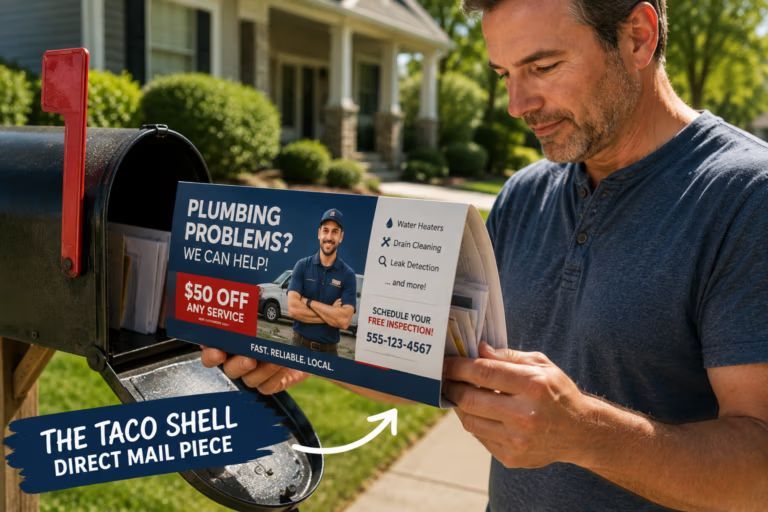
Gary Pizzati: Don’t get crazy with the big giant postcards and try… You know, you want the, you want, you want the postman to turn around and, and put it in the mailbox. Now, one of the things that we do for a lot of our customers is an 8.5 by 11 solo letter. A lot of plumbers use it as well. When I started WeMail America, um, one of the things I did with my mask on is I went around and I interviewed, uh, mail carriers, and I held up, I held up a, uh, an 8.5 by 11 letter, and I said to them, “If you were delivering this letter without an envelope, 8.5 by 11, what would, how would you deliver it?”
Gary Pizzati: A hundred percent of them said, “I would deliver it like a taco.” Now they didn’t say taco, I, I named it a taco, but they said they would cradle it, the mail goes there, and in the mailbox it goes. So the 8.5 by 11 solo letter acts like a taco shell. And all the mail… So the consumer takes their mail, and what do they do?
Gary Pizzati: They open up the letter. You got 10 seconds, if that, to go, “Oh, that’s right. You know, our hot water heater, I saw a little puddle of water. I need to call these people.” So, you know, our 8.5 by 11 solo letters do very, very well with service-based businesses. No envelope. No envelope.
Paul Benton: So Gary, does size matter? I mean, in postcards.
Paul Benton: Um, how big- Yeah … should the postcard be?
Gary Pizzati: Uh, not, not, not normally. I, I would stop at 8.5 by 11. We start at 6 by 11, and we go to 8.5 by 11. Those are the two big, those are the two big ones for service-based clients.
Paul Benton: And how small, uh, is… H- how small, uh, of a postcard would you go before you’d say it’s, it’s losing its effectiveness?
Gary Pizzati: I don’t go below 6 by 11.
Paul Benton: 6 by 11. Okay, that’s… So those two sizes. Okay. Let’s make this practical. Suppose I’m a 5 to 10 truck plumbing company- Okay … with a limited marketing budget How much would I realistically need to spend to get a good result, and for how long should I be spending over the year? So what’s my monthly spend and my annual spend that I should plan on to do well with direct mail before I would get into the direct mail game?
Gary Pizzati: Look at it this way. When we turn around and pitch direct mail to clients who have a smaller budget, we always say to them, “You know, you can mail 2,000 homes.” They go, “Oh, only 2,000 homes.” And I, I, and I say to them, “Well, let’s do this. What I want you to do over the weekend is I want you to get in your car, and I want you to drive around and start counting houses.
Gary Pizzati: When you get to 2,000, call me and tell me how long it’s gonna take you to count to…” 2,000 homes is a lot of homes. Now, we do mailings for service-based businesses. To some people, we mail 50,000 homes. Do you have any idea how fast that is? That’s, it’s massive. It’s a massive marketing campaign. So we always say to our clients, “If you don’t, if you’re low on budget and you wanna start off small, you can start off at 1,800 a month.”
Gary Pizzati: You know? You, you know, ’cause the less you mail, the more your per piece cost is. So the more you mail, because it’s the same work we do. So if you wanted to mail 2,000 homes and spend 1,800 bucks a month, you could do that.
Paul Benton: So, uh, if $1,800 a month is the, a starting budget, what is an average budget? This isn’t, this is, doesn’t speak to what you charge, because postage is driving most of it, but it’s more what are you seeing in what operators are investing, and what is the size budget of a medium and large plumber that you’re seeing as, uh, an appropriate budget to their scale?
Gary Pizzati: The larger companies are spending between 5 and 7,000 a month in mail.
Paul Benton: Okay. ‘
Gary Pizzati: Cause remember, with WeMail America, we’re, our postage is pass-through. So whatever we pay for postage, you pay for postage. So basically, when we, when we sell direct mail, we always say to our clients, “Look, postage on this is 22.2 cents.
Gary Pizzati: We’ll send you the receipt that we’ve paid for postage on your behalf. And, and so your postcard’s gonna cost you, like, 19 cents.” They’re like, “Really?” Yeah, ’cause postage is pass-through. So, you know. But yes, you can get, you can get a great campaign for that, you know, 7,500, 5,000, you know, in that range. And service-based businesses are doing it all day long.
Gary Pizzati: Larger ones as part of a marketing mix
Paul Benton: That, those are great answers, Gary. Really actionable. If you were advising somebody, what’s the first 90 days looking like, uh, for somebody that’s new to direct mail? They come to the table, they’ve not done direct mail before. Who would you target? What would you send, and how often would you send them?
Paul Benton: And what numbers would tell you what the campaign is, it, it, whether the campaign is working? Um, I think you mentioned- Well, as
Gary Pizzati: we discussed earlier… Go ahead.
Paul Benton: Mm-hmm. Well,
Gary Pizzati: as we discussed earlier- Yeah. No, I
Paul Benton: think… Yeah, go ahead.
Gary Pizzati: Well, well, the first 90 days, I mean, as we discussed earlier, it all starts with having that call, you know, the initial Zoom call with the team.
Gary Pizzati: You know, we… It’s very serious. I mean, we, we… If a, if a client calls us and says, “Look, I wanna mail, uh, 1,000 homes or 500 flyers,” whatever, and, and they’re a large company, you know, we don’t… We, we, we rather not take the business. Uh, we, we like to sit down with our clients and have a, “First, take your time. If it’s 6:00 at night, we’re good.
Gary Pizzati: If it’s 8:00 in the morning, we’re good. Let’s sit down. Let’s have a conversation of h- let’s look back at history, where you’ve marketed before, what you’ve done.” You know, what we used to call needs analysis meetings. And, and we then talk about where, and then we talk about what, what they wanna mail, what they w- what their offer is gonna be.
Gary Pizzati: We talk about when, you know, all, all those, all those, all the, those pieces of information, and then we go back and we craft a campaign. And we craft a campaign that could be, uh, it could be, uh, um- Several dates and times. Um, you know, we’re the national mailer, uh, for a lot of large franchises. We’ve gained that business because of the work we’ve done with one franchise who told the other, who told the other, who told the other, who told the other.
Gary Pizzati: There’s so much value in sitting down with a, with a, with a plumbing organization and saying, “Okay, first of all, let’s talk about what you’ve done before.” “Well, you know, I’m doing this Google stuff. I don’t know where it’s coming from, and I’m doing YouTube,” and, and all this stuff. They, you know, they, they’re- they’re- they’re plumbers.
Gary Pizzati: They’re, you know, they’re… That’s why they hire people like us to, to market for them. Uh, they understand marketing, but they understand plumbing a lot better. So we really make it very simple for them. Where, where have you been? How successful have you been there? Where do you wanna go, and how practical is that area that you want to go into?
Gary Pizzati: And then once you tell us that, we’ll, we’ll draw the map for you. We’ll pull it all together, and then we’ll, we’ll give you, you know, different sets of campaigns, and we’ll work through it. It just, it takes a lot of time, but those customers that you take that time with will always tell you, “Man, you know, no one’s really ever spent that much time with us on direct mail.
Gary Pizzati: You know, they just wanna, you know, ‘Here’s a postcard. Here’s our templates.’” ‘Cause we have no templates at WeMailAmerica. When someone asks us to send a sample of a postcard, we don’t have any. We don’t share anybody else’s content with, with another company. If you want, send us your logo, send us your offer, send us pictures, and we’ll ground up design it for you and show you exactly what’s gonna work for your market and for what you do for a living, so.
Paul Benton: That’s, that’s awesome. Hey Gary, as we, um, b- begin to wrap here, would you be open to some quick factoid questions, you know, CNN style? Uh, and, and just basic facts of, of what people can take away with to understand how direct mail works. Is that okay?
Gary Pizzati: S- sure, yeah.
Paul Benton: So, uh, quick question, quick answer. What percentage of direct mail actually gets looked at by the homeowner, would you say?
Gary Pizzati: That’s a, that’s an answer that I, I couldn’t tell you. I, I don’t know. I don’t know the habits of- Um … every consumer out there.
Paul Benton: A- and how much time would you say a direct mail piece has before it perishes? You send a postcard, how much time does somebody actually take that in?
Gary Pizzati: Um, it all depends if they feel…
Gary Pizzati: You know, it all, it all depends if that consumer has a future need. Uh, we do mail campaigns and we get calls back from our customers that say, “Geez, we dropped three months ago, and I just got a call, I just got a phone call to get my tree cut down.” You know? So it all depends on, some people take that mail piece and they s- put it on their desk somewhere, and then all of a sudden they need it and they use it.
Paul Benton: And I think you’ve answered this already, but I, uh, this was one of my biggest takeaways from our time together today. How many times does a homeowner typically need to receive something, uh, from a plumbing company before they take action? I thought it was 8 to 12, and you had mentioned it could be as little as two.
Paul Benton: Uh, is that correct?
Gary Pizzati: Yeah. I mean, timing’s everything. If, if, uh, you know, no one gets up in the morning and says, “Hey, you know what I’m gonna do today? I’m gonna call a plumber. I don’t know why I’m gonna call a plumber, but I’m just gonna call a plumber.” People don’t, they don’t do that. They’ll call and say, “You know what?
Gary Pizzati: I feel like having a pizza,” and they’ll call and have a pizza. But they are not gonna call the plumber until the faucet can’t stop dripping, the disposal stopped working, or the hot water heater’s leaking, or I ain’t got no heat. You know what I mean? They- that’s when they’re gonna call the plumber. So, so you’ve gotta be able to be a multidimensional advertiser that touches many, many different things, including screens, ’cause that’s where everyone’s nose is buried.
Gary Pizzati: And at the same time, that tangible piece of mail really enhances all of it. It puts that, it puts that cherry right on top of that parfait, as they say.
Paul Benton: And here’s one that everybody wonders about. What response rate should a plumbing company consider good for a direct mail mailing? So I do a mailing, a single mailing of 5,000 pieces.
Paul Benton: What percentage should I get back in, uh, positive replies?
Gary Pizzati: One half of 1%. ‘Cause remember, what is truly… Yeah, what is truly the lifetime value of a customer? Gotta think of it that way. And then you gotta think of the next month when you do your marketing budget. If you get a call from that person you mailed to, uh, a month and a half ago, that month’s cost per lead is zero.
Gary Pizzati: Or even the next year, that cost per lead is zero. So you’ve gotta really say to yourself, “What is the true lifetime value of a customer?” And if you get one half of 1% and you do… You get 25 new customers, that’s a lot. You know? Because people, people, people, people wanna do business with people they know and trust.
Gary Pizzati: We’ve said that for, for ages in the advertising business. You know? So if you do a good job when you show up, you know. Quick story before we hang up. I had, I had an AC problem in my basement air conditioning unit down in my home. I called, I called the company. The c- the HVAC company came out and they said, “Oh, your compressor’s bad, your unit’s bad.
Gary Pizzati: This whole thing, we need to replace the whole AC unit.” I’m like, “How much is this?” “$14,000.” “Okay, great. Let me give it some thought.” I called the second company. Company came out, they go, “Oh, Mr. Pezzotti, all you need is a fuse.” Pop. They put a fuse in. The AC unit still works today, and guess what? That HVAC company got a tankless water heater system from me, another AC unit for my upstairs, a brand new unit from me, and they just came out and served, serviced that basement unit from me.
Gary Pizzati: And you know why they did it? Because put that fuse in and it works, have a nice day. They… I, I will be a customer of theirs for life. So I won’t call them anymore, anybody else. I won’t call anybody else. If something breaks, I know to call Reliable Heating and Air in Atlanta, Georgia. They’re amazing. And, and, and they, uh…
Gary Pizzati: And, and I just had them out here just a couple of days ago. So it was not only is the, the, the reputation of your company, stand out of that direct mail piece or whatever, however you advertise, is what happens when you get through that front door of that, that customer. ‘Cause a lifetime value of a customer is, is…
Gary Pizzati: That’s what we’re all in business for, so.
Paul Benton: Gary, I got two more factoids. You up for it? And then we, uh-
Gary Pizzati: Go. Go, you beat me up today. Awesome. Go ahead.
Paul Benton: Gr- But you’ve shared a lot today. I appreciate that, Gary. Um, what’s the minimum number of homes you need to mail, Gary, before you have enough data to know whether a campaign, uh, can succeed?
Paul Benton: I’m not- 5,000 … you’re probably not gonna take me on 5,000. 5- So we got it … 5,000. We got… Okay. And the last one I think is, uh, very interesting. Is there a certain age, income level, uh, or home value that makes someone significantly more likely to respond to direct mail?
Gary Pizzati: Uh, if you’re a plumbing design company, high income, high home value.
Gary Pizzati: If you’re a plumber, uh, pipes, no, no home value. Disposals, no, no home value. You could have a disposal in a house worth 20,000 bucks, or you could have a home with a disposal in a house worth $3 million. Doesn’t really matter.
Paul Benton: Gary Pezzotti, thank you for being at the table. You’ve shared a lot of insight and wisdom today.
Gary Pizzati: My
Paul Benton: pleasure. And we will see-
Gary Pizzati: Yeah, thanks …
Paul Benton: and we will see everyone on the next episode of the Plumbing Marketing Success Podcast. Thank you, Gary.
Gary Pizzati: My pleasure. Thank you
Questions or want to learn more?