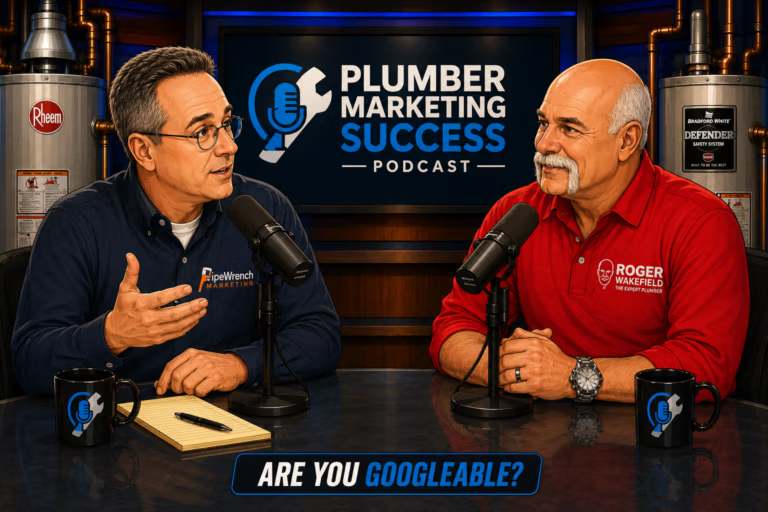
Roger Wakefield is a Master Plumber, entrepreneur, educator, and content creator with more than 1.7 million followers across his social media channels.
Roger originally began creating videos to help grow his plumbing company. His work has since expanded into plumbing education, speaking, consulting and technology ventures, including Are You Googleable?
Paul Benton is the founder of PipeWrench Marketing, a marketing agency dedicated exclusively to helping family-owned plumbing companies grow through better lead generation, local search visibility, artificial intelligence, and customer acquisition systems.
Through the Plumber Marketing Success Podcast, Paul interviews leading experts from inside and outside the plumbing industry to uncover practical strategies that help contractors generate more calls, book more jobs, and build more valuable businesses.
Roger Wakefield knows plumbing from the inside out. He’s built a plumbing company, sold it, experienced what happens when private equity enters the picture, and built an audience of more than 1.7 million followers across social media.
Now he’s tackling another problem: How does a plumbing company know whether its website is actually built to get found?
Roger joins Paul Benton to explain Are You Googleable?, his new website analysis platform, and why the rise of AI is changing the question contractors should be asking about search.
As Roger puts it:
“The question isn’t anymore, do you rank? It’s when a homeowner asks ChatGPT who to call, does your name come up?”
The conversation goes well beyond AI. Roger shares practical lessons about marketing accountability, social media, YouTube, creating video from everyday plumbing jobs, marketing budgets, ServiceTitan, and what he learned from selling his company and going through a private equity transaction.
Roger’s idea grew from his own frustration as a plumbing company owner.
He was spending serious money on marketing but didn’t have an easy way to determine whether the website work he was buying had actually been done correctly.
Roger describes Are You Googleable? as something similar to a CARFAX report for your website.
A contractor can analyze individual webpages and identify structural and content issues rather than simply being told, “Your website is optimized.”
Roger says the tool examines factors involving SEO, AEO, GEO and AI crawler accessibility. It focuses on the website itself rather than attempting to measure every off-site ranking factor.
For contractors, the value isn’t simply another score.
It’s accountability.
Not necessarily.
When Paul pushes Roger to define a good score, Roger says he’d personally be happy around 95, although some of his pages score 100.
More importantly, Roger recommends looking at the score in context.
If your competitor’s important service page scores 92 and yours scores 95, that comparison may be more useful than chasing perfection for its own sake.
Roger also argues that not every page deserves equal attention.
A page targeting water heater installation, sewer repair or another high-value service can be far more commercially important than an About or Contact page.
Optimize where it matters.
For plumbers who don’t have a large advertising budget, Roger’s advice is simple:
Start creating content about what you’re already doing.
He shares the story of a plumber who posted a basic video about his work. His wife shared it on Facebook. Someone from church saw the post, realized her husband was a plumber and eventually hired him to install a water heater.
That one video generated a job the plumber probably wouldn’t otherwise have received.
The lesson isn’t that every plumbing company needs to become an influencer.
It’s that people need to know what you do before they can think of you when they need you.
A multi-truck plumbing company doesn’t necessarily have a shortage of content.
It may have a shortage of people documenting it.
A technician could be installing a tankless water heater while another is repairing a sewer and another is diagnosing a disposal.
Those are all opportunities.
Have a technician or helper pull out a phone and explain what they’re working on. Send the footage to the office and turn it into a post.
Roger’s approach turns the question from:
“What content should we create?”
into:
“What happened in the field today that’s worth showing people?”
Roger believes almost anyone can learn to communicate effectively on video.
His three rules are straightforward:
Roger describes the relationship he wants content to create as:
“Know, love, trust, and be connected to.”
Roger has substantial audiences across social platforms, but he makes his preference clear:
“YouTube is my core.”
One reason is that YouTube functions as a search engine.
People don’t just scroll through YouTube. They actively search it for answers.
Roger’s own journey began with videos intended to help market his plumbing company. Years of consistent publishing ultimately helped him build an audience far beyond his original local market.
He says that at his peak, his best monthly YouTube AdSense check was just under $35,000.
But the bigger lesson for a plumbing contractor isn’t necessarily YouTube monetization.
It’s the long-term value of becoming the person customers repeatedly see answering their questions.
Roger also shares candid lessons from selling his plumbing company and subsequently experiencing private equity ownership.
His first piece of advice:
Build your company correctly long before you plan to sell it.
Maintain good financial records. Have appropriate legal and accounting professionals involved. Document the business. Build systems.
A buyer may look back years.
Trying to clean everything up immediately before a transaction isn’t the same as operating a well-run company for years.
Roger’s second warning is even more fundamental:
Once you take the check, understand that the business is no longer entirely yours.
The buyer has its own financial goals and strategy for the company. Owners need to understand that reality before completing the transaction.
Are You Googleable? is Roger Wakefield’s website analysis platform. It evaluates individual webpages for structural and content factors that can affect whether the site can be properly found and understood online.
Roger says the idea grew from his frustration as a plumbing company owner paying marketing companies without having a straightforward way to determine whether the work had actually been performed correctly. He wanted to give business owners a way to independently evaluate what they were buying.
That’s not how Roger describes it. The tool focuses primarily on the structure and content of the website itself. Roger specifically acknowledges that other factors, such as backlinks and citations, can affect rankings but aren’t what his test is designed to measure.
Roger believes the discovery process is expanding beyond traditional search results. Instead of only Googling for a plumber, homeowners can ask AI systems questions about whom they should call. That makes it increasingly important for a business to publish clear information that search engines and AI systems can access and understand.
Roger says he’d personally be happy around a 95. He has pages scoring 100 but doesn’t argue that every webpage must achieve perfection. He also recommends benchmarking important pages against competitors.
Roger discusses a benchmark of roughly 10% of revenue that he’s encountered through best-practice groups. For a $1 million company, that would represent about $100,000 annually across marketing—not necessarily $100,000 purely in advertising.
Roger recommends starting wherever you’re already comfortable. For many plumbers, that’s Facebook. If you naturally use Instagram or TikTok, start there. His larger point is that beginning and being consistent matters more than finding a theoretically perfect platform.
Show the work you’re already doing. Explain a water heater installation, sewer repair, disposal problem or another common issue. Educational content simultaneously helps homeowners and demonstrates that you understand your trade.
Roger views YouTube as both a content platform and a search engine. People actively search for answers there, and YouTube videos can also gain visibility through Google. Roger considers YouTube the core platform behind his own content strategy.
Roger recommends getting the business in excellent condition years before a potential transaction. That means good books, documentation, professional advisors and strong operating systems. He also stresses that owners need to understand that once they sell, the new owners will run the business according to their own financial and strategic objectives.
Paul Benton: Roger Wakefield is a master plumber, an entrepreneur, and one of the most recognized voices in the trades, with more than 1.7 million followers across his social media channels. After building his plumbing company and selling it to private equity, Roger turned his experience into a mission to help contractors build stronger businesses.
Paul Benton: Now, Roger’s launched Are You Googleable?, a new venture designed to help plumbers and contractors succeed in search and AI. Roger, welcome to the table. Thank you.
Roger Wakefield: Well, thank you for having me here today. I appreciate it.
Paul Benton: Roger, why did you start Are You Googleable??
Roger Wakefield: You know, it’s funny because the thing is, Google doesn’t answer questions anymore.
Roger Wakefield: AI does. But three years ago, when I thought of Are You Googleable… Let’s go back even eight years ago. Felt like I was getting ripped off by marketing companies. I, I knew that I was. And I literally… I tell a story about imagine driving down the road throwing $47,000 cash out the window and knowing that when you get to your office, the phones are not gonna be ringing.
Roger Wakefield: So I wanted to do something that marketing companies apparently knew nothing about, and that was social media. I’d talked to marketing companies. I even had one marketing company tell me, “Hey, look, tomorrow’s National Pizza Day. Make a post.” And I’m like, “Well, what does that have to do with plumbing?” He says, “Well, nothing, but it’s National Pizza Day, so put something about pizza in there.”
Roger Wakefield: And I said, “Look, the only way pizza’s got to do with plumbing is after people eat it, and that’s really not anything I wanna talk about.” So I walked into a social media conference to learn about marketing. Then three years ago, I woke up in the middle of the night. I had someone that I knew that, that helped build Yahoo, and I text him.
Roger Wakefield: I said, “Look, I’ve got this idea, and call me tomorrow.” And this… I’m talking 3:00 or 4:00 in the morning. And he texts me back, he says, “I’m awake. Call me.” So I called him and I said, “Look, I’ve got this idea called Are You Googleable?” And he just started laughing. He said, “I don’t know what it means, but I love the word.”
Roger Wakefield: So I explained to him, I said, “Look, the reason- That I think marketing companies are able to rip off tradespeople is we don’t know if we’re Googleable or not. I can’t go look at a page and tell you, is this page built properly? It, does it have the correct content? Does it have the correct structure? Is it built the right way?
Roger Wakefield: Now, there’s a lot of other things, and I understand that, backlink citations, a lot of things that I don’t even mess with. But I had the idea, it’s like a CARFAX report. Anybody in the world can go to CARFAX, put their u- their VIN number in, and it tells them, “Hey, is your car okay? Has there ever been any major damage to it?
Roger Wakefield: Is there anything wrong with it that maybe you can’t see from the outside?” I had that same idea about are you Googleable, and that’s the way I’ve built it. You literally, you go in, you put in your URL per page, or you can do 25 pages at a time if you want to look at your website. And, and most plumbing websites are under 25 pages, that’s why we set the number there But you can go in and run a page, and those pages can f- be fixed structurally.
Roger Wakefield: I went and looked at one of my pages this morning, ’cause I knew I was gonna be talking to you. One of my most popular pages is sponsors. Okay? We make a lot of money through sponsors on YouTube. The good thing about it is the more sponsors we find, the better we are. Well, I looked at my sponsor page, it was scoring a 90.
Roger Wakefield: And I’m like, “You know what? I’m gonna work on that.” And I worked on that, Paul, for about 20 minutes before I got on. I took that 90 up to a 97 That’s not bad. And the reason being, if people are searching for sponsors and they’re doing it the right way, and I’ve learned a lot here lately because when I first thought about it, it’s are you Googleable?
Roger Wakefield: And to be honest now, the, the question is, are you searchable? Because it’s not just Googleable. AI searches everything. And, and the question isn’t anymore it’s do you rank, it’s when a homeowner asks ChatGPT who to call, does your name come up?
Paul Benton: And Roger, if I understand the test correctly, it’s, it’s an accountability test and a baseline test, so it holds the marketing agencies accountable so that you have 40 factors that it’s reporting on, and that equips the plumber to ask the marketing question, uh, uh, the marketers about each of them.
Paul Benton: But it is also a baseline test, and it’s confined to the website. So for example, it doesn’t… Is, am I correct about this? It does not factor your social media presence. It does not factor off-site. It’s the on-site health of the website, and that’s the s- that’s the four corners that it’s operating on.
Roger Wakefield: Absolutely. And y- you know, the, the good thing is, in getting to meet you a while back, I’ve given you access to it, so I know you, you’ve at least got to look in and try it When I started this, it was all about the plumber. It, it was all about the entrepreneur. Anybody who owns a website, they paid money for it.
Roger Wakefield: They built it for a reason. They want people to find it. It’s not just something to point people at. If you’re already talking to people, you don’t need to point them to a website. You need to talk to them. So I built it for the entrepreneur to where if I hire marketing company A and they tell me, “Oh, my gosh, we built you the most amazing website,” well, I can go in and run the pages, say, “No, you didn’t.”
Roger Wakefield: There, there’s no SEO behind it. There’s no AEO behind it. There’s no GEO behind it. The, the, the AI crawlers can’t see it. The human can’t search and find it, and it is literally structure and content. That’s it.
Paul Benton: And, and Roger, what do you think that you ma- It’s a great point you made, so what do you think is a, in your mind, a, quote unquote, “passing score?”
Roger Wakefield: I’ve got pages ranking 100. I, I’m a, I’m a plumber. My thought is, look, if you’re doing an A… And remember, Paul, I’ve built in another aspect to this. You can compare to your competitor. You can do a head-to-head. You can run your homepage versus your competitor’s homepage and see how you compare with them.
Roger Wakefield: Now, remember, this is structure. This is content. This is not if they’re paying for a million backlinks, you know what? You’re probably gonna lose every day. But if you go in and ask ChatGPT, you know, “Who’s the most affordable plumber, the best plumber?” You know, however you wanna be found for, if pe- if you build your page properly, the AIs can help answer that question for homeowners that are actually looking for you.
Roger Wakefield: Now, the good thing is, and, and there’s free versions, anybody can go run this for free. You’ve seen that, but there’s paid versions, and you’ve seen those too. You can get a complete report telling you what needs to be fixed on every page. Here’s where this expanded into. I started it for the, the entrepreneur, the tradesperson, but now they can buy that report.
Roger Wakefield: They can send it to their website developer and say, “Hey, here’s a list of what needs to be fixed. Fix it.” But my thought is they’ve already messed it up. Why are you having them fix it? Why not find maybe somebody that does it better?
Paul Benton: So that’s a very useful tool. Let me take another bite at this apple. So, uh, yesterday, I don’t know if you caught that in the, the I- it just came out yesterday in the press, the University of Michigan has d- which is a, an elite college, has announced that they are not going to give grades publicly in the first year because of student anxiety.
Paul Benton: And then they also reported that 75 or 80% of the student body get As anyway. So the students are killing themselves between an A minus and an A, and that’s relevant here, I think, because it used to be years ago you had what’s called the gentleman’s C. That was a passing grade, but not today anymore.
Paul Benton: Everybody, it’s like Lake Wobegon, everybody needs to be above average. So I’m trying to understand in Roger’s mind as an operator, what is the score that you can be proud of? Does it have to be an A and 100%, or can you be proud of a B or a 92%? Where is the winner’s circle that, uh, the plumber who runs his marketing agency, his new website through this test can say, “You guys did a good job.
Paul Benton: It’s not 100%, but you did a good job.” W- what is that point?
Roger Wakefield: Y- you know, when, when I look at how much money I pay marketing companies, I’m expecting something good. I don’t, I don’t use the cheapest marketing. I don’t… I never call the guy who says, “Hey, man, I, I can build you a website for 200 bucks.” I’m like, “Yeah, thank you, but no thank you.”
Roger Wakefield: Understand the value. And my, my biggest thought is if I’m paying a marketing company and they tell me, “We’re building you the best pages. We’re, we’re building everything in. We’re making it SEO. We’re making it where you get found,” but I go in and search and say, “No, you’re not,” and there’s a tool for that now.
Roger Wakefield: Me, I probably, I’ll be happy around a 95. As long as I’ve got a good, nice A, I’m not expecting 100 on every page, but you know what, Paul? I’ve got pages that score 100. I’ve gone through it and done everything right. Is it worth it? Man, you w- you could tell me more about that than I can. But to me, I wanna do better than my competition, and if I can score my competition and they’re scoring a 92 and I’m scoring a 95, Paul, I think you did your job and, and I think you did it very well.
Roger Wakefield: And you know, the, the good thing is with these tools, Paul, you can take that same tool that I’ve given you, you can go do a complete analysis on the competition And say, “Hey, here’s what you need to do to beat them. Here’s where you… What do you wanna beat them for? Do you want your About page or your Contact page to rank way up there?”
Roger Wakefield: Probably not. Who cares? But do I want my Water Heater page to rank up at a 98, 99, or 100? Yeah, if you can do it, why not? And that’s the way I look at it as a plumber point of view. We build it per code, we put it in right, it passes inspection, but did we do everything right or does it look sloppy and ugly?
Roger Wakefield: And as a plumber, that’s kinda the way my mind goes with it.
Paul Benton: Kinda reminds me of my, uh, health score at the doctor. I’m doing real well on one, but I gotta, uh, get rid of the fat. Uh, my weight’s good, fat could come down, so there’s always room for improvement, and it sounds like that’s what this test is.
Roger Wakefield: Well, I mean, you’ve, you’ve had a chance to look at it. What are your thoughts about it?
Paul Benton: So I’m gonna defer that question because we are actively studying it, and we’re actively… We’re like the Michigan kids. We’re, we’re unhappy with our score, Roger, and so you’ve gotten us a little anxious, and we’re working on improving it.
Paul Benton: That’s a compliment to
Roger Wakefield: you. No, no, and, and I love that, and I, and I appreciate that. But Paul, let me ask you this. Do you know what pages are important to you? And, and I love the fact you said, “Look, it’s got me a little anxious.” I looked at my sponsor score today, it was a 90. In about 20 minutes I took that to a 97 because I have a tool that will tell me step by step what to do, what to fix on it Where I love this from an agency point of view, which is what it’s kind of morphed into, if you’ve got a VA working wherever, you can literally run this report yourself, send it to them, send them one page and say, “Fix this page.”
Roger Wakefield: Or you can send them the whole report and say, “Hey, look, you’re busy for a week or two.”
Paul Benton: So that is right now in the kitchen, and I will report back to you once it comes out of the kitchen, but we’re looking at it right now, so that’s awesome.
Roger Wakefield: Here’s what should be good to you. If a plumber- Mm-hmm … can take a page from a 90 to a 97 in about 25 minutes, you should be able to do it in, like, 5 or 10.
Roger Wakefield: You’ll just look at it and say, “Oh, yeah, I know what to do,” click, click, click.
Paul Benton: We will- we shall see. I think you’re being humble, Roger. I think you spent more time with, on, on this than you’re letting on.
Roger Wakefield: Oh, this morning, this morning, I literally spent 20 minutes to, to go from a 90 to a 97. On one page, though, a- and I pulled that one particular page ’cause it was my lowest scoring page on the report that I looked at.
Paul Benton: Let me, uh, shift gears if I may. Um, so, uh, Are You Googleable is not only a kind of public service to the industry, but it’s also a business. What is the business model and who is it directed to?
Roger Wakefield: You know, I’m still working on that, to be honest. I, I see two sides to it. I’ve got the plumber, electrician, HVAC tech, roofer, chiropractor, dentist, massage therapist that wants to be found in their area.
Roger Wakefield: They can run their site and, and they can know, hey, it’s good or, or, hey, it’s not good. That’s one end user. A- and these free reports that I give away, this helps people
Paul Benton: But are you looking for subscriptions then for, for agencies? And as I understand it, they’re… Y- you are, um, creating a badge program. Is that correct?
Paul Benton: It’ll be a cert- And that’s for- …
Roger Wakefield: certified agency …
Paul Benton: for pro- When are you rolling that out? Is that
Roger Wakefield: released yet? It will probably be ready to roll out within a month. I’ve already got people reaching out about the founder seats, ’cause we’ve got a certain amount of people we’re gonna let in that will get that certification at the, the, the current founder’s pricing.
Roger Wakefield: But the, the cool thing about it is I’m building systems into going in check what websites are you running, are the scores increasing? Because even though I can’t see your data, I c- I can’t see who it is, what it is and all that, I can see the numbers. If you take 1,000 scans a month, and 80% of them are s- are going up because you’re, you’re scanning them a multiple times, I know you’re going in fixing things.
Roger Wakefield: So there’s a way to look to say, “Look, is this agency really using this tool to improve the, the product that they’re delivering?” And the person that I originally talked to three years ago about building this, I brought him in and talked to him. I said, “Look, if I walked you into 100 marketing agencies here in Dallas, how many of them are doing things right?”
Roger Wakefield: He said, “Probably three.” I said, “Out of 100?” He said, “Yeah.” And Paul, I know you’ve seen this. A lot of marketing agencies these days, you go hire them, they’ll jump in and fix a bunch of stuff. They never look at your site again. You just, they just keep collecting that retainer every month in case you call and say, “Hey, I have a problem.”
Roger Wakefield: I asked him at the same time, I said, “How many of those three are doing everything right?” He said, “Probably none. Maybe one.” So when you look at 1% of an industry is trying to do everything right, I, I think that’s a tough, tough position to put tradespeople or, or entrepreneurs in, because we’ve gotta find that 1%.
Roger Wakefield: And this just is a tool to help people find out, “Look, are the people really doing what they tell me they’re doing?” And that’s all it is, it’s a checks and balance system.
Paul Benton: So it’s a seal of approval. What does, for you as an entrepreneur in this project, what does success look like three years from now? How many subscriptions do you have?
Paul Benton: How many agencies do you have in the program? How many plumbers are using Are You Googleable?
Roger Wakefield: I’m lucky. I, I’ve got studios out here w- we’re doing some good things. I’ve got other projects that I’ve worked on and, and helped grow. I travel around the country and speak a lot. When… I, I got reached out to by a small agency in Arizona, and this young lady’s like, “Roger, look, this is phenomenal.
Roger Wakefield: This, this just changed my life, because you’re doing the biggest part of my work for me. You’re telling me exactly what the problem is, and I know how to fix it. But now I don’t have to go in and just search everything. You built a tool to tell me, ‘This is the problem, this is what page it’s on, and this is how you fix it.’”
Roger Wakefield: If a plumber can look at his report and say, “Hey, I’m scoring a, a 65, but you told me you SEO’d this,” chances are they probably didn’t. And I can’t tell you, Paul, how many times I’ve hired people to build websites, twice that I know of, that, that just literally flat out said it, “Oh, well, you paid us to build it.
Roger Wakefield: You didn’t pay us to SEO it.” It’s like, well, isn’t that building it right? And I don’t think a lot of people know to ask that question. And if plumbers can learn… And I say pl- I keep saying plumbers ’cause, ’cause that’s what I am. A chiropractor or a dentist will even throw more money at it, but they still don’t know the right questions to ask.
Roger Wakefield: That’s not what they do. And this is just something that I have started learning because I got tired of getting ripped off.
Paul Benton: What do you think, Roger, is a good, um… You’re a five-trucker. You, you’re two trades, five trucks, HVAC and plumbing. What should you be investing in the build of a website t- as you understand it today?
Roger Wakefield: I don’t know that the build is the right question. I think that the, the right question is, and, and I’ve been parts of best practice groups-
Roger Wakefield: Companies should pay 10% a month of what they’re making in, into marketing. So if you’re running a million dollar a year company, and you’re not spending about $100,000 a year, that’s eight grand a month. Now, part of that can be ads, part, part of that can be a retainer to keep your marketing company looking at your pages.
Roger Wakefield: Part of that can be for, are you Googleable to say, “Look, they’re doing a good job. I don’t need them to, to watch my pages, I just need them to run ads.” There’s a lot of different ways out there. I mean, you know this. Once the website’s built, it’s just, it, it’s like a building. Well, we don’t have to keep rebuilding the building every day, but we gotta go in, fix stuff every now and then.
Roger Wakefield: And a lot of plumbing companies don’t get that. They think, “Well, I’m gonna build a website, it’s gonna be perfect forever.” No, you get a 404 redirect in there, and all of a sudden Google says, “Well, we don’t like this site. There’s problems with it.” But a plumber doesn’t know that unless somebody’s running a report on his site to say, “Hey, you’ve got problems.
Roger Wakefield: We need to fix it. Here’s what we need to do, and here’s how we need to do it. Here’s how much it costs Don’t go the cheapest website, whatever you do
Paul Benton: Uh, uh, this is fresh from the pages of Instagram. Uh, th- there, uh and there are some platforms out there that are using Lovable that teenagers are now using with, uh…
Paul Benton: They’re getting excited that they, they can build a complete website in five minutes, cold-call a business, and get paid $500. So there’s a lot of education that, uh, needs to be done out there, because the frame-up of a website is the least of it. It’s the marketing, the branding, and then the technical configuration.
Paul Benton: And, um, Lovable sounds good. It’s a good start. It saves, it saves several hours of, um, work, but it isn’t the, the project. And yet, uh, the marketplace is now being led to believe that you can just punch up, uh, a, a website like you’re Scotty on the Enterprise. So that’ll be something to navigate, uh, as well.
Roger Wakefield: It’s… It’ll be something to stay away from. Y- y- you know, my, my dad taught me when I was young, if something sounds too good to be true, it probably is. And if you think you’re gonna pay $500 for a website that’s gonna compete with a multi-million-dollar company that is your competitor, and I don’t even look at them as competitors.
Roger Wakefield: It’s like, look, I can learn from them, but you need to look as good as they do. And if you’ve got a, a Lovable website that has no SEO, AEO, GEO, anything at all behind it, man, you look good as long as you’re pointing people to it, but it is not gonna help you get found. And my thought is you’re just throwing $500 out the window
Paul Benton: Roger, Roger, let’s switch gears if I may.
Paul Benton: Um, the industry is consolidating, um, and I’d love to talk to you about what you learned from selling, merging and selling to PE. Um, what was your biggest lesson? Was it a good experience, not necess- Let’s drill down, if you can, on the, on PE. What is done right and wrong in that experience? Everybody in the industry now is dreaming of a PE exit.
Roger Wakefield: Y- y- you know, I, I’m lucky because first of all, I sold to an HVAC company down the street. I was doing about a million a year. They were doing about 10 a year or about nine a year. So at the time I sold, together when they combined it, we were doing 10 million a year.
Paul Benton: I- sorry, in revenue or, or profit?
Roger Wakefield: Uh, revenue.
Paul Benton: Okay.
Roger Wakefield: Mm-hmm. So in two years from there, we were doing 40 million a year.
Paul Benton: Wow.
Roger Wakefield: Massive growth, cross-marketing, a, a lot of good things. Now, the good thing is I pretty much stepped out of it. So when the, when the, the private equity firms came in, you know, one of the things you’ve gotta be ready for is an audit that is going to pull a telescope out and go through any and every orifice they can find.
Roger Wakefield: They wanna see it all That, that part’s a lot of fun, but, but it’s also expensive, because there’s only certain agencies that they trust allowed to do that… Or, or not allow, trust to do that size of an audit, and you’ve gotta pay for it. So I mean, I know sometimes these audits are 60, 80, $100,000 depending on how big you are, and you’re like, “Wait, I’m trying to sell it and make money, and you’re costing me money.”
Roger Wakefield: But to get your documentation all right, it’s, it’s important. One thing that I would tell people is build your company so you never wanna sell it. Okay? Build it amazingly. Make sure that you’ve got attorneys, CPAs, you’ve got everything on board and done so everything’s done right from the very get-go. You don’t wanna wait till the last minute and say, “Hey, you know what?
Roger Wakefield: We decided we’re gonna go ahead and sell the company, and we wanna sell to PE, so let’s make everything look pretty.” It doesn’t work that way. They’re gonna go look back two or three years. So make sure that you got things looking pretty now and you can keep them that way. That way when it does get time to go to private equity, there’s nothing to worry about.
Roger Wakefield: You’re like, “Yeah, we’ve got all our ducks in a row. We’re lined up. We’ve been waiting for this.” Don’t build for it to sell tomorrow. If you’re gonna build for it to sell, build for it to sell in four or five years. That way you’ve got time to make everything amazing.
Paul Benton: Roger, do you… What, what do you think of this idea?
Paul Benton: Do you think it makes sense that to get ready for a PE, um, exit, it’s a good idea to jump aboard ServiceTitan early, even if it’s a little more than, uh, you would ordinarily need, only because ServiceTitan is so, um, the go-to platform for private equity, so that if you can get that dialed in, cleaned up, you have your ServiceTitan certified provider so that you, your books are pristine years before.
Paul Benton: Do you think, do you think that’s a reason to get ServiceTitan, in your view?
Roger Wakefield: I, I think it’s a good reason. ServiceTitan isn’t cheap, a- and everybody knows that. And to get started with it, it’s difficult. There, there’s a lot of onboarding. It’s gonna take a while. You’re gonna need one or two people at your company, maybe more depending on how big you are, to be your ServiceTitan champions.
Roger Wakefield: So they’re gonna have to understand everything about ServiceTitan, so when a plumber or an apprentice from the field calls in the office, says, “Hey, I can’t get it to do this,” they’re like, “Okay, don’t worry about it. We, we got that. We know how to do it.” And that’s what makes it difficult. We hate being handed a product that we don’t know how to use.
Roger Wakefield: There needs to be a lot of training. That way everybody- Mm-hmm … understands, hey, this is how this works, this is how we make it work, and this is how it helps us grow. If you can give me a tool that makes my job easier, I’m all about it. If you’re giving me one that makes my job more difficult just ’cause I know you’re getting ready to sell, well, that’s not enough motivation to get me to say, “Hey, I really wanna learn to use this and use it well.”
Paul Benton: What’s the one thing you should not screw up, uh, as an operator getting ready to dance with the PE crowd?
Roger Wakefield: And, and I don’t think it’s the one thing to not screw up, but one thing you need to know.
Paul Benton: Okay.
Roger Wakefield: The one thing you need to know is the day you take that check, this is not your company anymore. It’s not what you built.
Roger Wakefield: It’s gonna completely change. It’s gonna morph. It’s going to look completely different. You need to understand that these people are not buying your company ’cause, gee, they think you… It’s great the way you’ve built this loving family relationship. I remember somebody telling me one time that, you know, they, they sold to PE, and PE starts moving their people in.
Roger Wakefield: And, and they, they had the first few in, and they had a big m- meeting, and call them together and say, “Man, look, we’re, we’re so glad that y’all are part of the family, and we’re gonna do this, and we’re gonna do this. We just want y’all to know this is wonderful. Y’all are, y’all are welcome. And here’s the refrigerator, and we brought y’all cookies,” and yada, yada, yada.
Roger Wakefield: And the head guy stopped and says, “Guys, I’m gonna let you know, we’re not a family. This is a business, and it will be run like a business. It will not be run like we are family.” And people need to understand that. This is a business decision for them, and chances are, what they’re gonna do, they’re gonna come in, they’re gonna borrow a bunch of money against your company to help pay them back.
Roger Wakefield: Your company’s gonna pay off that loan, because that’s what they bought you for. ‘Cause now after your company pays back that loan, they got all paid back. Now they own the company that you used to own, and you paid the loan back for. And they’re gonna invest some of that money in you, ’cause they want you to pay that loan back faster, ’cause now they wanna be able to roll you up and sell you again.
Roger Wakefield: Your business is not your money anymore. Your business is their money. And your business is, how do you make more money for them? Can you grow? Can you absorb anything else? Or can you just feed them more money so that they can tie you into something else to make the multiplier go up the next time they sell you?
Paul Benton: When you sold, Roger, how long after the contract were you still involved in the operation and still accountable? What’s that period of time that’s typical?
Roger Wakefield: I stayed involved for a year, but really what they wanted me to do is keep doing social media. Keep talking about Texas Green Plumbing, my company. It was great, and it’s funny ’cause I don’t, to, to be honest, I don’t know why a private equity firm hadn’t come in and said, “Hey, we’re gonna buy you, Roger,” or, or “We’re gonna, we’re gonna hire you to, to run you for the next five years,” talking about all these different opportunities.
Roger Wakefield: You know, when, when, when you talk to almost 10 pe- 10 million people a month- Mm-hmm … it’s like, so- sooner or later somebody’s gonna realize, “Hey, we could talk to Roger, and Roger can talk to a lot of people, and this could be really good.” I th- I think that’s one of the things that they wanted to keep me on for.
Roger Wakefield: But, you know, after we got bought by private equity, ’cause remember, I sold to them, they sold to private equity, and then a year later it had changed so much, it’s like, “Guys, look, I just want out.” Just ’cause I still had a percentage after private equity bought it. I’m like, “Look, just, just buy me out, we’ll call it good.
Roger Wakefield: I’ll walk away.” So it, it was. It, it, it was, it was a, a unique opportunity is what it was.
Paul Benton: I was thinking about a transaction I was involved in and had kind of a shudder, because usually when you’re in the middle of a transaction and everything is good, there’s always a shoe to drop at the 11th hour. And, um, is that something that you can, without revealing anything, is that true?
Paul Benton: That you are in a honeymoon with your buyer- And then, uh, one hour to midnight, they will come back to you, uh, for a haircut. And is that true? Is that a fair warning that if you do private equity you have to be prepared for, or am I off base on that?
Roger Wakefield: You know, I, I, I think, I think you’re, you’re right on base.
Roger Wakefield: I think that… You know, I think knowing what I know now,
Roger Wakefield: if I were coaching someone, well, if, if you, if you told me, “Hey, hey, look, we’re, we’re, we’re selling to private equity, the VC group. We’re doing this, we’re doing this,” I’d say you let them know now The week before the contract signs, you’re gonna be in a cave in Kathmandu, unreachable by cellphone, internet, anything at all.
Roger Wakefield: Everything needs to be done a week beforehand
Roger Wakefield: You will climb out of the cave and up on top of the mountain just to sign the document that will be an electronic document. Don’t call you the night before. You’re not gonna be there. You’re due to sign at 3:00 the next afternoon. Guys, y’all better have everything ready a week in advance. I better know about everything, ’cause there will be no last minute changes.
Roger Wakefield: And at least then you know what’s going on.
Paul Benton: Hmm.
Roger Wakefield: It’s hard at the, you say the 11th hour, at, at 11:45 to say, “Oh, wait a minute. Let’s back up. I don’t, I don’t know that we’re ready for this.”
Paul Benton: Okay, Roger, let’s switch gears if I, if we may, to social media. That is where you’re spending and adding so much value today.
Paul Benton: And I am in some Facebook groups, and a common question I am observing are plumbers who are either just early on in launching their company, they don’t have a marketing budget, they can’t pay Google or Yelp thousands of dollars, and they’re asking, “Where, uh, should I start?” And the typical advice that, um, we give is if you have zero budget, think Google My Business, that’s important.
Paul Benton: Think website, that’s important. And then social media. Where would you on a, on, on given the, the one in 1.7 million followers you’ve built up, what’s your advice to a f- to a, uh, new guy who’s just starting out? What channel should they start in, and how should they start to get the phones ringing in social media?
Roger Wakefield: I, I love this question because I, me and my son have talked about this i- in our livestreams before. I went to WWETT. God, I believe it was earlier this year. Was it earlier this year or the one last year? I don’t even remember anymore. And we had just got our badges, and we’re walking down the corridor, and this guy sees me.
Roger Wakefield: He’s like, “Oh, Roger, Roger, Roger.” And he, you know, he comes up and he says, “I wanna tell you what you do works.” “So what do you mean?” He says, “Well, what you tell people to do.” Said, “Okay.” He said, “I made a video.” He said, “It’s the first one I made.” He said, “I made a video of installing a water heater.” Not, not one. He made a video of changing out an isolation valve going into a house.
Roger Wakefield: He said, “So I made this video.” He says, “And it wasn’t anything good,” it was just, “Hey, look, here’s what we’re doing,” yada, yada, yada. He says, “Roger, my, my wife shared that video.” He says, “So I put it on my Facebook, ‘Here’s what we’re doing today.’ My wife shared it.” He said, “She came home Sunday after church and said, said, ‘Honey, guess what?’”
Roger Wakefield: Says, “You know, Miss Smith came up to me at church and said, ‘Hey, your husband’s a plumber, isn’t he?’” And I said, “Yeah, he is.” Sh- she says, “I, I g- I need a water heater.” He says, “Roger, I called her the next day, and we went and installed a water heater for her.” He said, “This is a water heater I would have never gotten had I not made that video.”
Roger Wakefield: Here’s the thing. Most of us, a- and I used to think this, think Facebook is just where you talk to friends and family and see what they do. But it’s that last part that see what you do. If people know that you’re a plumber and they’ve got a plumbing problem, and you’re friends of theirs, guess who they’re gonna wanna call?
Roger Wakefield: And if your wife or your children or your brothers and sisters and aunts and uncles share this, and they’re in your area, now there’s more people that know you’re a plumber. And if you’ll do this consistently, now consistently maybe once a day, once a week, once a month. The more consistent you are, the more people are gonna know.
Roger Wakefield: You’d be surprised how many people there are on Facebook that do not even know what people they’re connected to to. There’s an old saying, Paul, people buy from people they know, like, and trust, and I’ve been changing that for years. People buy from people they know, love, trust, and they’re connected to.
Roger Wakefield: There’s a lot of people I like, but I wouldn’t buy anything from them. But when you build a relationship through social media, and people do, they feel like they know you. They’ve seen you on video. They’ve heard you talk. They’ve listened to you. I have people tell me, “Roger, I listen to you. I, I, I…” Lori, pull up YouTube, “And I watch your videos all the way to work every day.”
Roger Wakefield: I’m like, “Well, focus on driving.” But we get invited on drives with people, to work out with people, to, to go on a treadmill walk with them, just to go on a walk around their neighborhood. People feel like they know you, and when they know you and they’ve heard their stories, they connect with you
Paul Benton: So how much, in order to get to that, how much do you have to be producing in content and posting every day, and which channel do you want that plumber to start out with?
Paul Benton: And let me ask a compound question here. Uh, I ha- we have debated internally for a number of years about how it’s important to up the content, and in the agency world, everybody kind of has an eye on Gary Vaynerchuk. And then when you look at how much Gary Vaynerchuk is posting, and you look, uh, in the blogs to find out what he has to produce that, he’s got a whole crew following him around, and I think he’s posting 30, 40 times a day.
Paul Benton: That’s more than a mere mortal can do. So my question is, what does a professional like you in social media produce? How big is your team helping you to produce it? And what is your prescription for a plumber starting out? They can’t… They, there’s no way they can produce at your level. What can they produce and how much should they?
Paul Benton: I think there are about five questions there. Sorry about that, Roger.
Roger Wakefield: Uh, no, it’s good. Uh, to, to start off with, mo- most plumbers are already on Facebook. Start where you’re at. That’s the easiest place. I- if, if you, you hang out more on, on Instagram or TikTok or something like that, or post there. It really doesn’t matter.
Roger Wakefield: How many jobs do you do a day? You know, you could literally say, “Hey, guys, look.” You know, you pull up your phone and say, “Hey,
Paul Benton: here.
Roger Wakefield: Guess what? Guess what I’m doing. See this here? W- this is what we’re working on today, and we see this problem all the time. It’s something a lot of people don’t know about.” It doesn’t take long to do that.
Roger Wakefield: If you go on three different jobs, you do a tankless water heater, a sewer line repair, and a garbage disposal change out There’s three different posts. You’re telling people what you’re good at, what you do. If you do something different than other people, say, “Hey, look, most people do it this way, but here’s what I do.
Roger Wakefield: Here’s why I like this.” If you go to a house that the garbage disposal’s jammed, it’s humming, and you can show them how to, can show them how to set the reset button, say, “Look, guys, I just showed you something that most of y’all can do for free. But if you have a problem, man, let me know. Reach out. I’ll see if I can help you.”
Paul Benton: Let me push you on this a little bit. How many posts do they need? So when, when we’ve got clients in front of us, it comes, it comes down to brass tacks. How many, Mr. Plumber, should you be doing? How many posts should you be putting up every week, month?
Roger Wakefield: Is it a one truck plumbing company? Is it a five truck plumbing?
Roger Wakefield: If you got a five truck company- A five,
Paul Benton: call it a five truck.
Roger Wakefield: Okay. You- A five truck … you, you got people doing different things.
Paul Benton: Mm-hmm.
Roger Wakefield: Most of these people have a helper with them, an assistant. Have them pull out their phone, have them video them for just a minute. Say, “Hey, man, what, what, what are you, what are you working on?”
Roger Wakefield: “Oh, well, here’s what we’re doing today.” Send it to the office. The office can post that, or y- or here, here’s what I… Uh, literally, I had a meeting with a marketing company one day. They had 400 offices, 20 people at each office, and I showed them how they could create nine billion pieces of content a day, uh, um, a year.
Roger Wakefield: You take your six CEOs, let them share it, or let them post it. Now you take your 427 office managers, have them take that post and share it. Now you have your 20 people at each office take that post and share it, and say, “This is what I love about working here.” extrapolate that out. That’s one post a day shared Thousands of times, and you do that every day.
Roger Wakefield: And if you got six executives, have each of the six executives, “Your day is Monday. Your day is Saturday.” Everybody watch when a dinger goes off. Oh my gosh, I, I love that Roger’s in the office today editing a video. This is why I love working here.
Paul Benton: The one way that a, a plumber could get a lot of content at scale is if they started, and what is your…
Paul Benton: From your chair.
Roger Wakefield: Mm-hmm.
Paul Benton: Is it reasonable for a plumber to go out there and start an interview podcast? Basically interview the home inspector, interview, you know, the mayor, interview homeowners. And the idea is if you do that once, you can repurpose that content, and from that one hour you can get 30 pieces if you needed to.
Paul Benton: Do you think there’s a, that’s a-
Roger Wakefield: I think, I think it’s a good possibility. I- it’s… You know, you wanna do things, number one, that other people aren’t doing. You know, Jesse Cole, the owner of the Savannah Bananas, says, “Look, do what other people aren’t willing to do.” Okay. And maybe that’s part of your, your CSR reaching out or calling him, “Hey, by the way, our plumber, w- we’re doing this thing with video now.
Roger Wakefield: Mm-hmm. Would it be okay for him to just ask you a few questions a- and video you while you do it?” If you’ve got somebody out there waiting for the inspector, ask the inspector when he gets there, “Hey, do you mind if I video you going through the inspection? I’m trying to show people that we do things right Most of them are gonna say, “I don’t care.”
Roger Wakefield: You know? That they’re not worried about it. So anything that you’re willing to do or can do that’s gonna help draw positive attention to your company is the right thing to do. Go ahead and do it.
Paul Benton: So let me ask you this. So there is, is, is, there, it, I’m gonna draw a connection here. There is a, uh, famous book that lots of people have read called, uh, from Dale Carnegie, How to Win Friends and Influence People.
Roger Wakefield: Absolutely.
Paul Benton: And part of his, uh, one of his g- great lessons is there is no excuse for not knowing someone’s name. If you are not good at recalling a name, get good at it. And I wonder if that same approach from the 1920s is true with video today. I, we have had clients who have, uh, told us on day one, “I am camera shy.
Paul Benton: I will not go on camera.” And I wonder if the best advice in 2026 is to say, “Get over it. If you wanna grow your business, you have got to fall in love with your camera or you won’t get, you won’t get step five in social media today.” Is that too tough?
Roger Wakefield: No, I think it’s very fair. You, you, you, look at, look at things today.
Roger Wakefield: You’ve got people spending millions of dollars to advertise on TV, but what do we do when the commercials come on? We pick up our phone. We go to social media. We watch the video here, not the video on TV. Not unless we’re watching social media on TV, which YouTube is becoming big on TV. Here’s the thing, people don’t know how to talk to a camera.
Roger Wakefield: I, I know that when we first went, went, went through the big pandemic, you’re watching all these reporters at home, so you’re watching them on the screen, and the whole time they’re facing this direction because they’re looking at how they look on the screen, you know? And it’s like me, I look down there now ’cause I’m looking at you because I’m talking to you, but then I remember, wait, when I talk to you, you’re really up here.
Roger Wakefield: Three things that I tell people, and anybody can become good on camera. Anybody. Number one, these lenses, know which one you’re looking at. When you set your camera up, put your finger in front of it and say, “Okay, this is the lens that’s gonna get me right there,” and then make sure you wipe it off again, that way you don’t smudge it.
Roger Wakefield: Hit record, go over there, line up, look at that particular lens, because that’s the difference in the way I’m looking at you now and the way I’m looking at you now. And I’ve literally talked to people before on Zoom, and I keep thinking like, “What are they looking at?” Because they’re looking, like whatever you just looked at, that makes me think you’re looking over here.
Roger Wakefield: So I’m literally like, “Hey, what is he looking at?” Look at the lens, ’cause that’s like looking someone in the eye when you’re talking to them Say the word… I’ll, I got, I got two more real quick. Say the word you. We think we’re talking to 1.7 million people. We think we’re talking to 10 million people a month.
Roger Wakefield: In reality, we’re talking to one person. We’re talking to the one person watching the video at that time. And if you’ll remember that, you’re gonna connect with them. Remember, I said know, love, trust, and be connected to And the last one is talk to them like they’re your best friend. Don’t try to preach to them.
Roger Wakefield: Don’t try to sell to them. Don’t try to coach them. Don’t try to motivate them. That’s not what you’re here for. Talk to them like your b-… Hey, look, d- have you ever had a water heater do this? ‘Cause, look, I’ve had it happen to my house. I remember when it happened to my house, it flooded my laundry room. Dude, I was so upset, but it was my fault because I saw water coming out the garage floor, and I thought, “You know what?
Roger Wakefield: That’s probably from where I spilled a cup of water last week or something.” Instead of going in and looking at it then, and then when I saw I had water in my carpet floor, I knew it was really bad. And look, if you’ve ever done anything like that, don’t feel bad. I’m a plumber. I’ve done it. Talk to people like they’re your best friend.
Paul Benton: So it’s the, it’s the one-to-one relationship that you have to, you have to establish. But do you think it’s fair to say that every plumber just needs to learn this skill today? If you own a plumbing company, can you get on without it?
Roger Wakefield: You know, you can get on without it, but it’s gonna be very expensive, and I don’t think you’re gonna build the relationships with people.
Roger Wakefield: If you’re just investing all your money in a website and ads that don’t show you, don’t talk about you, you’re just another company. Nothing special about you. I’ve literally had grown men come up to me at conferences and hug me and be like, “Oh my God, you completely changed my life.” They hug me like they know me.
Roger Wakefield: They hug me like they love me. They hug me like they’re connected to me. Know, love, trust, and connected to.
Paul Benton: On that front, you know, you’re on all the channels. Some are stronger than others. You’ve got almost half a million on TikTok, and you have 100,000 on Instagram. Is TikTok five times better? W- what’s going on there?
Roger Wakefield: You know, TikTok is, to me, a different animal. It, it’s… You know, we, we, we take little clips that we know are funny and put them on TikTok. Instagram’s a little bit more serious. You know, I’ve hired Instagram coaches and still couldn’t grow. TikTok, I make no money on. I, I just… It’s fun. But, you know, at the end of the day, YouTube is my core.
Roger Wakefield: And, and the, the only reason… And the day I learned about YouTube i- is the day I learned it. And I’m at a social media conference, and this guy walks out on stage, and he says, “YouTube is the second largest search engine in the world.” And I literally thought, “This guy’s nuts. He doesn’t know what he’s talking about.”
Roger Wakefield: And I shut my notebook and I put my hand on the chair next to me, and I’m raising up to walk out of the room, and I look behind me, and the back of the room is standing room only So I turned back around to look at him like, “Okay, maybe he does know something.” And the next thing he said is, “And it’s owned by Google, the largest search engine in the world.”
Roger Wakefield: And in my mind, I immediately thought, “Why aren’t we sending any money to YouTube?” Little did I know that about two years later, Google, who owns YouTube, would be sending money to me because people are watching my videos I think everybody’s end game should be YouTube, ’cause it’s a search engine, and we all want…
Roger Wakefield: Anybody watching right now, you s- you, you say plumbers are your audience.
Paul Benton: Mm-hmm.
Roger Wakefield: Anybody here right now can go to YouTube and search the word plumbing, they’re going to find me. But better than that, go to Google, search the word plumbing, and since my form of communication is video, click on the video tab.
Roger Wakefield: You’re gonna find me there, too. How many of your customers would love to be found for the word plumbing on the two largest search engines in the world? It’s just consistency, doing it over and over and over again. That’s what makes us good.
Paul Benton: And can you give some insight, Roger, on… I mean, you’re actually monetizing and doing well from…
Paul Benton: Google is paying you money. Um, can you give some advice and some… How, how do you make sense of that, uh, if you’re starting out creating content? How long’s that road?
Roger Wakefield: It, it’s gonna
Paul Benton: take you- And how, and how big is the pot of gold?
Roger Wakefield: It, it’s gonna… The, the, the pot of gold can be as big as you want it to be. So I, I’m just, I’m looking down at my phone for a second.
Roger Wakefield: I normally don’t do that. Right now I’m getting about 65,000 views i- in the last 48 hours. That’s 32,000 views a day. Now, that’s down a little bit because we haven’t been posting lately. I’ve kind of slowed down because I’m building apps, and I’m looking for a new videographer. So I’ve got different reasons, but a- at the end of the day, it can be really good.
Roger Wakefield: My, my best month my, my AdSense check was just under $35,000. Normally w- with it, with my numbers down around where they are right now, I’m, I’m probably gonna be down around five grand a month. But I can bump that back up to about 10 just by starting posting it, by starting to post again on a regular basis like I was.
Roger Wakefield: And I have slowed down because I’m, I’m working on apps, I’m working on SponsorKit and Are You Googleable and all that, but also built an app that every tradesperson needs to know. This is what got me invited to Washington, D.C. I got interviewed by the acting Secretary of Labor, Keith Sonderling, because I built an app called TradesOnRamp.com, and it’s an app to help people figure out…
Roger Wakefield: It’s like an aptitude test. What is the best trade for you? So anybody who knows anybody in high school or college or somebody that’s like, “Look, I just, I don’t know what to do with my life.” Send them the app. It’ll tell them, and then they’ll tell them where they can go to school around them to help them learn how to do that trade better than other people.
Paul Benton: Roger, you are an entrepreneur. An entrepreneur is somebody who does many things and develops many things to m- uh, many projects and brings them to market. So that’s a lot of stuff you’ve got going. And, uh, as we, as we come into closing here, I wanted to ask two marketing questions.
Roger Wakefield: Okay.
Paul Benton: Sort of taking stock of how you built a company and everything that you’ve done, um, what was the number one right move you made in marketing to build your business?
Paul Benton: What’s, that, what’s that one thing that you did that was the winner for you to make your plumbing company grow?
Roger Wakefield: Doing social media, making videos. It… You, you know, I started it to help grow my plumbing company. That, that’s the only reason I did it. Matter of fact, when my f- channel first started, it was Texas Green Plumbing.
Roger Wakefield: Then it became Roger Wakefield, the Expert Plumber, because of a contest that I won through American Standard. And now it’s Roger Wakefield. It changed actually to just Roger Wakefield. We took off the Expert Plumber, and then we went to Roger Wakefield Plumbing Education, ’cause that’s what I think I do. I teach.
Roger Wakefield: I teach tradesmen to be better tradesmen. I’ve got courses for it, I’ve got coaching, I’ve got memberships. I, I’ve got all kinds of things. I’ve got people that just hire me to consult with them. But at the end of the day, when, when I go to SkillsUSA a- and I see, you know, 40 or 50 plumbers there, and I think 40 is about their number, and I go by and they’re all like, “You’re the reason I got into plumbing.
Roger Wakefield: You’re the… I saw your video and I realized I could do this.” If I hadn’t started making videos eight years ago, I couldn’t do the things I’m doing today. I mean, I was the trades person invited to Washington, D.C. to talk to the Secretary of Labor on the National Mall during America’s birthday. And getting invited to do that was, was such an honor.
Roger Wakefield: But I mean, to be interviewed by the Secretary of Labor and say, “Look, what do we need to do with the trades?” Really a neat deal.
Paul Benton: And let me… That’s awesome. Now let me ask you th- the opposite. In, in your long career, what was the biggest pitfall, the big mistake that you would warn that five, uh, five to 10 truck plumbing company to watch out for, a mistake that you would say, “Don’t make”?
Roger Wakefield: You know, it, it, it goes back to self. Number one- Invest in yourself. Invest in yourself, your business, and social media. And to me, if you’re not marketing, if you’re not… A- And I used to say the reason I love organic is I can make the phone ring. But I can’t make people get online and search plumbing, but I can turn up the knob on ads.
Roger Wakefield: If I need my phone to ring more, I can say, “Hey, turn the volume up.” If we’re busy, turn it down a little bit. If you’re not booked out three days in advance, turn the volume up. Say, “Hey, let’s get these guys booked. Come on, let’s go.” Do outbound calls, something most companies don’t wanna do. Do outbound calls.
Roger Wakefield: You’ve got a customer list that, have you ever followed up with them? There’s so much automation these days that you can do that marketing companies are really great at setting up. Reach out to your outbound customers. Just say hello. Say, “Hey, y’all know it’s getting hot this year. Remember, put soaker hoses around your house.
Roger Wakefield: I know I’m a plumber, ties under your faucet, but that may keep you from having foundation problems.” What value can you bring to them all year long that keeps you top of mind? ‘Cause if you can stay top of mind when they need a plumber, guess who they’re gonna call?
Paul Benton: You. Absolutely. Um, Roger, thank you being at, for being at the table today.
Paul Benton: Um, this is a great pleasure, and we will see everyone on the next episode of the Plumber Marketing Success Podcast. Roger, thank you.
Roger Wakefield: Paul, thank you. This has been great. I loved it. I, I love what you’re doing for plumbing companies, for tradespeople, so… And, and this has been a great experience. And also like the fact that you said, “Hey, let me play with Are You Googleable and see what it does.”
Roger Wakefield: So thank you for that.
Paul Benton: To be continued. We are, we’re, we’re, we’re gonna up our grade, I’ll tell you that. All right. Thank you, sir.
Roger Wakefield: Thank you.
Schedule a free consultation with our team and let's make things happen!