Crystal Horton is a Platinum Google Business Profile Product Expert and Google Local Services Ads Agency Partner. She is recognized by Google for her deep knowledge of Google Business Profiles and contributes her expertise through the Google Business Profile community.
Her work across hundreds of accounts gives her insight into the patterns that influence LSA and Google Business Profile performance.
Paul Benton is the founder of PipeWrench Marketing, a marketing agency dedicated exclusively to helping family-owned plumbing companies grow through better lead generation, local search visibility, artificial intelligence, and customer acquisition systems.
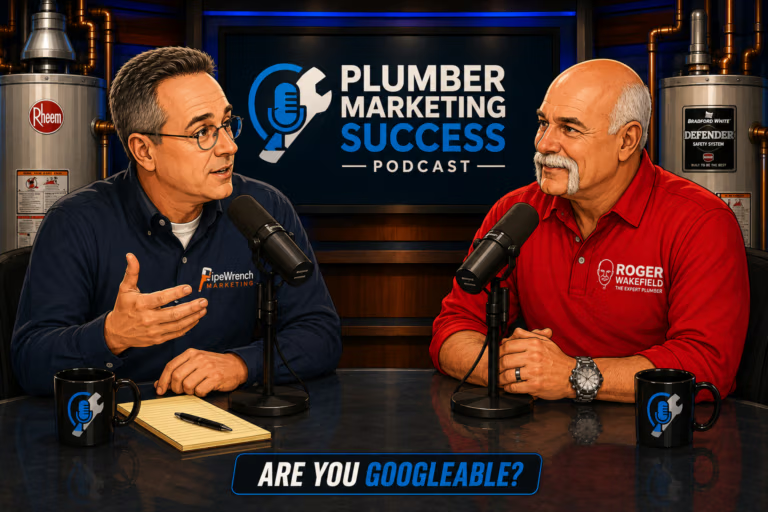
Through the Plumber Marketing Success Podcast, Paul interviews leading experts from inside and outside the plumbing industry to uncover practical strategies that help contractors generate more calls, book more jobs, and build more valuable businesses.
Google Local Services Ads can be one of the best lead sources available to plumbing companies. But they come with a frustrating problem:
You can tell Google you’re willing to spend more money, and Google still may not spend it.
In this episode of the Plumber Marketing Success Podcast, I sit down with Crystal Horton, a Platinum Google Business Profile Product Expert and Google Local Services Ads Agency Partner, to unpack why that happens — and what plumbers can do about it.
Crystal brings an unusual perspective because she can see patterns across hundreds of accounts. And one of the biggest lessons from our conversation is that LSA isn’t nearly as simple as it looks.
“LSA is not a Ronco oven. You can’t just set it and forget it.” — Paul Benton
That became one of the central themes of our conversation.
A plumber may be willing to spend $10,000, $20,000 or more through LSA, but budget alone doesn’t determine how many leads Google sends.
Google is looking at signals that indicate which businesses are most likely to provide a good experience to the searcher.
According to Crystal, several factors can limit your ability to generate impressions and leads, including your service area, job types and the amount of search demand available in your market.
There’s also an important distinction between what Google calls your LSA “budget” and what’s really happening behind the scenes.
LSA operates as an auction.
Simply telling Google you’re willing to spend $10,000 doesn’t guarantee that Google will find $10,000 worth of leads to sell you.
And when two plumbers are competing for those leads, Google is looking at considerably more than their budgets.
Crystal identified several factors she sees influencing performance:
Your marketing team can optimize the account, but what happens when the phone rings can influence what happens next.
One of my favorite moments came when I asked Crystal to choose the most important factor among review volume, review frequency, review quality and proximity.
Her answer:
More frequent positive reviews.
Crystal has observed companies receiving roughly one or two reviews per week achieving better visibility than businesses that receive reviews less consistently.
That means a plumber with fewer total reviews may still be able to compete against a company with a larger historical review count by building a steady stream of recent positive reviews.
Crystal’s answer is yes.
She has observed that accounts offering message leads can receive greater visibility and lead volume. But there’s a catch:
You have to respond quickly.
If your company can’t reliably respond within minutes, technology and automated responders may become increasingly important.
The same principle applies to phone calls. Crystal discussed how AI voice technology can potentially help businesses answer immediately instead of forcing prospects through long phone trees or hold music.
The potential scale surprised even me.
Crystal has seen individual LSA accounts spend more than $156,000 in a month.
For strong accounts operating in major metropolitan markets, she suggested that approximately $40,000–$75,000 per month can be achievable in some circumstances.
Of course, those figures aren’t guarantees. Every market and account is different.
But they demonstrate why plumbers shouldn’t necessarily think of LSA as a small supplemental advertising channel.
When it works, it can become a major source of new business.
If you’re a plumber frustrated because Google isn’t spending your LSA budget, raising the budget again may not be the answer.
Look deeper.
Are you generating fresh reviews consistently? Are calls answered immediately? Are message leads enabled and answered quickly? Are your service areas and job types configured correctly? Is your Google Business Profile healthy and properly maintained?
Those details may help explain why one plumbing company gets the lead while another doesn’t.
Learn with PipeWrench.
Your budget isn’t a guarantee of spend. Search demand, competition, service areas, job types and other account factors can all affect the number of leads available to your business.
Yes. Crystal emphasizes not just the number of reviews, but their consistency. She has observed businesses receiving one or two positive reviews per week performing particularly well.
Crystal has observed strong performance when calls are answered within approximately four seconds. Fast response is one of the factors she watches when evaluating LSA performance.
Crystal recommends it. Message leads provide another way for customers to contact your company, but businesses need a system capable of responding quickly — ideally within minutes.
Yes. Your Google Business Profile and LSA account are closely connected. Reviews feed into LSA, and problems such as a GBP suspension or verification issue can cause your LSA ads to stop running.
No. Crystal explains that the service areas do not have to match. However, she recommends reviewing both because she frequently finds that a company’s GBP is better optimized than its LSA account.
That’s one of the biggest mistakes Crystal sees. Account activity, accurate information, reviews, responsiveness, service areas, job types and other factors should be monitored and optimized over time.
Paul Benton: If you’re a plumber or a friend in the trades, you’re in the right place today. My guest is Crystal Horton, one of the country’s leading experts on Google Local Service Ads and Google Business Profiles. She’s a double expert. She’s a platinum Google Business Profile product expert and is an agency partner credentialed directly with Google.
Paul Benton: She runs her own agency and works with other agencies, and you’ll find her listed on the Google support page as a Google forum product expert, and you will see her in a hall of fame, using my words, among the leading lights of SEO. And all you have to do is google her name, “Crystal Horton Google,” to find her.
Paul Benton: She’ll pop right up. Crystal, it’s a pleasure to have you here today, and we’re gonna talk about the changing, uh, landscape in LSA. Things are changing. Google moved the cheese, so that’s what we’ll gi- jump into. How are you?
Crystal Horton: I am good. I’m very happy to be here. I am super excited about the migration that’s taking place
Paul Benton: So why don’t we start there?
Paul Benton: What … Why did they move the cheese? Why did they move Go- The, uh… They’re closing the old dashboard, and they’re folding it into the rather more complicated Google Ads account. What’s going on there?
Crystal Horton: Well, I, I think it’s about time because LSA is part of the Google Ads department. So for the last couple of years, we’ve really been working between two different dashboards, the LSA side and the Google Ads dashboard.
Crystal Horton: So having it all, uh, merged, migrated underneath one dashboard kinda helps the scatterbrained sort of thought process
Paul Benton: But is it fair to say, this is I’m speaking for my own, uh, from my own chair. When I go into the Google Ads account, that’s like climbing into a 747 cockpit. If you’re going into the traditional LSA dashboard, that’s more like flying a Cessna. Um, is that fair? It’s getting much more complicated. Do you think it’s- they’re gonna– it’s going to, uh, it’s gonna become more complicated to operate?
Paul Benton: Um, will it take a higher level of expertise to run LSA than it does now?
Crystal Horton: Those are some great questions. Um, ah, I wouldn’t… I would, um, let’s see. Those are some great questions. So when … Yes, moving into the Google Ads dashboard, there are at least 10 menu items to every icon and menu option that you have.
Crystal Horton: Um, from what I understand, moving an LSA account into the Google Ads dashboard, it is going to be a separate dashboard from your current Google Ads account, so that’s not gonna merge or cause any issues there, and they’re sort of going to mimic w- the pages that are currently in the LSA dashboard. So in a way, it’s as if tra- uh, Google is training you slowly into the process instead of going into a sudden shock.
Paul Benton: Okay. And, and the… We’ll have to see how that plays out. Now, they have n- they are beginning, is it correct, Au- This, uh, our recording is in August of ’26. They’re beginning the rollout. Is that correct? When, when are you expecting to see this in your clients?
Crystal Horton: So the rollout is beginning. Uh, there will be a 14-day email notification that goes out first to all admin email accounts that are listed in the LSA Access and Security page.
Crystal Horton: That was a long process, but, so you at least have a 14-day notification. We have not seen any of those roll out yet, so I’d say maybe in the next couple of weeks we’d start to see the new dashboard and migration.
Paul Benton: Okay. Well, this it’ll be exciting, um It, uh, we’ll have to see how complicated it becomes. But it does appear, uh, that with the– there’s more nuance in the new account.
Paul Benton: So for example, how does the daily versus the weekly budget change? And does that- Is that suggesting that we’ll be able to manage for better performance? Are you seeing that as likely?
Crystal Horton: That’s what I’m definitely excited about is this, uh, change from weekly to daily. Uh, f- so from what was shared with me, it is still going to be a one, up field box that you update just like you do with the weekly bid and budget in the LSA dashboard.
Crystal Horton: So you can set that daily budget to run the same ta- the same day instead of setting some kind of budget every single day and constantly overworking in the Google Ads dashboard. I do think that this is going to help some of the issues that we face in the LSA dashboard where sometimes if you have a budget, a weekly budget set, it doesn’t necessarily spend that amount.
Crystal Horton: And this has always been the constant confusion while giving Google money or telling them how much I want to spend but it’s not reaching that amount. That field actually I, I don’t like that they put the word “budget” in there because really it’s a bid. It’s an auction; the one with the highest bid wins the lead
Crystal Horton: So that’s where the confusion has always lied right there in the LSA dashboard. But in the Google ads dashboard when you’re studying this daily budget why I’m excited is because the way it was explained to me is that’s the daily budget you’re actually going to be able to umspend and set a goal for within the Google Ads Dashboard
Paul Benton: Let’s make the rest of our conversation based upon LSA as it, as it stands today.
Paul Benton: And we’ll have to see what, um, the new account and dashboard will look like. But you have gotten early information through your direct access to Google and, um, it sounds promising. Um, let’s start out, if I may, with the number one question I get from clients and prospects all the time, “Why won’t Google spend my money?
Paul Benton: I go in there and I wanted to spend 10 and I might get two,” so say, uh, m- many plumbers. What’s going on there? Why is that the case?
Crystal Horton: Well, eh, the way that LSA is set up, it’s based on, uh, like searcher’s intent from the job types that you have selected and the keywords or key phrases that Google’s system is targeting for each job type.
Crystal Horton: So you may have a high budget of 10,000… Also, let me backtrack. The other thing that is important is your service area, how you have those set up. If you’re s- targeting zip codes or cities or counties, that also depends on how large of an audience that you can reach. So if those things are not set up properly, you might not have enough impressions or reach to get to that budget amount.
Crystal Horton: Or, uh, Google might not have enough search intent to spread between all the 25 profiles that are listed on the Pro list, um, to meet what you’re willing to pay versus having to share those leads with the rest of the other profiles.
Paul Benton: You said something important about the Pro list. Can you tease that out a bit more?
Paul Benton: Wha- wha- what do you mean about where, i- you mentioned 25 in the Pro list. What does the 25 number refer to?
Crystal Horton: L- Let’s say, eh, you type in plumber near me. So what, eh, shows up on the search engine results page is first the LSA accounts. It sometimes it will show the top two or the top three. But when click on that dropdown, you stay on that same page and it shows the top eight.
Crystal Horton: But there’s also an option that says View More Businesses or, or something along those lines. Now when you click into that, it takes you into what, um, we, uh, w- what the Google team at LSA calls the Pro list, and this is the top 20 that are on the list that show up there
Paul Benton: Okay. And, um the top eight is as I understand it what?
Paul Benton: That w- you get a s- you get a percentage in LSA for the, the top impression score and the absolute top impression score and that’s relevant to this list that you just talked about. Can you explain what that is? That’s one of the key metrics.
Crystal Horton: It, it definitely is because it shows up underneath the, uh, the report i- currently in the LSA dashboard.
Crystal Horton: Top impression rate will show the percentage of your impressions that show anywhere above the results that aren’t paid se– So, uh, like I had explained the search results page earlier, first it shows LSA sometimes we then see pay per click ads after that you’ll see one LSA ad in the Google Maps pack and then you’ll see the three, um, Google business profiles that are organically placed there.
Crystal Horton: Underneath there it might show, uh, questions and then underneath that it has the website, um, organic. So the top impression rates are those either … Uh, are those top eight spots that show up above the organic results.
Paul Benton: And within the LSA listing or in the, uh, primary Google page are you referring to?
Crystal Horton: Great question.
Crystal Horton: It’s within the primary Google page.
Paul Benton: Okay. If you have a top impression share within LSA in the LSA account that says, “Uh, I’m at 93%-” Top impression share. That means I’m in position one or two of the Google place, Google LSA placement 93% of the time. Is that correct?
Crystal Horton: That would be that you’re in position one through, either one through eight.
Crystal Horton: 93% of the time.
Paul Benton: 93%
Crystal Horton: of the time, yes.
Paul Benton: That you’re in the, in the top eight positions. Okay, gotcha. Let’s switch gears here for a, uh, a bit. LSA is driven heavily by the Google Business profile. Can you talk about the relationship between the two? They now share reviews. They didn’t always, but now they do. How important is your Google business profile to your LSA success?
Crystal Horton: It, it, it is definitely important. So if the Google Business Profile gets suspended, or it goes under verification, that is going to affect your LSA account, meaning the ad will be paused until those two, um… The, the suspension or the verification has passed or been reinstated. So, uh, it’s important to keep your Google Business Profile up to date.
Crystal Horton: Another part of the Google Business Profile is the ranking factor i- uh, for reviews. So reviews are connected into the LSA, uh, dashboard and that’s how Google keeps track or ranks you accordingly on the pro list. If the business name and the address do not match what is listed on the LSA profile, that also affects the account.
Crystal Horton: Sometimes the account will be paused because there’s mismatch, or sometimes it just affects your, uh, rank placement and, and you might be number 18, 19, or 20 in the top 20 list and can’t figure out why. Well, it– That could mainly be the problem.
Paul Benton: Have you seen s- Uh, aside from, uh, a pr- GBP being suspended or, um, uh, uh, some way taken off line, have you seen a, a strong LSA paired with a underperforming or weak GBP, meaning a GBP with few or no reviews?
Paul Benton: Have you ever seen in a competitive environment where you can succeed in LSA despite having, um, a weak but functional GBP?
Crystal Horton: There are some strange instances, especially in California, where I’ve seen accounts ha- have a 3.0 star rating and I believe it was 38 reviews, and for a week that business profile was ranked number one, um, on LSA across the board.
Crystal Horton: So yes, I have seen it but not as often.
Paul Benton: So there are exceptions to the rule, but it’s fair to say that LSA success is driven… It’s good you want to promote review volume and recency sometimes called velocity. You wanna get lots of good reviews; that is a primary driver. Is that, is that a good bit of advice for plumbers?
Crystal Horton: Yes. I have noticed this past year where Google has sort of changed the rules i- in, in my opinion from review count to more of a consistent basis. So I’m noticing that re- um, companies over let’s say the last five weeks that have recei- consistently received one to two reviews per week are actually hitting some type of optimization factor that Google has which allows them to rank higher on the list and increase lead volume.
Crystal Horton: So sometimes it’s not necessarily the review count that you might be up against maybe it’s more of a consistent, uh, ranking factor.
Paul Benton: So what I heard you say is you are good if you can target one or two reviews per week. That places you in a separate category, uh, and, uh, increases your chances of success than the plumber who might only get, uh, five reviews every third or fourth week.
Paul Benton: So if, if it’s one to two per week, that’s better than, um, five per month Let’s shift gears, if we may, um, and ask this is a common refrain, a common comment I- I encounter all the time particularly in the agency world, um, that there isn’t really much you can do to LSA. You just switch it on and hope for the best.
Paul Benton: Some people think of it like a Ronco oven, you just set it and forget it. But in the course of my getting to know you, I have learned that is actually not true. How do you explain to people that LSA isn’t a Ronco oven? There’s actually a lot going on there. What is that?
Crystal Horton: It, it definitely is hard to explain because when you’re looking at the LSA dashboard, there’s really only a few pages that might make a difference.
Crystal Horton: First, it is your verifications page. Always make sure that information is verified because that is… That’s gonna affect the ad. Um, it’s looking into the business and pro-, uh, business and budget, um, page which is where you can make any changes and optimize the account. A set it and forget it type of situation is not showing Google that you want to play o- on their platform.
Crystal Horton: Google really wants to see those, those factors that you’re involved in the dashboard because they have live leads that are being sent to these profiles and if it hasn’t recognized that you haven’t been signed in for a while or haven’t made any updates to a profile, Google doesn’t think that you are participating in that platform.
Crystal Horton: So the more that you update things about your business or add photos, for example, or if your hours have changed because the holiday is coming up, you’re showing Google system that you want leads and you’re giving those updates for the system to know when and when they can’t send it.
Paul Benton: And is that a true statement of both, uh, LSA and also the GBP?
Paul Benton: So you wanna be updating not merely one, you wanna be doing both, is that correct?
Crystal Horton: Yes, absolutely. The more accurate information that you can provide, the better it is, l- I mean, not only for Google but for your target audience and those who view, um, those Google channels.
Paul Benton: And Crystal what is it that, that somebody of your expertise can do that a customer has difficulty doing privately
Crystal Horton: Well, well I think what helps is that we get to see patterns across hundreds of different accounts.
Crystal Horton: We also get to see what happens in different categories. So for example, if something is happening in a- a law firm lawyer, for example, and we h- we start to notice that it’s going across different categories, we can notice that pattern and give that type of expertise to better prepare companies for what’s to come or what we’ve seen that has worked to help enhance or optimize an LSA account
Paul Benton: And um one thing that is uh worth asking there seems to be a practice within the LSA world to set your budget to absurdly high levels Can you untease that?
Paul Benton: What is going on? Uh, it’s not for the faint of heart If you look– If you’re not prepared and you look at a well managed LSA account and you see the budget set tell us about that It might give you some concern
Crystal Horton: It- it definitely-
Paul Benton: Until you know what’s going on
Crystal Horton: Yes, it can give concern And that’s why I had mentioned earlier where the confusion is is because it says bidding and budget where you can set those details But it’s really reading each sentence through that process that Google is sort of giving you i-in setting that profile and budget So the budget can be as high as thirty five million per week which can be very scary Um I’ve heard several owners’, uh, concerns of if we set this budget in…
Crystal Horton: To this amount Am I going to be charged a one-time fee of $35 million for one lead? And so that’s where it gets very confusing, um, with, with educating because of what it’s showing the words that are being placed in the profile, uh, that, that says budget versus what’s actually happening because it’s more of an auction with the one with the highest bid that wins the lead.
Crystal Horton: But for so many years, you know, o- originally when LSA first came out, that was the top secret. You just set it at 35 million and you’d win all those leads that came through. But Google got smart over time knowing that that amount is not… can’t be the primary or the main ranking factor, otherwise their product would just shut down if they gave all the leads to one person or one company.
Crystal Horton: So over time, Google has set some type of game, reward system. I don’t really know what I wanna call it yet, but it’s, it’s just based off of patterns that we see that, um, what bids will work to bring in the type of leads or the amount of leads that somebody, um, it wa- wants to go after.
Paul Benton: But in general, is it true to say that if you want, uh, to spend $5,000 a month, chances are you need to set your stated budget well beyond 5,000?
Crystal Horton: Definite-
Paul Benton: Correct?
Crystal Horton: Y- yes, that is correct
Paul Benton: And then this, um, bear- brings to mind the, the, uh, warning: beware what you wish for, you might get it. Have you ever encountered, uh, Google suddenly charging well beyond giving people what the wish, what the stated wish was, but g- that’s far beyond what they were actually expecting?
Paul Benton: So they might set their budget to 50,000 wanting 5,000. Have you ever heard of somebody getting charged far beyond what they expected?
Crystal Horton: Um, I really have not, uh, but I think that’s because we’re constantly in the accounts. So I wouldn’t know, uh, uh, for, uh, somebody who’s outside of our MCC management if that has actually happened.
Crystal Horton: Now, I have seen, though, during busy season, um, where we actually prepare knowing that the majority of the leads are gonna come through, uh, that time, that we may end up pausing the ad in the third week just because we’ve hit the budget or we’ve reached the goals, um, of that amount so we don’t pass what was approved.
Paul Benton: Uh, I’ve been advising clients, uh, just in a bu- an abundance of caution that you… It’s not clearly known. You might get what you wish for, but it’s highly, highly unlikely That it would be wise to configure your Google LSA account to be tied to a business savings account that has an absolute, uh, limit on it so that if it can allow you to sleep at night, that if you have a budget set to 35 million, if Google suddenly takes you up on your proposal, that, uh, your s- your bank will have a circuit breaker and your money will be safe.
Paul Benton: Um, that sounds out s– That sounds a little silly, but I think it’s a good idea just to sleep better at night. Do you agree, or do you think this is overly cautious?
Crystal Horton: Yes, I agree, but I, I… What you also reminded me of, Paul, a-and here’s why I’m excited too, ’cause there’s another good reason why the migration i-is taking place.
Crystal Horton: So in the Google Ads dashboard underneath the, uh, billing summary, you can actually set what is called a threshold. So you can tell Google my threshold is $500. And so every time you reach 500, that’s when it then pulls the amount from what e-if you have a credit card, debit card, ACH, whatever you have set up in billing, then it pulls from the, uh, bank account, that threshold.
Crystal Horton: You can increase it over time because Google sort of gives you those rewards as you build your ad history there, but that helps to recognize what’s happening within the, um, ad spend. So if you have your budget or bid set at 35 million, but you got enough leads that reached $500, it’s gonna pull from your bank account.
Crystal Horton: You’re gonna get a notification knowing that you, you know, whatever noti-notifications you have set up with your bank, knowing that Google pulled $500 for ad spend. So that kind of helps allow, uh, monitoring, uh, the spend that way
Paul Benton: Okay. So there are, uh, there are ways of protecting yourself against what seems to be crazy budgets that you have to do because that is what Google, um, is rewarding even if it seems counterintuitive.
Paul Benton: But that’s one reason why, um, working with professionals like you is a good idea, because you know what you’re doing.
Crystal Horton: Yes. Thank you.
Paul Benton: Let’s, um, let’s try to reorganize this a bit and, uh, straightforwardly ask, um: If two plumbing companies are competing in the same market and both are willing to spend, what are the biggest factors determining which company gets the lead?
Paul Benton: If you had to rank the top three to five factors, what would they be?
Crystal Horton: Okay. I would say review consistency- Response rate, but there’s two different response rate factors. The, uh, how quickly you answer your phone and how quickly you respond to message leads. So those two ranking factors keep them as, um, low as possible.
Crystal Horton: So, um, a- answering the calls has been within four seconds that I’ve seen that get the most, um, rewarded process, and then responding to message leads within five minutes has also helped reach those factors. Next is really your service areas, what you’re targeting, and the job types, um,
Paul Benton: o-…
Crystal Horton: is, is what I see when those companies are competing in the same market.
Crystal Horton: Um, the other thing is also ad schedule. Sometimes a company will win out versus a competitor if maybe they’re open 30 minutes longer.
Paul Benton: The question of service area, do you want a bigger service area or a smaller service area to win in the auction?
Crystal Horton: So a bigger service area, uh, what LSA likes to see is counties or cities.
Crystal Horton: They definitely do not like to see zip codes.
Paul Benton: Okay. And is AI kosher? Can you use… it used… AI gi-. Google gives you demerit- … if you don’t answer the phone. If an AI answers the phone, why is that d- is that sufficient?
Crystal Horton: Yes. Uh-
Paul Benton: Just please Google.
Crystal Horton: Uh, absolutely, and that’s, that’s what gives the competitive advantage of reaching those four second, you know, answering the call at four seconds, or responding to a message lead as soon as it comes in.
Paul Benton: What is the difference, do you know? And some of it is just you’re ob- you’re observing it, and sometimes there is no why. You just, you just take the observation and run with it. So I’m asking for the why here. There might not be a why But why is AI helpful to please Google in this, uh, in being responsive but a voicemail is not?
Paul Benton: How can Google tell the difference between a voicemail and an
Crystal Horton: AI? Um, that’s an excellent question. Because I’m not exactly sure how Google can tell, but I can share how I’ve seen it, uh, evolve probably about four years ago. If an LSA call, a lead call went straight to someone’s cell phone, for example, they didn’t answer and it went to voicemail, LSA would count that as an answered call and give you points for, um, answering the call even though it was voicemail.
Crystal Horton: Over time I didn’t, uh, I- I saw the system not no longer give responsive rate percentages for that. But then as I started monitoring AI calls, it started to increase the response rate percentage again. So I’m not necessarily sure how the system can tell the difference between the two, but it seems to have evolved a- and gives the right percentage for response rate.
Paul Benton: And do you… Can you detect any benefit in terms of responsiveness over an AI which generally answers on the first ring versus a live CSR, which typically in, in plumbing companies that we have, uh, e- experienced, there seems to be a pattern. If you have a, a CSR team check the amount of time that it takes from the first ring to the time that somebody s- a human being says hello, that is often a minute.
Paul Benton: Does it make a difference that an AI answers on the first ring versus a human being after a minute and you’re on– You’re listening to on-hold music for 60 seconds? Do you see that as influencing LSA performance?
Crystal Horton: I definitely do because the co- uh, m- the first ring, the communication starts, the questions start to get answered, and you sound like you’re in a conversation type of situ- conversation.
Crystal Horton: Sometimes when I’m, uh, w- with these leads, I don’t even realize that it’s actually an AI. Uh, what are they called? Bots
Crystal Horton: that have the conversation. A, a, AI voice.
Paul Benton: Yeah. AI voice.
Crystal Horton: Mm-hmm. Yes. I, I can’t tell the difference. But, um, when there’s, uh, you know … W- What are they called? Call trees. So it picks up and it’s like, “Thank you for calling us today. Please hold.” And then you’re on hold for a minute before you get to the dispatching service.
Crystal Horton: That hold mu- music will definitely be a telltale, or the words that are being said within that call trail, call tree, are also a telltale. But the conversation doesn’t actually start until a dispatching service gets to it. So you can tell the difference where immediately the potential customer is receiving those answers that they’re getting from AI Voice versus waiting
Paul Benton: So that is reason to believe that if you wanna run an effective LSA campaign, you can have benefit if you steer those calls to AI voice knowing that it will have the back-and-forth cadence faster than your human operators only because it takes a minute, up to a minute for your customers to go through your phone tree before a human answers.
Crystal Horton: Totally. Yes.
Paul Benton: And that would be interesting to know, uh, uh, to get more evidence for. It seems intuitively correct. Can you talk about in your experience what does a… Maybe describe what does a well-managed LSA account look like compared to a poorly managed one? And without revealing anything confidential, can you give us examples of plumbing companies that you’ve taken over and become involved with where the lead volume has increased substantially?
Paul Benton: W- What, what specifically changed?
Crystal Horton: Well, I, I think that goes back to our discussion of, uh, what actually determines an LSA that wins. So it, it’s best understanding where the account is at with review consistency. When was the last time that the company has received a review? How often was it? Are they in alignment with what we typically see in patterns?
Crystal Horton: It is, uh, listening to leads to see what the response rate is and how quickly that’s being answered, if message leads are being answered or going unanswered, and sort of working with the team o- on those things because that’s something we can’t control, right? That’s, that’s really in the team’s, um, court.
Crystal Horton: After that, it’s reviewing the difference between what is listed as the service areas in the Google business profile versus what’s in the LSA account to make sure that we’ve got enough reach, right? And then sometimes what we see, um, is maybe one or two job types that are being targeted. So it’s looking at that pro list to see, okay, what’s happening with these top eight accounts that are showing up in the top eight consistently?
Crystal Horton: Do they target the same amount of job types that this profile is targeting to better optimize it?
Paul Benton: You said something very interesting. Say your Google business profile service area is smaller than your LSA Market area. Is that a problem?
Crystal Horton: That is not a problem, but what I often find is the Google Business Profile is well-optimized compared to the LSA account.
Crystal Horton: So I always like to look at what’s listed in the service areas .
Paul Benton: To make sure I understand this correctly, if, if my GBP says my service area’s 100 square miles and my LSA says it’s 200 square miles, that’s okay?
Crystal Horton: Absolutely. They don’t, they don’t need to match, no
Paul Benton: What’s the potential here? How big can LSA actually scale?
Paul Benton: And I’ll preface this by saying in my observation when we first advise clients, we say that LSA, Thumbtack, Yelp, and then Google PPC should be the, uh, the arrows you fire in that order. LSA takes a while to set up, but once you have it, it tends to be the highest quality lead, um, at the best cost. And I’ve noticed in our…
Paul Benton: in, in our clients, the ones who do really well on LSA are killing it. It’s really their ROAS is also the highest, uh, 10 to 15 times, uh, compared to, uh, other channels which will be a lot less. How … When, when LSA is done really well, what have you seen its potential in, in your management of it? How far can it– Can you go with LSA realistically?
Crystal Horton: Uh, as far as ad spend?
Paul Benton: As ad spend. In other words- Oh, okay … what have you seen as the … In, in your large experience, what have you seen as the highest monthly spend that an LSA account can take when it’s firing on all pistons?
Crystal Horton: Okay. Absolutely. So on, uh, several accounts, I’ve seen where the highest spend for a month has been 156,000 or slightly above that.
Paul Benton: Per month?
Crystal Horton: Per month, yes.
Paul Benton: Challenge with LSA is getting it to spend. It’s, it’s, it’s, um, that’s typically the main complaint or aspiration I get from clients is why can’t we get it to spend more? Now, 156,000 a month is pretty substantial.
Crystal Horton: It w- absolutely .
Paul Benton: What would you say is the average that, that if you were in a, um, in a metro area, top 20 metro area, what, what can plumbers expect really as they build out their marketing plan, what’s a good kind of gut place of how high they should expect it to grow if 156 is the highest in peak performance What’s a typical performance that you can kind of grow to?
Crystal Horton: A typical performance, mm, I would say anywhere maybe 40,000 up through 75,000 a month. In spend
Paul Benton: if- I- in spend … you wanted to.
Crystal Horton: Yes.
Paul Benton: Mm-hmm. What’s the biggest screw-up that plumbers make in their LSA accounts?
Crystal Horton: I, I, I’d like to say where you set it and forget it . And just sign up and say, “I’ve got a profile now.
Crystal Horton: Where are my leads?”
Paul Benton: And let’s talk about, uh, message leads. I remember in previous conversations we’ve had that, um, message leads accounts will… Tell us here in the, i- the update, what percentage… How does message leads help you? You have a choice. You can turn them on or you can turn them off. What do you recommend and why?
Crystal Horton: I definitely recommend turning them on. Um, Google does seem to favor accounts that have message leads as an option because that’s really what search intent likes. Sometimes they don’t like to make a phone call. They prefer to send a message to start the conversation. Accounts that have message leads see about 12% increase in impressions, which leads to a 37% increase in lead volume.
Paul Benton: Okay. And now the challenge is if you have message leads turn turned on, you have to respond to them within five minutes How do you do that without response technology? Do you advise people to have responders-
Crystal Horton: Yes …
Paul Benton: to play that game?
Crystal Horton: I, I definitely advise, uh, to have responders. Um, the, the better your response rate is.
Crystal Horton: So you have options. It’s like it’ll show on your profile that you’ve responded within a few minutes, you’ve responded within 15 minutes, you’ve responded within a few hours or within a day. Like, that, that will, um, remain on your profile as a pop-up so that the potential customer who’s looking for a service can see how quickly you respond.
Crystal Horton: If you have a response within a couple hours or one within a day versus another profile that immediately responds within a few minutes, who are they gonna pick?
Paul Benton: The faster res-… Of course.
Crystal Horton: Yeah. Mm-hmm.
Paul Benton: I am still, though, nostalgic for a quieter time, and I still encounter older school plumbers that will say, “Heck, if somebody can’t wait around for a half an hour, I don’t wanna do business with them anyway.”
Paul Benton: Maybe if we’re living out in the country and you’re riding horses, that’s a better life, but the modern age in the city doesn’t ac- doesn’t permit that unfortunately. Let’s ask a question and to drill down. What really– If we wanna isolate the most important Uh, to your success so that we can give a plumber something actionable to do.
Paul Benton: Is the volume of your reviews, the frequency of your reviews, the quality of your reviews, or the proximity of the customer which is the number one driver of L- LSA ex- uh, success in those? If you had to pick one out of these four, do you want lots of reviews, more frequent reviews, the highest rating, or do you just wanna be closest to the customer?
Crystal Horton: Oh gosh, that’s a good question.
Paul Benton: It’s a hard question.
Crystal Horton: Mm-hmm because I want to answer that quest- One sentence but like pick all of them So I would say, uh, more frequent positive reviews.
Paul Benton: Okay, so review velocity and would you say that’s more important than the, uh, location of the, uh, the, the, uh, proximity, the distance between the searcher and the business is less important to your success than frequency and quality of reviews.
Paul Benton: Is that fair to say?
Crystal Horton: Yes. Yes.
Paul Benton: Okay. Let’s go through some quick factoids and as we put this, bring this in for landing. What is the Policy Manager in LSA? That’s really technical.
Crystal Horton: Yeah, so the policy manager is if you have any type of violations that are affecting the ad to be live. Um, so if there’s issues with your website, it’s gonna show up in this Policy Manager letting you know that there are some type of issues with the website and you have to submit an appeal.
Crystal Horton: If there are what we often hear are called circumventing policies, so it could be something where Google’s system has recognized something with the way that you’re answering calls and handling leads, that you might get flagged for circumventing policies
Paul Benton: So can you drill down on that a little bit?
Paul Benton: What’s an example, I didn’t even know it was possible. What’s an example of an LSA policy that I can violate or my, or my staff can violate?
Crystal Horton: Um, I, I would say, uh, so, so there was a, for example, there was a while where these robotic calls, uh, would go through what… Like they’d catch onto the LSA tracking number that’s listed on your profile and it would call and it would either offer you $10,000 loan or it would be a political ad of some sort And so it would give a 20 second spiel and then it would hang up.
Crystal Horton: So it, it would look as if it were just missed calls over and over and over. And so somehow that was triggering circumventing policies as if you weren’t exactly completing the lead call. And so then the, some companies would get flagged for that.
Paul Benton: Well let’s close on this. We’ve spent our time together talking about LSA but we haven’t really celebrated the fact that you are a platinum Google Business Profile product expert.
Paul Benton: That is a word salad. What does that mean?
Crystal Horton: Yes. So a Google Business Profile Product Expert is a trusted community volunteer that is recognized by Google for having this deep knowledge of their business profiled product. So anyone can go to the Google Business Profile Community Forum and ask questions about what’s happening with their business profile.
Crystal Horton: Based on that, uh, you can answer those questions to earn that type of status and be recognized by Google for your knowledge.
Paul Benton: That’s awesome. Crystal Horton, thank you for being at the table and we will see everyone on the next episode of The Plumber Marketing Success Podcast
Schedule a free consultation with our team and let's make things happen!