Call or Text
Host: Paul Benton
Guest: Konstantinos Christopoulos
Questions?
About Guest: Konstantinos Christopoulos
Founder
Meraki Ops
Konstantinos Christopoulos is the founder of Meraki Ops and an AI automation strategist. Before moving into business and AI, he graduated from the Hellenic Air Force Academy and served as a pilot in the Hellenic Air Force. He credits that experience with teaching him the discipline, systems thinking, procedures, and precision he now applies to business automation.
About Host: Paul Benton
President
PipeWrench Marketing
Paul Benton is the founder of PipeWrench Marketing, a marketing agency dedicated exclusively to helping family-owned plumbing companies grow through better lead generation, local search visibility, artificial intelligence, and customer acquisition systems. Through the Plumber Marketing Success Podcast, Paul interviews leading experts from inside and outside the plumbing industry to uncover practical strategies that help contractors generate more calls, book more jobs, and build more valuable businesses.
Connect on LinkedIn
Artificial intelligence is moving quickly from something you talk to into something that can actually do work for your business.
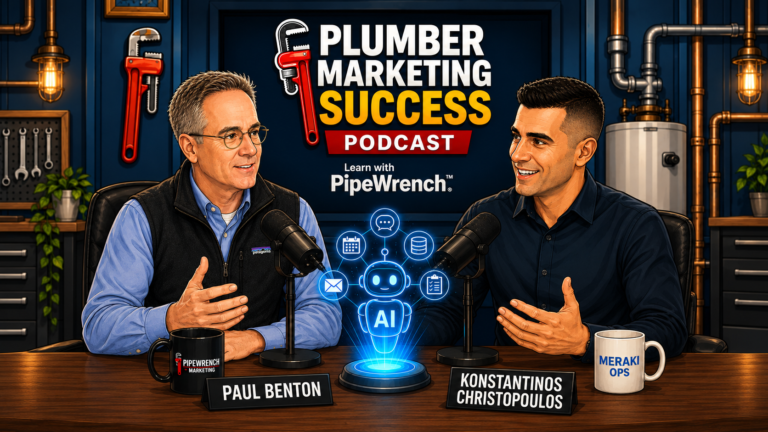
In this episode of the Plumber Marketing Success Podcast, Paul Benton sits down with Konstantinos Christopoulos, founder of Meraki Ops and an AI automation strategist, to break down what AI agents are, how they work, and where plumbing companies can begin using AI and automation to eliminate repetitive work.
Konstantinos brings an unusual perspective to the conversation. Before moving into business and AI, he graduated from the Hellenic Air Force Academy and served as a pilot in the Hellenic Air Force. He credits that experience with teaching him the discipline, systems thinking, procedures and precision he now applies to business automation.
The conversation starts with AI 101.
Konstantinos explains an important distinction: using ChatGPT or Claude to answer a question isn’t necessarily the same thing as deploying an AI agent.
An AI agent can be given a goal, access tools, use memory and work through multiple steps toward accomplishing that goal. In other words, the opportunity isn’t simply to have AI tell you what to do. Increasingly, AI can become part of the system that does the work.
But that doesn’t mean every task needs an AI agent.
One of Konstantinos’ most useful lessons is knowing when not to use AI.
Traditional automation works extremely well when there is a predictable trigger, process and outcome. AI becomes more useful when the process requires reasoning, interpretation or decision-making.
Don’t start by asking, “What can we do with AI?”
Start by asking:
What is consuming our team’s time?
Konstantinos recommends identifying repetitive manual tasks—particularly things like data entry and processes employees perform over and over again—and then prioritizing opportunities based on their potential value.
The mistake is automating something simply because it can be automated. A task performed once a month may be far less important than a small task performed 20 or 30 times every day.
He describes one project involving information submitted through a form that required employees to repeatedly prepare proposals or contracts. Automating that single process saved tens of hours of manual work.
That’s where AI and automation become more than interesting technology. They become business tools.
AI isn’t automatically valuable because it’s new.
Konstantinos explains that AI agents can generate ongoing usage costs. The question therefore isn’t simply, “What does the AI cost?”
The better question is:
What is the AI producing in return?
An agent costing hundreds of dollars can make tremendous sense if it helps generate thousands of dollars in additional business or eliminates significant labor. The same agent can be a waste of money if it’s merely being used because the technology is interesting.
“Before you automate anything, you have to know the manual way.” — Konstantinos Christopoulos
Konstantinos draws this lesson directly from learning to fly. His first aircraft was intentionally manual: before pilots rely on sophisticated technology, they need to understand the fundamentals. He argues that businesses should approach automation the same way—you need to understand the process before you can intelligently automate it.
You don’t need to turn your plumbing company into an AI company.
You need to identify where people are spending valuable hours doing work that a machine could reliably handle.
Understand the process. Find the repetition. Measure the value. Then automate.
That’s a practical place to start.
Learn with PipeWrench.
An AI agent goes beyond simply responding to a prompt. Konstantinos describes an agent as having access to tools and the ability to work toward a defined goal, evaluate its progress and continue through multiple steps. Memory can also allow an agent to retain important context instead of requiring the user to repeatedly provide the same information.
Traditional automation generally follows a predefined workflow: a specific trigger leads through defined steps to a predictable output. AI can introduce reasoning into that process. Konstantinos recommends using traditional workflows for simple, deterministic tasks rather than unnecessarily assigning everything to an AI agent.
Start with repetitive work. Ask employees what consumes the most time and identify tasks such as data entry, moving information between systems, preparing documents and other manual processes performed repeatedly. Then prioritize the opportunities that could generate the greatest time savings or business value.
Potentially, yes. Konstantinos discusses bringing information from different systems into a more centralized location and then allowing an AI agent to retrieve information from that system. He also cautions against unnecessarily giving an agent access to numerous systems because inefficient architecture can dramatically increase token usage and costs.
It depends on the problem. Konstantinos says an individual task might sometimes be automated in roughly a week, while more complicated projects require discovery, testing and a deeper understanding of the company’s processes, people and software. A broader initiative to streamline an entire sales process is fundamentally different from automating one repetitive task.
Paul Benton: If you’re a plumber or a friend in the trades, you are in the right place. At the table today is Konstantinos Christopoulos, an AI automation strategist with a really fascinating background. Konstantinos graduated from the Hellenic, yes, that’s Greece, the Hellenic Air Force Academy, and went on to serve as a pilot in the Hellenic Air Force, an experience that taught him the importance of systems, procedures, training, and precision.
Paul Benton: Today, as founder of Meraki Ops, he applies that systems mindset to business. He helps companies implement artificial intelligence. Today we’re gonna start with AI 101, and then we’re gonna get very practical. What are AI agents? How do you build them? And how can plumbing companies use this technology right now to become dramatically more efficient?
Paul Benton: Konstantinos, welcome. Good to be with you. Hi, Paul. Thank you for having me here. It’s a, a pleasure to be here. So Konstantinos, let’s, let’s start a little bit about your background and then get into the, uh, main topic. Um, it’s unusual, uh, to meet anybody that’s in, that, that’s been an Air Force pilot. What, uh, uh…
Konstantinos Christopoulos: Tell us about how you got started and how it works in Greece, your Air Force career, and how you made the transition into consulting on AI. I was always a good student, I want to say. So after, uh, I finished high school, um, I joined the Air Force through very difficult exams. Uh, in my year there were about, I want to say, like, 55 people, around that number.
Konstantinos Christopoulos: Uh, and, uh, eventually we remained, like, 45. It’s, it’s very hard training, so people quit . Um, so that was the first, uh, uh, the first win, if you will, uh, for me, that I was able to, uh, go through the training, uh, on all aspects. I, I want to say, like, the training that I’ve been through is the hardest, um, days of my life on physical, mental, emotional aspect all at once.
Konstantinos Christopoulos: Um, so all of that gave me the tools that I- I’m using to this day to, uh, be focused, to work on my business and, and help my clients, and, uh, overall, like, um, go through challenges in my day-to-day. Um, and I have a lot of, um- What did you… By the way. Mm-hmm. What did you fly, by the way? What were your- Um, so the first time, fun fact, the first time I flew an aircraft o- on my own, uh, that’s, that’s when you get, like, the certification for your first solo flight, was before I even dr- I drove a car.
Konstantinos Christopoulos: So that was, uh, my 18. I was 18 years old. Um, so that was, like, a old, um- Can’t remember the, the, the name. It’s, uh, it’s, um, T41. Uh, it’s a very old, like, uh, Cessna model, um, ’cause it’s very, it’s all manual, right? So the first thing you learn to fly- Mm-hmm … is, like, something that’s manual because, and this is, like, a good actually entry point, before you have, before you learn how to use a, like, technology and modern systems, you have to learn the manual way.
Konstantinos Christopoulos: And it’s the same thing also in business. You have to know the manual way, following a process, before you automate anything, before you make it a system, because otherwise you can get overwhelmed super, super fast. Um, so yeah, that was the first, the first, um, aircraft that I flew. And after that, on the third year, I was, uh, 20 to 21 years old.
Konstantinos Christopoulos: This is where, uh, this is when we, I, I flew another aircraft, which is the T, uh, 6A, or Tango 6 Alpha. Um, um, that’s an American model. So it’s a training aircraft, which is, had more capabilities, is faster, uh, can do maneuvers. So it’s was, and that was the first time that I flew a formation flight, some other interesting, um, or cool type of flights.
Konstantinos Christopoulos: So yeah, um, I stayed in the Air Force for, like, eight years. Um, so actually it was four the academy and plus four, uh, after the academy, after I graduated. And that was when I decided to, um, go full-time with my business and m- and do what I do today. Well, let’s, um, Konstantinos, let’s jump in with AI 101, and I’d like you to talk to me like I’m, I would like to say 12, but I think make it more like 8, uh, since 12-year-olds- Sure
Konstantinos Christopoulos: seem to know more about AI than we might, uh, give them credit for. Um, let’s start with something really basic. What is an AI agent, and how is the agent different from simply knowing how to put something in a ChatGPT and ask it a question? Yeah, that’s a great question. Um, an AI agent is, is, um, has access to, um, tools and is able to do what’s called looping.
Konstantinos Christopoulos: So it basically, um, almost like questioning itself, and it can test, um, whatever goal you give it. Um, so ChatGPT, like normal interface, or Claude or whatever that is, is, is like the, the, the, the chat interface where you can talk to it and it will give you one answer, um, right away to whatever you say it, but it, it, it can’t, it can’t, uh, go after a specific goal.
Konstantinos Christopoulos: But with an AI agent, you, you give it the, the goal that you want, um, and it will work towards it, and only if it can’t move forward, it will ask you questions for, like, what direction to take. Uh, but besides that, um, the, the normal chat, like ChatGPT, can’t provide the same amount of value, not even close, because it doesn’t have– you, you can’t train it as much as an AI agent.
Konstantinos Christopoulos: You can’t give it the right, um, uh, tools, and it’s only a matter of time, and this is the most important one. It’s only a matter of time until the memory is, is pretty much full and starts making things up. Um, and that’s where when I hear, I, I hear this all the time from, um, from my clients when they say, “Hey, Konstantinos, like, I had, um, ChatGPT or Claude, uh, trained, uh, or I trained it, whatever, and it was working well until it started hallucinating and making things up,” right?
Konstantinos Christopoulos: And that’s the diff- the big difference between, um, using just ChatGPT and, um, using an AI agent. And the last thing, uh, I want to add into this, which is, I see this all, all the time, really, is that ChatGPT and Claude is, are, are the tools that will, um, show the, the user that they’re lacking the proper communication skills, I want to say.
Konstantinos Christopoulos: And I know it sounds harsh, but, like, if you don’t, um, articulate it very well what you’re trying to achieve, it will not be able to help you, even on a simple task, and it works the same way in everything. Let’s say you have a, like, a new employee. You say, “Manage my inbox” or, you know, “Make sure all emails are, are responded,” but you won’t give it enough training.
Konstantinos Christopoulos: So how can you expect, um, AI to do this when you don’t give it not even close to that training or that information? So people say, like, “Remind me when I, if I have something urgent that I have to, um, pay attention to.” And then you have to ask yourself what is urgent. Like, what are the potential fires I have to deal with?
Konstantinos Christopoulos: And all these things, all these issues arise, so we have to be very clear Um, what is happened, what is, what is the definition of done, I like to call it, and just articulate our thoughts very well. Um, it’s called prompt engineering actually. Um, and that’s the big difference between the two. To explain agentic, am I correct in thinking about it, when I import reports into ChatGPT and I ask it to interpret it, that is not agentic.
Paul Benton: Agentic would be if after it interpreted it, it would then go out and take action in a process or a system, so it might post something online. That is the line between analysis, let’s say, or to what we experience in just prompting ChatGPT and then building an agent to actually do something. So it’s maybe the difference between thinking and doing.
Konstantinos Christopoulos: Is that f- is that fair as an entry point? It’s very close. The AI agent, uh, like I said before, also has memory. So, uh, for example, for the AI agents that I’m using and I have, uh, every time I tell it something new that it, I haven’t said before or I haven’t asked to do it before, it will say like I’ve, “Okay, I, I saved this to my memory,” and the next time I don’t have to give it as much context, right?
Konstantinos Christopoulos: It’s another thing. In ChatGPT, uh, you have to give it, uh, context in every session, like who are you, what are your clients, what are you trying to achieve, what is the problem, and, and just type more things and so it, it will take more time. Um, plus like I said before, it will give you the res- response right away.
Konstantinos Christopoulos: Um, to, so to answer your question, that’s like the… You’re very close to what you said, but, um- Mm-hmm … the, the, the, the memory function is, is what makes it, um, uh, much more powerful because it can learn things as y- as you’re using it. Before we move on, for, for just a basic entry point, ChatGPT or Claude, which is better?
Konstantinos Christopoulos: Which should I be using? By default- Mm-hmm … I’m using ChatGPT, but it seems like all the cool kids are using Claude. What’s going on? Well, I, I was, I was using ChatGPT as well, but now I’m using Claude as well. Um, so I, I guess depends on the task, uh, on what you’re trying to achieve, right? So each, uh, model has its own strengths and weaknesses.
Konstantinos Christopoulos: So depending on what you need, um, you can go with a different, a different one. But if you’re using– if you have, like, the basic use of let’s call it AI, right, like ChatGPT, Claude, um, whatever, um, you will achieve ma- mostly the same, the same results. In– for somebody who’s a beginner, it is, it’s fine, like, um, whatever you use.
Konstantinos Christopoulos: Um, but I wouldn’t use many, um, many, many, many softwares, right? So I would, I would stick with one, uh, because it’s very common these days to add a lot of noise, uh, in the form of softwares, in the form of models, and, you know, you– there are so many updates so fast. Every single day, there’s something new that you can barely keep up.
Konstantinos Christopoulos: Um, and all of these changes add to, like, create this operational drag for a company. So if you change, um, how you operate all the time, uh, you will, you will not be as effective How do you actually go about building an AI agent? I have ChatGPT open, now what do I do? Well, it doesn’t work this quick exactly.
Konstantinos Christopoulos: So the AI agent has, like, some components. Right. So you don’t start from- Mm-hmm … from there. The, let’s, let’s go through, like, the, the recipe, if you will, like, of, of the AI agent. You have to, um- Please … pick, like, a large language model, the LLM. You have to choose the model. Uh, this is like the, the… It’s, it’s his brain, the power, let’s say.
Konstantinos Christopoulos: Then you connect it with tools, right? Um, and then you have the, the goal that you give it. Um, but I mean, this can change when you talk to it. And then you have, like, the infrastructure, the loop mechanism, and then you have the, um, the memory, right? Now, these three is what, uh, now, uh, is called, um, harness. You might have heard the, the word.
Konstantinos Christopoulos: It’s, uh, pretty new. It started, like, early 2026. It basically means, like, the environment, uh, within the LLM is operating. So there are a few. Um, my personal favorite is Hermes. Uh, I’m using that one. So from Hermes, um, I, I’m deploying agents, so I’m giving them the right, uh, LLM, right? Um, and then in there, I give access to different tools, and you can deploy different agents.
Konstantinos Christopoulos: Um, and each o- each one can have its own, uh, skill set. Uh, the skills, maybe you might have heard of the skills that you create and, and give it, give to agents. Mm-hmm. Um, plus the, its, its own, its soul. It’s called soul.md or agents.md. That’s how you give agent the personality, if you will, for what it, it, um, what, what it will be responsible for.
Konstantinos Christopoulos: So the Herme- Hermes is the, is an agent framework, but it is not an LLM. Am I correct about that? Uh, correct. And, and what’s the difference? It’s, it’s basically like otherwise you would have to, to manually create, like, the, the, the looping mechanism, the, the, the, the framework within which the agent will, will operate.
Konstantinos Christopoulos: Uh, and I forgot to mention before, in the, in the recipe, if you will, it’s like the, the, the messaging platform. So once you have everything, you can decide where you want the agent to live. You can have it, like, in Telegram, in email, on WhatsApp, like, all of these things. And the most common one I’m using in Telegram personally.
Konstantinos Christopoulos: Um, but I get clients asking to build agents in their WhatsApp. So they put it in their WhatsApp groups. They can tag the agent and do certain things, and they can talk to it, or they can get reports or all of this cool stuff that is really helpful, um, to be, you know, alerted from the agent. So there is, the, the LLM would be the large language model.
Konstantinos Christopoulos: That would be the body or the, or the found- the, the reasoning layer. But then the Hermes is what? The equivalent of The, um, it’s the structure, and that’s what I’m trying to understand. Yes. Why would, why do I need Hermes? Why can’t, why can’t Cla- Claude or ChatGPT operate an agent without Hermes? Yeah. The, a good example to, to, to explain it is the LLM is the engine of a car.
Konstantinos Christopoulos: Hermes is the chassis of the car. Is everything around it. The chassis. It’s, it, it- Okay … it’s what has the LLM, uh, as a, as the engine, right? So there are other as well, but I’ve lost track with like how many they are right now. Um, but, but essentially the same thing. Like, uh, you have a harness, we have the LLM, which is the engine, and then you have the m- the tools and memory that it has and, like the goal that it has.
Paul Benton: Like what, what, why did you build the agent? What is its purpose? When you build an agent like, like this, um, how are we thinking about our data? Um, when you build an agent in, um, uh, in, uh, uh… Well, uh, sorry. What did you say? Where did you build your agent in, um, in WhatsApp, for example. Yes. So if you build a, a- an agent for WhatsApp, it’s now encountering private communications.
Konstantinos Christopoulos: It’s using the LLM of your choice, and it’s using Hermes to the chassis, as you called it. How can you be sure that the data that is running through Hermes and your LLM of choice is actually staying private Or do we just accept the fact that we, it, it might not be private? What’s the answer? Well, it’s, it’s a little bit of a gray area, i- if you will, uh, the security and compliance, no- or, or, or that.
Konstantinos Christopoulos: There, there are many… It depends on how you use it. Like for example, uh, and I, I’m not 100% sure about, like, because things, these things change all the time. Like, it’s different if you use, um, Claude Chat in terms of like its privacy policy with if you use like, um, if you use it within another framework. Um, I’ve looked into this like a little bit, but, um, like I said, it’s, it’s a bit of a gray area.
Konstantinos Christopoulos: So I know that it’s possible to request, I think it’s called like, uh, zero-data retention. So you can request that they don’t keep, that they don’t, um, keep your data. Um, but for security, if, if you’re referring to like the agent going crazy and doing whatever it, it wants, um, because I, I, I’ve heard this about this as well.
Konstantinos Christopoulos: Um, if you, m- like it, it won’t do random things, uh, unless you tell it. And, and it’s not that you, if you give it access to a tool, it will start doing random things. Uh, that’s why you have permissions, you have scopes, uh, for each s- uh, software that you’re connected to. Um, so it can’t start doing random things that you don’t want it to do.
Konstantinos Christopoulos: Uh, but I like to, when I’m using agents for my day-to-day and for client work, to, uh, whenever I prompt it to do something, just for s- you know, an extra layer of safet- safety, if you will, I remind it not to do… Like the negative prompt it’s called, right? So I ask it to do something and I say, “Don’t do this.”
Konstantinos Christopoulos: Like for example, “Draft an email, don’t send it.” It’s the same thing, but you know, I, I, I like to be very, very specific when it comes to safety on the agent side. But on the data side from the companies like Anthropic, um, then that’s like a, it, it is a concern, uh, for the data. And even today, like, you know, every day there are news about that and what they do with our data and what’s happening.
Paul Benton: So I, I don’t want to say something that is not like very, um, specific, let’s say, or, or with certainty. So the, saying something philosophical here and before we move on, it’s almost like, uh, in, in cinema or literature, the concept of suspension of disbelief. You have to go into this, uh, knowing that there are risks that you don’t really know yet About your data.
Paul Benton: And you can’t be, uh, cut yourself off from it because then you’ll be left behind. So it’s really a dilemma. How, how do you proceed, uh, with your data protection and not be overtaken by your competition? That’s a ph- a, a philosophical question that there’s no answer to at the moment th- that I can think of.
Konstantinos Christopoulos: But if you have one, um, share it. But that’s an observation. Well, my personal two cents on, on this is, like, if we use our common sense, I wouldn’t give, like, a list, a CSV of, like, 1,000 people’s names and emails and contact information or contracts or things like that, you know, um, that are more sensitive by, by default.
Konstantinos Christopoulos: Um, so you can, you can have, like, um… You can have it draft an email, like I said before, but not give access to or, like, share information that are, that can be sensitive. So we all know what can be sensitive information. It’s using it to help you, but you don’t give it the keys to the kingdom, I think. You don’t- That’s a good way to put it
Paul Benton: you don’t give it your… And in, uh, to, to, to think about this in a simple way, I, I like to hook up as what I can the apps to, uh, ChatGPT is what I’m using, and we’re gonna build out more to do rapid data analysis so that we can do it at light speed, but I am not gonna hook up my bank account or my medical records or my, my personal information because w- it’s unclear in the terms and conditions, and they can change without your even knowing about it, where that information will end up.
Paul Benton: And of course, it then, the, the big question, which is getting a little into the weeds here, is how much of that can be subpoenaed if you ever get into a, a dispute with somebody, and I don’t think we have an answer to that yet. So it is a concern about how much we are talking to our LLMs and how much it knows about us.
Paul Benton: It’s also odd about its memory. So it will remember things that I brought up six months ago, and I will have forgotten that I brought it up, and it is speaking to me as though we talked about it yesterday. That’s a brave new world. But these are things that we just have to go in with our eyes open Um, and just be comfortable with we don’t know yet Well, I think this is all…
Konstantinos Christopoulos: I mean, if you see this from the… Its use, it can be a good thing, like if, if it has memory of, um, how your business works and, and, uh, prior client relationships or, uh, contact relationships, all of that, because y- you might find it helpful. Uh, one thing that I forgot to mention about, uh, privacy is that, um, you can use an LLM locally, so that’s not in the cloud, and that, that is 100% safe.
Konstantinos Christopoulos: Um, I haven’t personally used it as much, uh, like localhost, you know, like, um, to use an LLM locally because I, I like to be flexible. You know, I, I bought agents and b- bought, like I said before, Telegram, um, so I can use them on the go. Uh, plus I don’t want to rely on my, uh, laptop being open so it can do things.
Konstantinos Christopoulos: Um, but there is a way, uh, to use an LLM, um, safely if you don’t If you, if you have like a, like an open source and you use it locally Let’s move on if we, if we may, um, and finish up our 101. What is, um, what is Lovable? Lovable is a software that, uh, allows you to build, um, websites or, um, pages in general and, and you…
Konstantinos Christopoulos: Maybe like some simple, uh, softwares, um, with no code i- by just talking to it. It is good for a beginner. Like I, I recommend it if you are a beginner. But yeah, like it’s… Uh, these days, like maybe you’ve seen it that many websites look the same, so that’s the downside of it. Uh, but if you want to take imperfect action, like I used to say, uh, it might be a good tool.
Konstantinos Christopoulos: And if you want to use it internally, uh, then you can build something really fast, um, uh, with, with Lovable. Uh, but at the same time, if you know how to use AI in a better way and you don’t use Lovable, then you can build the exact same thing at a fraction of, of the cost. Uh, so Lovable, I would, I w- you know, it’s, it’s good for somebody who doesn’t know how to use…
Paul Benton: H- how to build, like let’s say the same, how to build the same thing in a different way. So it’s only for complete beginner, I want to say. Okay. So it’s an entry point. Let’s, let’s turn our attention to, um, what a plumber can do in his plumbing company. If he’s just starting to review his company operation, how do you make a list of what he should decide to bring Konstantinos in to apply AI to?
Konstantinos Christopoulos: Where do you begin? There is no specific answer for that, uh, for all, all businesses. I, I, I, I like to start with make, uh, like asking questions to, to the owner, um, about what takes most of your time, what are the repetitive tasks. Um, usually things that I see all the time are like data entry or, um, very simple manual tasks that take a lot of hours from the team.
Konstantinos Christopoulos: Um, so by asking these questions then I, I start to understand like what tasks come should be automated first, um, and not automate something just because it’s possible, but you do this once a month and it doesn’t, it doesn’t give as m- as much value as something else. So, uh, this is another thing that I see all the time as a common mistake, if you will.
Konstantinos Christopoulos: Can you give an example of, of what you’ve recently automated for a, um, somebody in the trades, construction or plumbing or anyone? What, what is that? An example that I would give is, um- Is y- you have, like, let’s say multiple lead sources, right? So, um, and I, I see this all the time where you have somebody, and spending half of their day, um, adding, uh, data to your CRM, updating them, logging activities, um, and keeping the CRM up to date when I always say that your team should be focused on sales and sales activities rather than updating it, which is a manual, um, task.
Konstantinos Christopoulos: Maybe in some sit- scenarios it’s needed, like somebody, y- y- y- you meet somebody on the street or somebody calls you and, like, you know, y- you, you wanna add them manually, that’s fine. 80, 90% can be automated so, so you can, uh, be more relaxed that everything is in the CRM, it’s updated, and you have many lead sources, you have many channels that you talk with your clients, um, and all that can be updated into one place.
Paul Benton: So you can trust this as a main source of information. So this is an, a common example that I see, and a very important one for the foundational work. How many hours are you seeing? If, if you, if you’ve got a company that has Let’s say 15 employees, and you come in, you go through the discovery process with the owner.
Konstantinos Christopoulos: How many hours after you have implemented your recommendations are you typically seeing being saved? A good question. Uh, it depends on the, on the task and, like I said before, how many times they have to execute this task. Um, sometimes, and these are the, the highest value automations, sometimes they are, like, little things that they do all the time.
Konstantinos Christopoulos: Um, to give an example that I did recently, um, for a company is that there’s, like, a form that leads submit all the time, multiple times a day, 10, 20, 30 times a day. And from there, the, the company has to prepare a proposal or, uh, a contract. And this is, like, one simple automation that I built in a, in a week, and that saved tens of hours just from one thing.
Konstantinos Christopoulos: So it will depends on the amount of manual work. Um, and every company, no matter the, the trade, the, the industry, um, they have a lot of internal operations, and I like to start there because it’s the easiest to build, in my opinion, it has the highest value, uh, to the company, and it’s the least risky, uh, because it’s not client-facing, right?
Konstantinos Christopoulos: And if it is, you can have… there- it’s a different conversation. You can have different, uh, quality control or safety nets or other people overseeing the automation. But, but yeah, this is, um, you can save, like, a lot of hours just from one simple automation, and it’s not, not, not all automations are the, the same.
Paul Benton: They don’t, they don’t provide the same value. And that’s where I come in and I, uh, prioritize what needs to be done. Sometimes a client says, “I want this,” and I’m like, “It’s better to start with this ’cause that’s higher value.” So here’s an example, Konstantinos, that, that, uh, I’ve seen in re- plumbing companies, it’s, there are separate systems.
Paul Benton: You have your ServiceTitan or your Housecall Pro, then you have y- uh, your review generation platform, which might be Podium, and very soon you’ll have your, uh, CSR team that answers incoming calls having to look at multiple screens at the same time. That is a common challenge. And so I’ve gotten requests from clients that, is there a way to pour all the information into one screen?
Paul Benton: And so the question is, is there an agentic solution here where you could have an agent look at your separate software screens, speaking into one dashboard that you, Constantinos, will have created in a custom fashion so that the team is only looking at one screen at a time, even though standing behind it are multiple systems?
Konstantinos Christopoulos: Is that something that can be done today? It’s a great question. Um, t- I mean, in one day, probably not in, in one day, but, uh, it’s definitely possible. Um, but w- there, there are a few things we have to look at here. The first one is, is it an absolute necessity to have so many different softwares for almost the same thing?
Konstantinos Christopoulos: It’s another thing that I see sometimes, uh, with clients where Ideally, you have to have, like, y- you have to be clear for what is your s- CRM software, where do you keep your tasks if it’s not the same, uh, where do you keep, like, what, w- what, what i- what each software w- does for you. So if you have, like, three softwares for a CRM, then you have three CRMs.
Konstantinos Christopoulos: You have to merge this information somehow, somewhere. Um, and the same thing for tasks. But even, like, even if you have to have all these softwares, yes, you can, uh, bring them together in one software, in one place, in one dashboard. Yes, you can build a custom dashboard. I wouldn’t recommend it typically because, um, it would take more time, uh, to build, and while you’re building it, you can’t provide value to the company.
Konstantinos Christopoulos: But if you, if you pick one as, okay, let’s– we have, like, 10 softwares. Let’s, let’s focus– L- let’s have one that will send information there in that one software. Then you can build the workflows with all the other softwares, send information in that one software, and then have an AI agent that reads information from that system.
Konstantinos Christopoulos: It’s another thing that, you know, we need to emphasize on this a little bit more because even if you built an AI agent somehow, like, or look at the training video, whatever, to build an agent, uh, on your own and you don’t know how to do this, it will be super, super expensive, the agent, uh, because it will…
Konstantinos Christopoulos: I- I- it’s usage-based. Like, its cost is usage-based. It, it’s using tokens, right? So if you don’t set up the right way and, and you give it access to all these tools, it will start, s- like, when you ask it something, it will start searching every single tool to find the information you need, and it might do this for hours, right?
Konstantinos Christopoulos: And that’s super expensive from the token side. But if you have, um, the workflows, these are typically… I mean, these are free. You build them for different softwares. These are the deterministic, um, workflows, automation workflows. You bring all the information to one software, and then you have the agent read one software to find the information, and then you can give it instructions for how to look for information.
Konstantinos Christopoulos: You can say for, for example, just, um, simply put If I ask about a lead, look at this software. If I ask about a client, look at this software. If I ask about a contract, look at this. You know, you give it instructions for where to, where to look, uh, and that’s where you start managing the, the, the expenses for your tokens, and that’s super, super important because these costs add up super, super fast.
Konstantinos Christopoulos: How much? What should you be your token budget, uh, in a s- in a, uh, medium-sized small business? I mean, it depends on how, how much you use it. Like, it, it, it m- might, might be, like, $500, um, and that, that can be cheap or expensive depending on what it does for you. If, if, if the agent helps you close two, three more deals, each one worth 5K, then it’s worth it.
Konstantinos Christopoulos: But if, if you just use it because it’s cool and you don’t wanna check your software and you just wanna ask the agent and type it, uh, then it’s not, right? It’s not worth it. So there’s a fine line in this. And the agents, and the automations in general, they can, uh, save you time, they can, um, help you increase revenue, or they can, um, uh, basically, like, like automate things so, so you do them faster.
Konstantinos Christopoulos: Uh, so- And talk to me, Konstantinos, about the difference between automation and AI. A business can benefit from both, but they’re not the same thing. You can have an automation workflow. This is very simple. Like a specific, there is specific input, it has specific output. Um, and there are steps in between.
Konstantinos Christopoulos: Um, and if something breaks in the process, then the automation will break. You won’t get the output. Um, and, and there’s only a sp- a very specific trigger that starts the automation. This is an automation workflow. An AI automation workflow is something similar, but you can add an LLM some- somewhere in the process to add the reasoning and give it, like, the logic for what to do, right?
Konstantinos Christopoulos: For example, you can have like a, um, let’s say an auto- simple automation. When I, I receive an email, specific trigger, draft a response. Somewhere in the process you can have an LLM that will- Um, think how to draft a response. You can have, you can have it read the thread so it understands, it gets the context.
Konstantinos Christopoulos: But this is a very simple, uh, example. Now, the AI, um, it, it, it doesn’t have specific input. It can, it can, it can do, uh, more things. It can, uh, loop. Like I said before, it can, um, uh, it can question itself. It can test. You know, you just give it the goal. You say, “I want this task to be done,” uh, and then it will s- it will start, uh, working towards it, and it will not stop until it can take a step further.
Konstantinos Christopoulos: Um, so the… But as I said before, like, a smarter way to do this, and this is my, probably my favorite one, is I build, like, a lot of, um, automation workflows or AI automation workflows. E- um, both are, are fine. Um, and then I have an AI agent that oversees that in case something breaks, so it can fix it or it can build automations.
Konstantinos Christopoulos: So the automations, the automation workflows are, um, faster to build. Are, of course, um, I mean, they’re, they’re, they’re technically free because you, you- if you, uh, have the software that hosts these automations, then, you know, from there you can build as many automations as you, as you want. So instead of having agents, um, doing very simple tasks, because the agent is, is, is non-deterministic.
Konstantinos Christopoulos: Like, it can’t expect the exact same output with the exact same input. That’s the big difference. But when you have the workflow, you can have very specific results. So if, if it’s like a very, um, like- very simple task or like a s- like a data input or transfer data from here to here. I wouldn’t use an agent for that When you come into a company, what’s the average duration of the project from, uh, begin- beginning to installation?
Konstantinos Christopoulos: How long does that typically take? W- when a c- if a, if a contractor hires you, what is typically your, your, um, wheels up to wheels down time period before you’ve installed the solution? Again, depends on the project. If it’s something simple, it might be, like, just one month. Uh, or I mean, it’s… I wouldn’t say, like, less than one month because, uh, usually will require some testing if it’s a, a bit- Mm-hmm
Konstantinos Christopoulos: more complicated. Um, but it, but it can take more, like a different… If, if, if somebody wants to… If you tell me, “Automate this one task,” then yeah, you can do this, like, in one week. If you say, “I want to streamline and automate as much as possible from the sales process,” it’s a different project. You have… I have to get all information.
Konstantinos Christopoulos: How is your sales process? How does it work? Uh, what are the steps? Uh, who is involved? What are the tools, the softwares, the… There are a lot of things that come into play. There are two ways that I personally, uh, like to, to work. So one is with a project. So you have a specific project. You want a specific outcome, and then we, we discuss about the timeline and all that and how long it’s gonna take.
Konstantinos Christopoulos: Uh, or it’s more like, um- A system that is more broader. Now, I think it’s more viable to work on a system that is broader. Why? Because I can get the big picture of the company, and I can see all the softwares, and I can, I can see more than what you tell me you need. And I can say, “Yes, that’s good, but we can do that as well,” that take it the next level, right?
Konstantinos Christopoulos: So for example, you have the form. You get the, the, the form submitted from a lead, let’s say, and you say, “I want this…” Very simple example, “I want this lead information to go into my CRM.” And then I s- I say, “Why don’t we do that, plus we send the first email so we can touch base with the lead fast?” Or, “Why don’t we create a task for the team to call them fast?”
Paul Benton: Or, “Why don’t we…” Like, there are other things that you can do on top of that, and this is how it’s built layer by layer, and this is where it becomes a, a system. If I’m hearing right, just to translate that into, uh, what we do as marketers, it’s, it’s, has the feeling of a project on average of being a good website.
Konstantinos Christopoulos: So ambitiously, people will say, “I can build you a website in two or three weeks,” and that’s very often six, six weeks to 12 weeks. But it’s, uh, th- is that fair? That, that, that to do an AI implementation on, in a b- small business scale is probably on par with building a new s- uh, a new, good, sophisticated website in terms of timeline, meaning, meaning maybe, uh, one to, one to two months is, is a fair capture of what the center average would be.
Konstantinos Christopoulos: Is that fair to say? Yes, you can say that. Um, but it- It could be longer or shorter depending on what it is … E- e- exactly, exactly. So I, I’ll give you an example, right? Like I said before, a, a client says, uh, “I want to build this automation with a form.” Took me two weeks, one to two weeks. Uh, and the second week was m- basically, uh, reviewing the results.
Konstantinos Christopoulos: So technically it was one week. The same client says, “The next project is I want an AI agent that can inform me about everything that’s happening in, in the company. Like, I want it to read, uh, Slack, WhatsApp, Telegram, uh, LinkedIn, Instagram, eight platforms, and inform me about what’s urgent to respond, and, and act on it when I talk to it.”
Paul Benton: Like, this is, again, one project, way bigger, you know? So- Mm-hmm … uh, p- plus it’s more, um, critical. Uh, so it’s, it’s hard to build because you can’t have it make mistakes. You, it takes more time to test it. So, uh, it really depends on the project. Sure thing. Well, let’s close, uh, land the plane here. Let’s close on, um, this.
Paul Benton: Say I’m a plumbing company owner And I’m, the only thing I know is I have my free ChatGPT account. I have nothing more. What should I… In, in order to know what, how to bring AI into my plumbing company, what should I learn first? What would you recommend I ignore? And what could I have realistically moved the needle in my company in 30 days?
Konstantinos Christopoulos: I’ll, I’ll start by saying what not to do and how not to use it, and I’m saying this because I’ve seen it. The first one is don’t expect the AI to make strategic decisions about the business, like what direction to take and where to go and, and how to, you know, uh, close more deals or how, like, what should be your next, uh, marketing channel, whatever that is.
Konstantinos Christopoulos: I see there’s people doing that, like, and relying on that, and they reach a point where ChatGPT or, or Claude becomes the CEO of the company, uh, without them even knowing and realizing, right? So i- it’s a trap, right? And then you start changing directions all the time, and then business starts going down.
Konstantinos Christopoulos: That’s one. The second thing is, um, if you’re gonna use it, give it some context. Um, uh, give it the information that it needs to respond back because- Uh, otherwise, I mean, it will do this regardless. Um, it will… I’m sure you’ve seen this. It will agree with you with whatever you say pretty much. So when it comes to decisions, it’s not, it’s not a good tool, and over time- It-
Konstantinos Christopoulos: you will lose your ability to make good decisions because of that. Uh, so I think this is something that- Yep … humans can keep regardless. Uh, like, and I don’t know if it’s gonna change in the future, but I think for quite some time, like, that will remain as is. Like, so y- you have to be the one making decisions, and that’s the most valuable thing as an owner.
Paul Benton: It will tell you what you want to hear. Exactly. Do you have any tip on what you can do to counteract that so you get a more honest answer? Is there a prompt you recommend to put into ChatGPT or Claude so that it doesn’t gaslight you? There are s- there are some prompts, uh, for this. There are some things to say, but what I’ve noticed is that, uh, it, it’s still not, um, super useful.
Konstantinos Christopoulos: Like, i- it won’t agree with you as much, but then it, it will challenge you without, um, a reason, without needing y- without you needing the challenge in, in the first place. So i- it’s like two sides of the same coin. It will either agree with you with everything, or it will challenge every detail, and, and it will not make any sense.
Konstantinos Christopoulos: Um, so I think the, the solution is just to not let it make decisions, not, don’t give it options. You decide what you wanna do and give it the information that it needs. Um, and then, you know, depending on how, how you use it, um, have it help you, um- Like, let’s say, uh, do something fast that you, takes a lot of time from you, like, like, uh, read, I don’t know, like some, some text or s- or an email, or ask about a software that you’re thinking about migrating.
Paul Benton: Like, something that is very, um… It will not make or break your business, let’s put it that way. Decisions, strategic, strategic decisions, um, I, I wouldn’t rely on AI for that. The last part of the question, what’s, what, what can, what can we hope for in 30 days going from knowing n- very little to doing something meaningful?
Paul Benton: Where, where, where would you start just on a 30-day time horizon? As somebody who is, um, helping a, a company or- No, if I’m the plumber, if I’m a plumber who, uh, wants to step out of the shadows with AI, I’m gonna, I’m gonna get the paid subscription to ChatGPT. That’s my first step. And what’s my second step that, what can I do in the next 30 days to meaningfully move value in my company without breaking things?
Konstantinos Christopoulos: The first thing is, um, I mean, the, the, the paid subscription won’t do any, uh, um, won’t have any impact or, or difference in terms of the automations. Like, because you can’t really build the workflows within ChatGPT or Claude, at least from what I know. Uh, so, but again, it, it can has, it can have more, more, more, more context to what you give it, um, as information and what you want it to do.
Konstantinos Christopoulos: Um, so I, what I wouldn’t do is I wouldn’t, um, build automations just for the sake of building them if they have no value. I see this all the time, even with people that are experienced, um, with automations. Um, and by experienced I mean you know some things. You have, you, you’ve watched some videos, maybe some basic, some basic things about automating stuff.
Konstantinos Christopoulos: They go ahead and- Stop doing like the, the income producing activities in the company, and they do more of like automating things that are n- not needed or don’t bring as much value. And it’s basically a distraction. So there’s a lot of noise. There’s a lot of noise, um, and there’s gonna be more and more, uh, as we go.
Konstantinos Christopoulos: More softwares, more tools, more opportunities, but that’s like a, again, another shining object syndrome here. So if, if, if you want to use it for simple tasks, then yeah. Um, but I would recommend if somebody wants to get into automations, watch a few videos, learn like some how to build basic automations.
Konstantinos Christopoulos: There are, depending on how much in depth you can, you wanna go, uh, you can pay like a bit more and, and make your life easier for simple automations. Or learn m- uh, a bit more stuff and reduce the cost of building these automations. But if you really know how to do this, uh, eventually it will be cheaper hiring somebody and do this basically for free for you, because this is like recurring cost if you don’t do this right, and, and deploy these automations very easily without you not knowing what you’re doing and stressing yourself out.
Paul Benton: Yeah. And Konstantinos, even though you are based in Europe, you do do work in the United States. And so what’s the best way for people to get in touch with you? Uh, yes. Um, so I mean, they can find me on LinkedIn. Uh, if they can see my name, it’s, uh, it’s a bit long. I’ve heard this many times. So it’s Konstantinos Christopoulos, and they can find me on LinkedIn.
Konstantinos Christopoulos: Um, and- Mm-hmm … they can message me there. Uh, but yes, uh, all my clients are in the US, so I do a lot of US work, uh, in US hours, so that’s not gonna be a problem. So, so yeah. Konstantinos Cri- Christopoulos, thank you for being at the table, and we will see everyone on the next episode of the Plumber Marketing Success Podcast
Questions or want to learn more?