
A practical guide to recovering estimates, supporting technicians, filling schedules, and understanding job profit
The most useful AI workflows for plumbing companies solve problems that already cost time and revenue: unsold estimates that go untouched, gaps in the schedule, and uncertainty about which jobs actually make money. Here are five places to start over the next 90 days.
Most plumbing companies do not need another AI tool just because it is new. They need a practical way to solve problems that already cost them time and revenue: estimates that never get a follow-up, gaps in the schedule, customer questions about price, and uncertainty about which jobs actually make money.
In a recent conversation on the Plumber Marketing Success Podcast, John Reay, founder of Elite Advisors Consulting, outlined five ways plumbing businesses can put AI to work over the next 90 days. His advice is to start with the outcome the business needs, then choose the technology that can support it.

5 AI Workflows for Plumbing Companies
1. Follow up on every unsold estimate
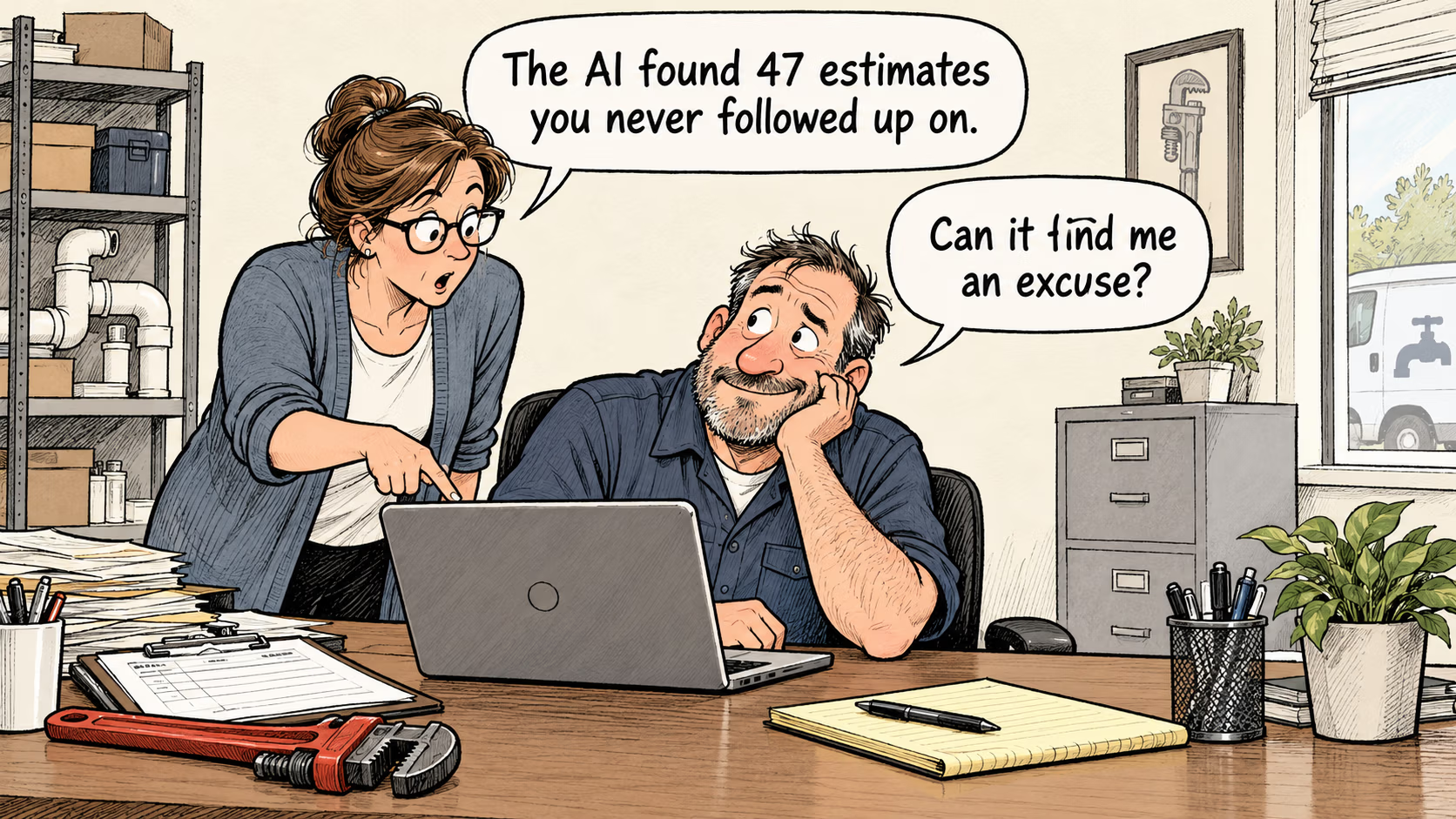
When a customer receives an estimate and does not accept it right away, the opportunity often slips between the technician, salesperson, and office team. No one is certain who owns the next step, so the customer hears nothing.
Start by reviewing estimates from the past 90 days that remain unsold. AI can help group them by job type and value, prioritize follow-up, and draft a message that reflects the work quoted. The important part is establishing a reliable process: a new estimate should trigger a reminder or follow-up sequence until the customer gives a clear yes or no.
This is a chance to recover work from leads the company has already paid to generate. It can also make follow-up more useful than sending the same generic reminder to every customer.
2. Help technicians prepare clearer quote options
A technician can capture important details while the job is fresh by dictating notes into a phone. Those notes can include the customer’s concern, the condition of the equipment, materials, labor considerations, and anything the next technician should know.
AI can use that information to help prepare several options for the customer: address the immediate problem, fix the underlying cause, or choose a longer-term solution. The technician remains responsible for reviewing the recommendations and confirming that they fit the job.
Clear notes can also reduce handoff problems. If another technician returns to complete the work, they have a better record of what was observed and discussed. Reay notes that voice input can also support communication across many languages, which may help teams capture information more naturally.
3. Reactivate past customers and fill schedule gaps
A company’s CRM may contain opportunities that are easy to overlook: lapsed service agreements, overdue maintenance, and customers who have worked with the business before but have not booked again.
Review those records and create a process for reaching out with relevant service reminders or available appointment times. The same information can help identify openings in a technician’s day and contact nearby customers who may be due for maintenance. AI can help surface the right records and coordinate outreach, while staff can handle exceptions and customer questions.
The goal is to make better use of existing customer relationships and available capacity, rather than relying only on new leads to keep the schedule full.
4. Give customers a realistic preliminary price range
Customers often want a ballpark price before they agree to an appointment. Plumbing companies may hesitate to give one because the actual cost depends on what the technician finds, and a price that is too low can put margin at risk.
AI can help analyze past jobs alongside labor, material, and vendor costs to estimate a range for common work. A company might then give a customer an informed preliminary range and explain that the technician will confirm the final price after inspecting the job.
The range needs to come from the company’s own data and pricing rules. It should not be treated as a guaranteed quote when the job has not been assessed. Reay shared an example of a company that saw a 29% year-over-year increase in estimate acceptance after adopting more upfront pricing; that result is one company’s experience, not a promise for every business.
5. Understand profitability by job type
Revenue and a busy schedule do not automatically mean a plumbing company is profitable. Owners need to know what remains after labor, materials, vendor costs, and other expenses are accounted for.
That information may be spread across the CRM, invoices, vendor records, and accounting data. An AI workflow can help bring those sources together and report on gross margin by job type. Reviewing the results regularly can reveal where supplier price increases are affecting costs, where the price book may need updating, and which work is not producing an acceptable return.
For marketing decisions, this also creates a more useful measure than lead volume alone. Knowing which jobs generate profit can help owners and marketers focus on the customers and services that are best for the business.
Start with the process, then choose the tool
These five applications do not require a plumbing company to replace its existing CRM or automate every customer interaction. The right setup depends on the software, data, integrations, and permissions available. Some tasks may be handled with features already in the company’s systems; others may need a more customized workflow.
Before implementing AI, decide what a successful outcome looks like, identify who owns the process, and set clear rules for customer communication, pricing, and when a person must step in. AI can help teams find information and complete routine work, but people still need to review important decisions and take responsibility for the customer experience.
The practical opportunity is to put useful data and follow-up systems to work sooner. Start with one of the five problems, measure whether the process improves, and build from there.
About John Reay
John Reay is the founder of Elite Advisors Consulting. He works with home service companies on systems that help capture more of the work they have already paid to generate and use AI to reduce operational friction.
Connect with John: LinkedIn: https://www.linkedin.com/in/johnreayofficial/ | Instagram: https://www.instagram.com/johnreayofficial/ | Website: https://eliteadvisorsconsulting.com