Jim Lusardi is a business process consultant and operations executive specializing in franchise and home service companies. During his career, he has led operations for multi-location franchise organizations, managed networks of more than 250 contractors across multiple states, and helped businesses improve customer experience, operational efficiency, technician productivity, and profitability.
Jim specializes in building scalable operating systems that allow growing companies to move beyond founder dependence. His work focuses on accountability, process improvement, leadership development, operational metrics, and using technology—including artificial intelligence—to create more efficient businesses.
Rather than chasing dozens of reports, Jim teaches owners to focus on the small number of measurements that truly predict business health and long-term success.
Paul Benton is the Founder and CEO of PipeWrench Marketing, a digital marketing agency dedicated exclusively to helping plumbing companies generate more calls, book more jobs, and grow profitable businesses.
Paul has worked with home service companies throughout North America, specializing in Google Maps optimization, Local Services Ads, paid advertising, artificial intelligence, websites, online booking, and lead generation systems designed specifically for plumbing contractors.
On the Plumber Marketing Success Podcast, Paul interviews successful contractors, industry leaders, technology innovators, and business experts to uncover practical ideas that plumbing company owners can immediately apply to grow stronger companies.
Most plumbing companies don’t fail because they lack leads. They struggle because they don’t measure the right things.
In this episode of Learn with PipeWrench, Paul Benton sits down with Jim Lusardi, a home service operations consultant with more than 20 years of experience helping contractors improve profitability through better systems, stronger accountability, and smarter operational management.
Jim shares the five key performance indicators (KPIs) he believes every plumbing company owner should monitor. Together they discuss how these metrics reveal the health of an entire business – from the first phone call through customer satisfaction, collections, and long-term profitability.
Whether you operate five trucks or fifty, this episode provides practical ideas you can implement immediately.
“Owners don’t need dozens of KPIs. They need a handful that tells them whether the business is healthy.” — Jim Lusardi
Jim recommends focusing on five core KPIs:
Together, these provide an excellent picture of the overall health of a plumbing business.
CSAT (Customer Satisfaction Score) measures how satisfied customers are with their experience through short post-service surveys. Unlike Google Reviews, CSAT gives business owners operational feedback they can use to improve processes before problems affect their online reputation.
Today’s customers often contact multiple companies at once. Responding within minutes dramatically increases the likelihood of booking the job before a competitor does.
Revenue per truck measures how efficiently a company is utilizing its technicians and equipment. Rather than simply adding more trucks, improving this metric often increases profitability with existing resources.
Healthy cash flow depends on collecting payment quickly. Strong billing systems, automation, clear ownership, and collecting payment at completion help prevent cash flow problems.
Callback rate measures how often technicians must return to correct or complete work that should have been finished on the initial visit. Reducing callbacks increases technician capacity, improves customer satisfaction, and boosts profitability.
Yes. Jim discusses using AI to automate follow-up tasks, improve scheduling, summarize phone calls, assist dispatching, and eliminate repetitive administrative work—allowing office staff to focus on higher-value activities rather than replacing employees.
Jim’s answer may surprise you.
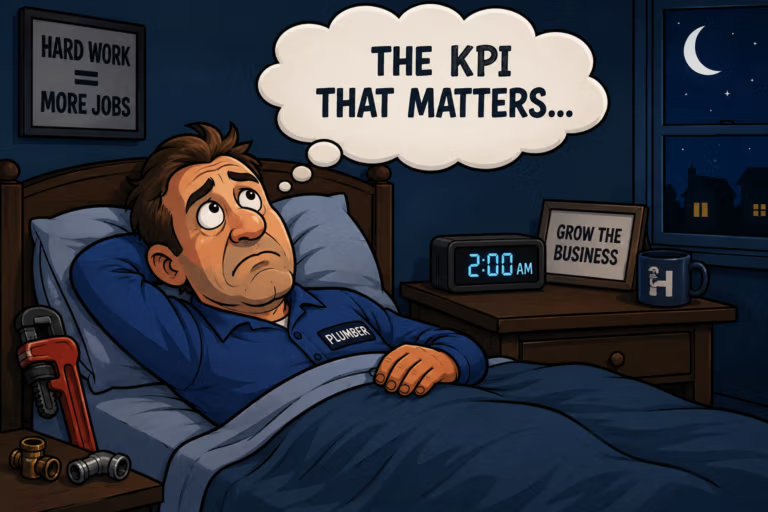
If there is one number every plumbing owner should think about at 3:00 a.m., it’s Quote Turnaround Time. Faster quotes lead to faster decisions, higher close rates, better truck utilization, stronger cash flow, and ultimately more revenue.
Jim Lusardi Podcast_1
Paul Benton: If you’re a plumber or a friend in the trades, you’re in the right place today. My guest at the table is Jim Lisardi. He is a business process consultant that has more than 20 years experience working with franchises and home service companies on optimizing internal processes to get more from their operations and more profit out of their operations.
Paul Benton: And I’m very glad, Jim, that you are here and that you can share today. The mission is your five favorite KPIs. You are yourself a COO. Correct. I am a marketer, and I depend on people like you to make sure that the organizations that we send leads to are actually acted upon. So I… It’s a great pleasure to have you at the table today.
Jim Lusardi: So much, Paul. It’s re- It’s an honor, a pleasure, and, uh, and I’m really excited to, to jump in.
Paul Benton: So tell us a little about yourself and your background. Go ahead.
Jim Lusardi: Sure. Thank you. So I spent my career leading operations across franchise and home service businesses. Earlier in my career, I led operations supporting 40 and 50 franchise locations.
Jim Lusardi: And a bit more recently, I led a network of 250 electrical contractors across 10 states, and I’ve been responsible for P&Ls, field ops, customer experience, as well as just the general execution for the company. And what I’ve learned is, whether it’s roofing, electrical or even professional services, the operational challenges are quite similar.
Jim Lusardi: To me, it starts with ownership. People need to know exactly what they’re responsible for, how success is measured, and from there, ownership creates accountability. And companies that, that consistently outperform aren’t working harder. They just have better systems, better visibility into team performance and accountability.
Jim Lusardi: So that’s just a bit about me.
Paul Benton: So you have, um, selected five KPIs out of so many-
Jim Lusardi: Yes …
Paul Benton: that you’re gonna take us through, and, uh, before we go through them in, in detail, how did you pick these five? And at the end of our conversation, we’re going to share with, um, our plumbing company audience here, which is the one that they should think about at 3:00 in the morning.
Paul Benton: So how did you pick these fives that we’re gonna go through out of so many? What… Why are they important to you?
Jim Lusardi: Yeah, I mean, uh, really there are dozens of KPIs that an owner can track. But owners n- really just need a handful that tells them that my business is healthy. And I chose these five because, for me, they tell the story of the entire customer journey, from phone call to the end result And so I’ll tell you the five I chose.
Jim Lusardi: So number one is customer satisfaction. That tells you how customers feel about their experience. Speed to lead, that tells you how responsive your business is. Just as important, revenue per truck, that tells you how effectively you’re using your capacity. Accounts receivable, how efficiently you’re converting that completed work into cash.
Jim Lusardi: And callback rate, that tells you the quality of your work and where your processes need improvement. And, and the last thing before we move on, to me, these are all connected, right? So if you improve, quote, “turnaround time,” you improve customer satisfaction. If you reduce callbacks, then you improve technician capacity and revenue per truck.
Jim Lusardi: And if you communicate better, you can improve collections and customer satisfaction, referrals. So I don’t see these as five separate KPIs. I just see them as five indicators that tell me the entire system is functioning and functioning well.
Paul Benton: That’s great. Uh, I’ll start with just a little story before we go through them, and maybe, uh, to warm up, you can give some feedback on it.
Paul Benton: So we just installed a fence, uh, my neighbor and our… and our, and our family. And the fence l- we’re happy with the quality. Everything was good. And then I, uh, this fence was installed weeks ago, and to this day, we cannot seem to get from this large fencing company, not a small operation, they’ve got over 1,000 Yelp reviews, to send us a split invoice, and it has come down to an odd dispute with their billing department.
Paul Benton: And I am in the unusual position of sending what I call to be a reverse collection letter. I’m, like, demanding an invoice because I know this is going to become awkward if they don’t get back to me, but for, like, nine months from now. I wanna take care of this now. And so I wrote the owner, or I wrote in a letter, and I said, “Surely your owner cannot possibly think this is the right way.
Paul Benton: Uh, he’s a smart guy. Does he know about this?” And I asked them to forward my email to the owner, and I cannot get but begrudgingly an answer back. And your first KPI here is customer satisfaction, and going through my mind is I am not the review kind of person. I like to… I’m old school. I’ll pick up the phone and let you know.
Paul Benton: I’m not gonna l- I’m d- I do not complain in reviews. But it did cross my mind, this is the problem with customer satisfaction. We’ve got, at this very moment, at the last link of the chain, it broke down. And maybe you could unpack, not my story, but how a, a big operator should think about customer satisfaction.
Paul Benton: Why is that such an important indicator, and where does it break down?
Jim Lusardi: Yeah, so that’s an interesting story. It’s an, it’s an unfortunate story because it sounds like they had everything right up until the very end, right, right before that closed. You know, and like I said earlier, uh, customer satisfaction tells the business if your customers are happy about their experience, and it sounds like you were very happy up until the billing moment.
Jim Lusardi: And as you were speaking, I was thinking this next statement: Will you refer your friends and family? Well, no And so I’d rather see a company improve from, say, 82 to an 86 CSAT than obsess over whether someone else is at a 94. In my book, it’s that continuous improvement that matters more than chasing an arbitrary number of, of where a company believes they should be, right?
Jim Lusardi: If they’re taking all the right steps, then that cus- customer satisfaction number will take care of itself, and it’s just a matter of time.
Paul Benton: Let me jump in, Jim. Yeah. What is a CSAT exactly, and how do you calculate it?
Jim Lusardi: So CSAT or customer satisfaction is just… is, is a score, score based on surveys received from a company based on the customer’s experience.
Jim Lusardi: And so, you know, for example, when I was at Chimera leading 250 electrical contractors, I improved our customer satisfaction to a, a 9.4 out of 10, which is, for the s- especially for a service industry, that’s extremely high. And I was, uh, and I think it comes from my days in franchising, you know, just obsessed over Operating procedures and doing things the right way, whether that customer is in New Jersey, whether they’re in Florida, they should have the exact same experience
Paul Benton: So, sorry, do you me- do you measure it with survey data?
Paul Benton: How do you get a CSAT score?
Jim Lusardi: That’s correct. You measure it with survey data.
Paul Benton: Do you have a platform that you recommend? So I mean, there are platforms out there like Podium that have b- business surveys as, uh, I think in their premium level. You can ins- instead of, uh, a review, if I understand correctly, you can opt for sending out surveys.
Paul Benton: Is that what you mean?
Jim Lusardi: That’s, that’s exactly what I mean. Yes, and, and we would send surveys with just maybe three questions at the most. I mean, I’m a consumer. You’re a consumer. I don’t wanna take 10 minutes answering questions about my experience. Like, was I happy? Yes. Will I refer friends and family?
Jim Lusardi: Yes.
Paul Benton: Is CSAT something that you send out continuously or only in batches sort of as a asset test?
Jim Lusardi: I send them to every customer.
Paul Benton: So this is kind of important. So at the conclusion of a job, as a marketer, we recommend what you really want is the Google score. That’s number one. Then you wanna go for the Yelp score.
Paul Benton: And for reasons we can discuss, uh, a Yelp review is worth more and harder to get than a Google review. But it… From the marketing world, that’s the ballgame. But in fact, from your world, you want a different instrument than a public review. Can you explain that?
Jim Lusardi: I like both. I like both Google review, Yelp, as well as the customer satisfaction score Right?
Jim Lusardi: It’s… I’ve worked with companies that have thousands of five-star Google reviews, and that is something to be celebrated, right? And, you know, and I’ve worked with companies to, you know, where a link for the Google review is automatically sent to the customer, so the customer can automatically, i- immediately upon the, the completion of the job, they can submit their review for the company.
Paul Benton: Are you sending two communications then? At, at the completion of a job, are you sending a review solicitation and a CSAT survey- Yes … or are you… How… So they, you get two pieces of, of information that go out-
Jim Lusardi: Correct …
Paul Benton: at the same time or, like, spaced apart?
Jim Lusardi: They’re b- they’re spaced approximately two weeks apart.
Paul Benton: Okay. What, what software… Do you have a software r- uh, platform that you like that does CSAT?
Jim Lusardi: Uh, actually, uh, uh, Podium.
Paul Benton: Podium is your, is, is the one you, you like? Okay. And how would you say is the Google review score a s- a substitute for CSAT? What do you get from a CSAT that you can’t get from looking at your Google reviews?
Jim Lusardi: CSAT is, is of m- a more internal data that we use, you know, and we use it to spot trends. Um, Google review is obviously is, is more, is, is just as important, but it’s a good public-facing, um, metric to show customers and potential customers how we are doing and, and how we are perceived in the public.
Paul Benton: And, and Jim, do you have just to sort of, before we move on to the next one, the next KPI, do you have sort of like what is the big misconception or mistake that a big company makes with CSAT, that they’re either overlooking…
Paul Benton: What’s the, what, what’s the opportunity that they, that they have to improve that you’ve seen in your 20 years?
Jim Lusardi: Yeah. I would say CSAT or customer satisfaction can improve operations. Google review, that helps measure your reputation in the community Similar, but two different things. And as long as the company’s looking at both on a regular and consistent basis, then again, the numbers will take care of themselves.
Paul Benton: And let me take one, one more question here. So what’s a typical CSAT question versus a typical… Well, a typical Google review question is how likely are you to refer us to a friend, and then is a request for the star rating, and then an open-ended how do we do format. A CSAT is more specific, correct? So what are you asking in a CSAT that you can’t typically ask in a Google review setting?
Jim Lusardi: We do ask if they would refer friends and family. We do ask for feedback such as is there anything that we could have done better? And we’ve received incredible feedback from asking that question, which we were surprised at. You know, improved communication. They would call out specific tech names and say, you know, “John was fantastic because not only did he clean up the workspace, he explained what the problem was, what he did, and what, uh, what the homeowner can do for preventive maintenance to keep this from happening again.”
Paul Benton: Okay, so is it, is it fair to say that a g- that a Google review is more open-ended, and a customer satisfaction survey allows the business owner to go in and query something specific that he’s testing for so that he can h- hyper-focus on improving that one thing? So it’s a different tool, and that’s why you wouldn’t substitute your…
Paul Benton: You wouldn’t, you wouldn’t rely only on Google reviews because you can’t learn from them as well as you can from a CSAT. Is that fair?
Jim Lusardi: That’s-
Paul Benton: Am I right about that?
Jim Lusardi: That’s exa- ex- exactly correct.
Paul Benton: Okay. All right, so that’s, that’s the first KPI that you focus on. Speed to lead, that’s important in my world as a marketer, but tell us why is that, uh, important to you?
Jim Lusardi: It’s really, it’s the time between a customer raising their hand and the company responding. And so it starts with the first phone call, the web form that they completed, and ends when someone has contacted the customer- Listen to their situation and sets clear expectations
Paul Benton: And what, um, so I, I can give what we see off from the marketing end, but what are you seeing from the operational end as the optimal response time?
Paul Benton: Lead comes in and until the job, each of those chains, how fast do the elite operators do it?
Jim Lusardi: During business hours, within minutes. Every company I, I work with, I always say, “Listen, I’m a consumer. I have contractors in my home, whether it’s plumbing or electrical, and if I don’t receive a response, then I go to the very next person in that Google search.”
Jim Lusardi: Right? I have a problem, whether it’s a leak, electrical panel, and I want it resolved immediately. And so, you know, that’s what I tell the company. Think of it as re- as lost revenue and that you’re just helping out your competitors.
Paul Benton: W- I’m often encountering older school plumbers who say, “If somebody can’t wait around a half an hour to hear from me, they probably aren’t wor- worth working with anyway.”
Paul Benton: What is your response to that? How do we, how do we shift that mindset to the reality that in today’s lead channels, Yelp, for example, the fastest response time that Yelp will badge you with is 10 minutes, but that’s just as a courtesy. Because in reality, the speed to lead systems are responding within seconds.
Paul Benton: Yeah. And it’s a horse race to get them into conversation. But how do we convince, uh, s- successful operators who say, “Hey, if they can’t wait for me for a half an hour, that’s okay”? Is it just, “Hey, you’re just gonna take a big revenue hit”? What’s the answer?
Jim Lusardi: A slow response isn’t just a customer service problem, it’s lost revenue, right?
Jim Lusardi: And, and I understand, you know, something may come up in your day-to-day where you’re unable to return a phone call or look at that web form that was just sent in, but it’s doing the right things on a consistent basis every day, and that’s what makes a difference for average companies and elite companies
Paul Benton: And I think one thing that I’ve encountered, uh, do you see it as well?
Paul Benton: There’s a sensitivity about, well, we don’t wanna import technology and AI because it’s going to pressure our staff or, or make them feel like they’re gonna be, uh, uh, laid off. But in fact, these technologies are leveling up because you… if you don’t have them in your shop, your… the plumber down the street is, and it’s just making your, your CSRs, your, uh, people answering the phones able to go at faster speeds, at light speed.
Paul Benton: So do you wanna be the one that is the last to return a call rather than the first? Are you seeing any particularly good AI solutions that you’re using or recommending for this speed to lead?
Jim Lusardi: We’re, we’re currently doing that now at this roofing company where we’ve actually just begun to implement AI to record phone calls for automatic upload into our CRM, which is JobNimbus.
Jim Lusardi: And then we can easily tag the appropriate crews for faster dispatch The next thing that we’ll be working on is scheduling, and, and we’ll be doing that scheduling based on average job time, the crew experience, traffic. And so instead of customers waiting days or weeks to get put on a schedule, we can notify them immediately when their scheduled time is for us to come out and help them.
Jim Lusardi: I… This is, uh, I don’t see AI as replacing the entire office staff. I seeing– I see it as changing the work that they’re doing and increasing the value that they provide on a day-to-day basis.
Paul Benton: Have you experimented with… I’ve encountered this, um, there are technologies out there that will do an instant video connection on the theory of race to face.
Paul Benton: So when others are trying to get you scheduled for an estimate, other companies are doing an instant video link and are already engaging in a sale. So you travel as, at, at the speed of light, you’re immediately in a video with the customer. Is that something that you’ve seen? It’s, it, it, it’s beginning.
Paul Benton: This is not ubiquitous yet, but I’ve, I’ve seen examples of this. Have you encountered that before yet in the wild?
Jim Lusardi: Yes. I, I’ve seen examples of it. It’s not something that I’ve implemented yet. It’s intriguing. You know, thinking about it from a, a consumer perspective, I, I’m going to, to wait until I have a bit more data o-on the, on how it works for the, for the entire customer journey.
Paul Benton: And ol- older school plumbers are… And there’s some franchises out there that teach the goal is to get where, so if the more modern way is race to face, if I’m the first to have you eye to eye and I can, I can engage you in a negotiation, that’s an advantage. But that’s in direct tension with the older school way of doing it, which is race across the threshold.
Paul Benton: If you’re the first plumber across that threshold, you’ve won the deal because people are reluctant to shop around once you’re in the home. They just want it over with. And it’ll be interesting to see how this plays out I’m hearing real changes, uh, in, in the folks I speak to from today than I did a year ago.
Jim Lusardi: Yeah. B- between prioritizing leads, you know, summarizing, uh, a call, routing jobs, um, you know, it should not replace the human element. I think it would just helps increase the efficiencies, provides data on a much quicker basis. So really it’s, it’s exciting what, what it can, what, what it can, can do right now.
Paul Benton: So your third KPI, Jim, on, on these, uh, on this parade of champions of five. Revenue per truck. How are you, um, thinking about that? And it’s gonna be different for different industries, but-
Jim Lusardi: Correct. Yeah. Yeah. So i- if total revenue increases, I want to know why. Was it because we added trucks? Did we increase prices?
Jim Lusardi: But revenue per truck really answers a different question. Are we becoming more efficient with the resources that we already have? You know, and, you know, when, when I get into revenue per truck- You know, the, the, the question next is, okay, so what’s a healthy target or where should a company be at? You know, I, I wanna focus less on comparing yourself to another company and, and improving that trend over time.
Jim Lusardi: That’s… Again, to me, that’s the most important piece for revenue per truck.
Paul Benton: And what’s usually limiting the revenue per truck? For example, um, in plumbing, there are excellent companies out there that do inventory management, and the idea is that if you’re on the way to a home and you realize you’re missing that one…
Paul Benton: You have one screw loose that you need to make the whole system work, you’re off to Home Depot and you’re just blowing your… The gas is the least of it. You’re blowing your next, um, the next job. How do, how are you seeing that in what home service operators should be thinking about inventory management?
Jim Lusardi: Yeah. It’s, you know, you’re waiting on parts or missing parts, s- poor scheduling, uh, excessive drive time, customer cancellations. It’s really just too much non-billable time. So there are a l- a lot of factors that go into it, you know, a- and that’s why having all of these s- components, you know, operating at, at its highest peak, highest efficiency, then n- that…
Jim Lusardi: then you’re just increasing the revenue per truck over time. So, you know, operate- owners may not realize how much impact scheduling parts inventory has. And so, you know, when I work with companies, it’s are we having a, a 15 or 20-minute meeting in the morning before crews go out for the day? Let’s look at the eight jobs I have.
Jim Lusardi: Do I have all the parts on the truck? Have we confirmed with the customer that they’re scheduled for that particular day? Great. Then I see efficiency for that, for that particular truck. If there’s one technician that doesn’t do that or is missing parts or hasn’t confirmed, then that’s, that’s a training area right there
Paul Benton: So let’s hop over to your next KPI, which is accounts receivable.
Paul Benton: I told you about the fence company that’s- Yeah … of its own volition is already getting close to 30 days because they won’t give me an invoice, even when asked. I heard about a gas company, uh, that, uh, fills up propane tanks that got a whole neighborhood upset because they realized they forgot to bill for a year, which is just staggering how y- that could occur, and suddenly the homeowners got gigantic bills after many months that it, that, and, it, that caused an uproar.
Paul Benton: How does something like that happen? What is amiss in the company to make the accounts receivable just unravel like that?
Jim Lusardi: Every person in the department thought the other person was handling it, right? It, you know, in the beginning when we first started, I mentioned ownership. Right? So if you have ownership in a company and you’re telling each person what they’re responsible for a- and how they’re being measured, then that doesn’t happen.
Jim Lusardi: And regarding ARs, cash pays payroll and revenue doesn’t, and so I want predictable ARs. I want no surprises, as little aging beyond 60 days as possible.
Paul Benton: What is your feeling… And, and there’s, there are restrictions in contracting. You can’t… How much can you, should and can you legally bill in advance? It varies by state as well, but what’s your, what’s your gut on that?
Paul Benton: Wouldn’t you wanna have, before you do a roof for example, wouldn’t you wanna have half down?
Jim Lusardi: Uh, uh, y- correct. I, I d- I would, and I do. And one thing that we started, we implemented about two weeks ago, maybe three weeks ago, is we’re taking credit cards up front for all residential work, residential repairs If we do not receive a credit card, then we’re unable to schedule that appointment.
Paul Benton: Do you charge the credit card, or do you just, do you just have it on file?
Jim Lusardi: We h- we have it on file until we come to an agreement on price and terms, and when the work is complete, then we have a credit card on file that we charge, unless the customer want, wants a, a different payment form.
Paul Benton: So what do you r- what do you say is healthy, are healthy, a, how many days AR is really acceptable, and what should, what should you be shooting for?
Jim Lusardi: I think 30 to 45 days is acceptable. Anything past 60 is, needs work.
Paul Benton: And what stops the, um, what stops for requiring payment the, the day of completion? Payment in full is due when we have completed the job. And what do you think accounts for the fact that it goes 45 and 60 days, and there isn’t a fire alarm after 10?
Jim Lusardi: From the work I’ve seen over the last month, that there are four people in this department, and each person thought the other one was handling collections, and so it just wasn’t getting done. Invoices weren’t being sent. I’m, I’m seeing ARs from five months, eight months, two years ago. And so I came in and said, “Okay, credit card’s up front- We appointed one person to call f- for collections.
Jim Lusardi: And another piece that we’re doing is we’re automating invoices too. As soon as the job is marked complete, invoice is sent out.
Paul Benton: Makes sense. What would you say is the biggest cashflow mistake that operators that you work with are making that, uh, we should think about, the audience should think about?
Jim Lusardi: Collect payment up- upfront or upon completion, clear communication about charges, automate follow-up, and review your aging on a weekly basis.
Paul Benton: This is a small but important point. How are you seeing your clients handle credit card fees? Are they charging a convenience fee? It’s becoming widespread now in California all over.
Paul Benton: How is it… How are you seeing it?
Jim Lusardi: I’m seeing credit card fees for larger amounts, say, over anything over $10,000 gets a credit card fee. Many home service companies, I think it’s becoming more and more common, offer financing, right? It can improve cashflow. Financing gets contractors paid faster. They’re also offering ACH options.
Jim Lusardi: So I think with different options that you can give customers, they’re more likely to say, “Okay, if this contractor can work with me, I can work with them.”
Paul Benton: Let’s move on to, uh, your fifth, your, uh, your fifth KPI here, callback rate. What is a callback rate?
Jim Lusardi: A callback rate is any return visit to correct or complete work that should’ve been resolved on the first visit.
Paul Benton: Okay. So are the, the, w- the callback rate can be reduced presumably if you had good communication upfront because it isn’t that people are, uh, out to get each other. It’s mostly that they don’t understand each other when they made the deal.
Jim Lusardi: 100%.
Paul Benton: How exact… And, you know, you could have a contract, but a contract isn’t…
Paul Benton: To a long-term customer relationship, a contract isn’t what makes the relationship. It’s good communication. And if you have big, thick contracts that people don’t read, you’re, you’re in a, you’re in a difficult position. How do you, how do you reduce the callback rate in your practice?
Jim Lusardi: Understand why they’re happening in the first place.
Jim Lusardi: While the percent, the callback rate percentage is important- I’m focused on why they’re happening. Because to me then knowing that why can, can bring improvements in training, in preparation. You know, is it, uh, related to a specific technician? Okay, that’s, that’s easy. That, you know, we can have a one-on-one, we can assign a mentor, a more experienced, a veteran technician to help out.
Jim Lusardi: So this is all solvable, but it’s just asking why until we can get to the root of it.
Paul Benton: So for the clients you work with, what is the, what is the benchmark callback rate that you’re looking for? Out of 100 jobs, how many should you be called back on?
Jim Lusardi: Again, I, you know, I’m, I’m focused on is it a training issue?
Jim Lusardi: Is it preparation? You know, is it communication, whether from the technician or from the office staff So I’m, I’m looking at continuous improvement and less about the percentage.
Paul Benton: So that means, uh, any callback rate is unacceptable. You, you wanna actively work at reducing it and optimizing the processes to prevent it.
Jim Lusardi: Cor- correct. A- a- and it’s something that we talk about on a weekly basis, right? We have, you know, Friday meetings where we discuss what worked well, where we had some opportunities for improvement, and that’s everything from callbacks to dispatch to ARs. I g- I get highlights from every department lead, and everyone has a voice.
Jim Lusardi: So whether you’re a technician, office manager, the owner, I wanna hear feedback from everyone. I mean, in, you know, in prior roles, I was in the field with contractors, with franchisees. I took feedback from those on the front line because they’re seeing… They have a different perspective than maybe I do or the owner.
Jim Lusardi: And so everyone, everyone’s feedback is valuable to me.
Paul Benton: That’s, that’s important. You wanna do some, uh, quick rapid fires here? Just what comes to mind. Don’t think too deeply about it. What’s the most underrated KPI?
Jim Lusardi: Uh, quote turnaround
Paul Benton: Quote turnaround. What’s the most overrated K- KPI?
Jim Lusardi: Revenue.
Paul Benton: What’s the biggest operational mistake that you’re seeing people make?
Jim Lusardi: Running the business from memory instead of systems and metrics.
Paul Benton: If you had to recommend one book, what’s the one book that every service owner should be reading?
Jim Lusardi: The Goal or Traction.
Paul Benton: Who, who wrote The Goal? Do you know? Do, do… The Goal or Traction.
Jim Lusardi: Yeah. It, uh, it, it escapes me, but those are, it… Please, highly recommend them.
Paul Benton: And what’s the one habit that celebrate, that separates the elite from the pack? What’s the one-
Jim Lusardi: Yeah …
Paul Benton: the habit?
Jim Lusardi: Weekly review with leaders, with its entire team. Reviewing what worked well, what didn’t, where we have room for improvement.
Paul Benton: And when you come to the office to w- to your, um, client to, uh, on the next day.
Paul Benton: If you could, if you go to the office tomorrow, what’s the one metric that you want to improve?
Jim Lusardi: A quote turnaround time. And the reason why, faster response, happier customers, higher close rates, better truck utilization, better cash flow, and ultimately more revenue.
Paul Benton: So that might be the answer to the next question I have, which is the one we started with.
Paul Benton: It’s 3:00 in the morning and the plumber is awake thinking about his business. What’s the one metric that he should be thinking about as he’s up at 3:00 AM?
Jim Lusardi: Quote turnaround time.
Paul Benton: Quote turnaround time. Awesome. Jim LaSardi, thank you for being at the table here, and we’ll see everybody on the next episode of the Plumbing Marketing Success Podcast.
Jim Lusardi: Thanks so much, Paul. Appreciate you.
Schedule a free consultation with our team and let's make things happen!