Call or Text
Host: Paul Benton
Guest: Josh Lam
Questions?
About Guest: Josh Lam
Founder
Casey Response AI
Josh Lam is the founder of Casey Response AI. He spent nine years working inside Yelp and has more than 15 years of experience across sales and software development.
About Host: Paul Benton
President
PipeWrench Marketing
Paul Benton is the founder of PipeWrench Marketing, a marketing agency dedicated exclusively to helping family-owned plumbing companies grow through better lead generation, local search visibility, artificial intelligence, and customer acquisition systems. Through the Plumber Marketing Success Podcast, Paul interviews leading experts from inside and outside the plumbing industry to uncover practical strategies that help contractors generate more calls, book more jobs, and build more valuable businesses.
Connect on LinkedIn
In this episode of the Plumber Marketing Success Podcast, Paul Benton speaks with Josh Lam, founder of Casey Response AI.
Josh spent nine years inside Yelp and has more than 15 years of experience in sales and software development. He brings a unique perspective on how plumbing companies can turn Yelp inquiries into real conversations and booked jobs.
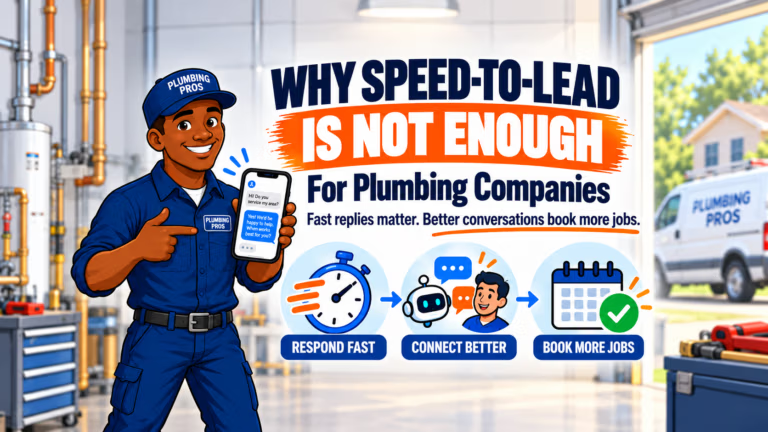
Speed-to-lead is now the minimum expectation. The real advantage comes from responding with empathy, asking the right questions, following up effectively, and connecting qualified prospects with skilled humans.
AI should make human conversations faster and better — not eliminate them.
For plumbing companies, Yelp success is not simply about generating more leads. It is about creating more meaningful conversations and converting more of those conversations into booked jobs.
Casey Response AI helps home-service companies respond to and engage with leads more effectively. It uses AI to support faster, more consistent communication while helping connect qualified prospects with real people.
Yelp users often contact multiple businesses at once. A fast response increases the chance of starting a conversation before the customer chooses a competitor. However, speed alone is not enough. The response must also be helpful, personal, and relevant.
No. AI can help respond quickly, ask initial questions, follow up, and identify serious prospects. The goal is to make human-to-human conversations happen more often — not to replace them.
Companies should track connected conversations, qualified leads, booked jobs, cost per booked job, and return on ad spend.
Speed-to-lead means responding quickly.. Speed-to-yes means using the conversation to build trust, understand the customer’s needs, answer questions, and moving the prospect toward booking. Humans beat AI at this because humans connect with empathy and human understanding.
Paul Benton: If you’re a plumber or a friend in the trades, you are in the right place. At the table today is Josh Lamb. He is the founder of KC Response AI, an AI-powered lead response and booking platform built for home service businesses. He brings more than 15 years of experience in both sales and software development, including nine years on the inside at Yelp.
Paul Benton: He has also held roles at Google and Talkspace, and completed training through the Harvard Business School online program. After watching contractors invest thousands of dollars in advertising only to lose opportunities because of slow responses and missed follow-up, Josh founded KC Response in 2024.
Paul Benton: The platform helps plumbers and other home service companies respond to leads within seconds, create human-to-human conversations faster, and has an AI that, if you want, can do all the talking if you want it to. Josh, welcome to the table. Excited to talk to you today.
Josh Lam: Yeah, Paul. Thanks for having me.
Paul Benton: So Josh, you spent nine years at Yelp.
Paul Benton: What do plumbing companies– Let’s start with, with your experience at Yelp before we get into how that experience inspired you to build what you did. So you spent nine years at Yelp, and what can you advise now that you’re an outsider, having been on the inside? What do most plumbing companies fundamentally misunderstand about how Yelp works?
Paul Benton: Boy, they get angry about Yelp.
Josh Lam: Yeah, definitely. I mean, I’ve had the review conversation plenty of times, and I think what’s funny is that usually the people that have the best reputations are the ones that are the most upset with Yelp. So… But I mean, I, I don’t think that, I don’t think that they’re getting anything wrong in that.
Josh Lam: I can understand if somebody writes something bad about your business, how that’d be hurtful. I think the part where they don’t think about Yelp is the lifetime value of each customer that finds you on there. So a lot of plumbers I think, think like, “Hey, here’s a lead. Here’s my chance to get business,” and they just wanna get that business once.
Josh Lam: Um, but if you have a great relationship with that customer, not only can they continue to buy services from you and continue to upgrade, but they’re pretty well-connected within their own local environment. So I think that’s where they, they look– they miss it, is they look at the advertising, they think, “I need to immediately make a return on this customer data now,” uh, when they could be using that customer, like, for decades, honestly, for the life of their business.
Paul Benton: And I might add one thing. Uh, plumbers, other home service folks are really kind of irritated about the Request a Quote feature, that they say people don’t call them back, they can’t respond fast enough, they’re not serious, they’re tire kickers. But what, um, I encourage every home service pro to do is the next time they h-have a non-trade need, go through Rack and notice what an incredibly good user experience it is.
Paul Benton: So the end user, it’s a delightful experience because from one interface you can immediately get the best deal. But it does put the contractors, uh, on their heels if you don’t know how to engage with that correctly, and that’s where you come in. What does Casey do to solve that problem for contractors?
Josh Lam: Yeah, that’s a really good question. So at my time at Yelp, that problem that you’re talking about, um, from the consumer experience, Yelp’s doing a really good job of getting the, the user to answer the questions and get the relevant information over to the business. The biggest pain point, uh, and then I think this is probably a better answer to your question earlier, is that a lot of the business owners, and I can understand why, are not working those leads appropriately.
Josh Lam: Like, for example, a lot of these leads come in on nights and weekends, so most of these owners or these teams might be at home, they’re probably with their family. They get that notification. Maybe they’re at their dinner table and they’re like, “Oh, let me just respond,” and there’s grammatical errors and, or it’s late.
Josh Lam: Um, that is how your customer has their first encounter with you, and they judge how good of a business you are based off of that first message. If there’s a grammatical error or It’s just not done timely. They kind of evaluate your business as a whole just based off of that first interaction, which, you know, I can understand as a consumer ’cause I do the same thing, I’m at fault.
Josh Lam: But I can also see from a business owner’s perspective, like totally not reflective of who- how good of a business they are, and a lot of times they’re just so busy that they can’t respond to it. Um, but yeah, that, that is like low-hanging fruit. I… And, and what I found, I, I think a lot of people would say, you know, people don’t respond or, you know, these leads are not good.
Josh Lam: That actually gets me excited today because that is my key of like, perfect, this person’s gonna love Casey. Because Casey will be responding to those leads instantly as the person is filling out that form and submitting their information. So you’re the first one that people see, and no human can compete with that.
Josh Lam: The grammatical parts of it, also no human can compete with that just at that speed. And more importantly, I was there for close to a decade, so I kind of know what these customers are looking for and, and what they want to see in these messages. So we do a really good job of like first engaging the customer.
Josh Lam: That’s the first step. You’re not gonna close the deal on that first message. That first message is to make sure that they’re chatting with you versus the other four or five people that are messaging them at the same time. Um, I got another one. Another big mistake that I think a lot of people do is that everyone’s sending the same message.
Josh Lam: Like it’s– The worst one is, uh, “Yeah, what’s your phone number?” Or how can we– Immediately going for the phone number, and I think we had talked about this before of, uh, you know, get to know them first before you- Mm
Paul Benton: Well, the, you know, it’s funny how fast technology unfolds, where now it, it feels like ChatGPT was invented a decade ago, and it’s only been three years.
Paul Benton: So that, the world has transformed. Well, three years ago, in speed to lead, when nobody had a responder and you were the first to respond to ask for that, for that phone number, uh, you were cutting, uh, a new advantage for yourself. But now it’s table stakes. Uh, all the top operators, and you can see that by going, uh, through Yelp.
Paul Benton: You can see, uh, the big companies by and large all have a 10-minute response time, and in fact they’re, uh, responding within seconds. But now if they’re all saying the same thing, the question is how can you be different from the other four responses that have just asked, “Let me have your phone number”?
Paul Benton: ‘Cause that begs the question, if I wanted you to call me, I would’ve just called you. So now we’re in a different era where Casey has a conversation.
Josh Lam: Yeah, exactly. I mean, that, that’s the biggest thing is I think when you have a problem and you reach out to someone, you don’t want to feel like you’re in a s- a lead funnel.
Josh Lam: I mean, at the end of the day you are, right? Like you filled out a form, that’s the beginning of the, of the sales funnel. But you don’t wanna feel like you’re being sold and you’re being told, “Oh, I need to jump through this hoop to get my answer. I need to do this to get that.” You want it to feel conversational, and that’s really where Casey comes in.
Josh Lam: Based on my background, I know in tracking all these ads and, and the lead funnels, you want it to be helpful and engaging so that you want to respond to it. And as you have those conversations, and even for some small things where the plumber or the business, the home service business wouldn’t even wanna service that job, if it can just give them a tip- That’s way better and leaves a much better impression on that user that found you through that platform than saying something like, “Oh, we don’t service that,” right?
Josh Lam: So it’s, it’s the overall approach of having the ability to focus and have that conversation as if it was the only conversation you were having that day. Because we’re doing it through Casey, Casey has the time and the ability and the bandwidth to be able to have that conversation like that. I think a lot of business owners are like, “Here’s another lead.
Josh Lam: I need to close it. What, what, what’s the closing language?” Um, and then if you go into the more template, it is like, okay, what is the message that would work 70% to 80% of the time? I know it’s not gonna work 100% of the time, but let’s have it work for 80% of the public. Uh, and then you start getting that really generalized, unauthentic, really templated structure that turns you off as a, as a, as a consumer.
Josh Lam: You’re like, “Okay, I’m in a sales funnel. What’s the trick?” Okay. Like we– I think as consumers, we see all the ads. We know all the different experiences. We’ve done it multiple times. Um, so they’re just getting smarter, and I think that we’re… The conversational part of it and having the AI that, that powers it, it’s meeting the customer where they’re at.
Josh Lam: It’s me- it’s genuinely, like, acknowledging them, being, you know, understanding and then also making a recommendation and moving through. Uh, but that has to do with, like, what we put into Casey. It’s I know that you– I know how these leads work, and you can’t… They want the free estimate instantly, and then also you want information out of them.
Josh Lam: So it’s a fine dance that you gotta do.
Paul Benton: There are two things about Casey that are really interesting. One is it has an intuitively easy-to-train AI. So for, for folks watching this who may have taken the step to use Claude or ChatGPT for many, many months, you’ll notice how much it knows about you, and it remembers the previous conversations, and it starts shaping its ad- advice based upon your previous questions.
Paul Benton: Um, Casey, am I right, is designed a little bit like that, so that when you first onboard Casey, it’s might fe- it might strike you as a toddler, so don’t put it in charge of everything. But after you have spent time teaching it and raising it up, then the magic starts happening. Tell us about how that training of the AI works in Casey.
Josh Lam: Yeah. I think honestly, that is probably what has made us the best in the space is I know that Casey can’t be the same Casey for every business that we work with. The way I really view it is, you know, each business has its own style of communication, it has its own flow, it has its own goals. So I think a lot of people wanna just, like, say, “Hey, you’re a business owner.
Josh Lam: Go ahead and put a prompt in, and you manage all of that.” Uh, where we really do it is we have our technology that learns from your business and then reconfigures itself, so that way it is catered to you. So as you… We call them micro-trainings. So as you’re having these, as Casey’s having these conversations and you’re in the loop, you’re able to see kind of what’s happening, and you can give just, like, a one-sentence feedback, and that feedback goes and reconfigures Casey.
Josh Lam: And, and the way I view this is, honestly, think of Casey like a virtual assistant, really. You know, you have a virtual assistant managing some of your tech platforms, your tech assets. They make a mistake, you send them an email and say like, “Hey, this is wrong. Uh, can you do it like this next time?” The same idea, except it’s our technology that is making it so that a business owner, all I want them to do is log in, hit five buttons, and have Casey up and running.
Josh Lam: Anything more than that is gonna be too much work. However, when there is feedback to be given, that’s what we love. And, and they’ll do that, like, in a text message, or now they do just do it directly through Casey. So they, they can connect directly with Casey and just give Casey feedback, and it’s automatically taken care of.
Josh Lam: So there’s no middleman. They don’t need to, like, go to a settings tab and start changing and maybe guess that this is the fix. They don’t have the time for that. A lot of our business owners don’t even log in. They just let Casey manage everything, and all they do is just answer the call when Casey calls, ’cause they know that that’s, that’s a customer.
Josh Lam: That’s a potential l- you know, new business. Or new client, I mean
Paul Benton: That’s awesome. And there’s some, you know, the, it, it is a highly sought after space. There’s some great companies out there. There’s Avoka, and there’s Hatch, and there’s Broccoli, um, and there are several others. What I have noticed, uh, from my corner is that Casey has something called Instant Connect, and it sets it apart.
Paul Benton: Tell us about that.
Josh Lam: Yeah. So, you know, this comes from working with so many businesses in this space. I know that it can’t be, like, a templated approach, meaning that every business falls into the same line. Uh, so I actually spend time and, and, um, learn a lot about my clients, and it’s built around what they need.
Josh Lam: And the main thing that they need is just to know, when should I connect with a lead? So what Casey will do is it’ll be monitoring the conversations, it’ll be monitoring the interactions, and based on certain things, that’s when Casey will trigger the connection with the CSR team. So as long as the CSR team is answering Casey’s calls, then they will be improving their booking rate.
Josh Lam: So our real… I think the, the difference is a lot of people are trying to get AI to do everything, and, you know, maybe in five years I’m wrong on this approach, but I just don’t think it’s possible. I’ve played with a lot of these demos, and it’s just not great. Uh, I, I think the humans are extremely talented.
Josh Lam: They are smart. They are able to, like, think outside the box, so if a weird edge case comes up, they can come up with a solution. They could also press hold and lean back and ask their friend or talk to dispatch. So there’s, there’s a lot of things that, um, technology just cannot do, and that’s where I think the human-to-human connection is the most important.
Josh Lam: So our, our vision is we have a hot lead, let’s connect it with a human as soon as the human’s available, and then when they’re available, we connect the leads. And that is, like, where I think the AI has the biggest opportunity is letting the human know, “Hey, I should be spending time here and not here.”
Josh Lam: That, that, that is really where I think it should be placed, not in replacing roles. Like, it, it’s just at this stage t- ask me again in five years, but I just think it’s nowhere near that.
Paul Benton: So Casey has AI as robust as the others, but you actually have a philosophical pro-human kind of approach here, which is to say, um, you want to accelerate human contact.
Paul Benton: That’s where the speed-to-lead advantage comes from. Get a human talking to a human faster than the next company. The other technologies are saying, “Let’s go in for the booking faster and hop over the humans.” And I can just say from my own humble homeowner experience, um, when you get called by an AI and you ask it and it refuses to answer your question, you feel unloved.
Paul Benton: That’s basically what it feels like. And so there is an i- a thought, you’re onto something in my humble opinion, that let’s get humans talking to humans faster to win the race. That’s not saying that your platform can’t have the AI complete the full booking, but you’re choosing not to, uh, advise your clients to do that.
Paul Benton: You’re choosing to take the other fork in the road.
Josh Lam: Exactly, yeah. And I think it’s honestly the best way to do it, even if you want to go full AI. So I, I, in sales, I think there’s like three buckets, uh, with all these leads as they come in. There’s the people that’ll say yes no matter what. You could charge them 10,000 for a toilet replacement, and they’ll say yes, right?
Josh Lam: And then there’s people that are the maybe. They’re the ones that are still shopping around. They’re still trying to get the information. There’s the nos where you’re like, “Hey, we actually have a special right now. We’ll install it for free, absolutely free,” and for some reason they’ll still say no. So I think people fall into three buckets, yes, maybe, and no.
Josh Lam: The big– I think where a lot of people are thinking voice AI is doing well is it’s catching a lot of these yeses where the human would’ve crushed it. Like that is a no-brainer. The human would’ve done that easily. But it’s dropping a lot of these maybes, and I think that’s the real needle mover. The yeses are good if you don’t have like an automated system or some- something in place, like even like an overseas thing.
Josh Lam: Like they can handle yeses. The maybes are in place where it’s like, all right, this is a customer that needs to be persuaded a little bit more. They’re not gonna just, “Yes, I’m free tomorrow at 2:00,” right? Like that’s where the human really comes in and accelerates it, um, because they can have those conversations.
Josh Lam: They’ve been having it for years now, right? Some of them even decades. I, I know some of the teams that are at these companies. They’ve been there for a very long time, and some of them are ex, you know, technicians, and now they’re in the office. So that’s what we’re focusing on is we’re wanting to get, use AI to connect with the humans on the maybes so that then they can increase those, ’cause that is a much bigger bucket.
Josh Lam: Uh, and yes, what we can do if we wanted to is have the voice handle the yeses. The automatic yeses, great. Let’s get them through and have the humans focus on the maybes. But say that somebody comes in the yes bucket and we realize, “Oh, this is a maybe,” let’s connect a human in. Like why not say, “Actually, you know what?”
Josh Lam: And, and, uh Funny, when we started building out voice, I personally am not a fan of voice. Whenever I’m on the call and I automatically know it’s voice, I’m like, “Oh, great.” Um, and I just start saying, “Representative, representative, representative.” And then it does the loop until three times, and then it sends me to the, to the, to the human.
Josh Lam: Uh, so our approach- Mm-hmm … is the exact opposite, especially when you just paid for this lead. Like, why are you gonna roadblock them from connecting with your sales team? Um, so what we do is we have it so if they do ask for a human, it’s instantly transferring it to the human and then connecting them, or even the human could be noticing, like, “Hey, this is a, a potential thing that we could take over.
Josh Lam: Let’s hop into that.” So, uh, it’s a very, very different approach, but it comes down from my background of like, you know, relationship building and sales. Like, I’ve seen the technology. It is just not there, and that’s just, that, that’s just how I feel, and I think it’s my sales background.
Paul Benton: Let me put one observation on the table.
Paul Benton: So you’re in the business of connecting humans faster, but that presupposes that the humans that are connected look upon that connection not as a transaction, but as a opportunity to sell So if all you’re doing is having a human give a price quote, an AI can do that far better. But if you’re having a human speak empathetically, do a discovery, say to the customer, “Hey, it’s gonna be okay,” and give them some reassurance on their price to build a relationship, that I think when th- your system, w- if accepted by the operators as a sales empowerment tool, not merely a transaction accelerant, that’s the ballgame that they can win, it seems to me.
Josh Lam: Agreed. Yeah, and I think that is from a… That even goes more in how I don’t think AI’s gonna replace a lot. I know it’s against a lot of the popular memes and all that, but, you know, there is something about when you call a business and it turns out that the person you’re talking to, you know, went to your high school or lived in the area or is familiar with that, right?
Josh Lam: So that, that small, like, connection is being lost. Again, for those automatic yeses, who cares, right? But these maybes, pushing them over, you’re right. It- they need a little bit more sales talent, a little bit more conversation, a little bit more of a connection before they choose from the other five people, and probably all the quotes are about the same, so at this point, they’re really just choosing who they like the best, right?
Josh Lam: Um, so I think that’s where our focus is. And I almost feel like it will get to a point where having a human answer the phone is more like a luxury enterprise, like, “Hey, we’re so caring about our customers. We have real people answering the phone.” Um, I, I think it will continue to go that way as more people think that this voice will be able to solve all that.
Josh Lam: And what you said from, uh, you know, being empathetic and all, all those other things with voice, I actually know the technology is not there yet. So whether I think it’s doing well or not, the technology is just not there. I’m sure it’s being built in, you know, these platforms come out with new releases all the time.
Josh Lam: As soon as it’s there, definitely we’ll play with it. It’s just not there. It, it actually is not there. Um, but, you know, that’s where the opportunity is, is all these maybes. Definitely the yeses, like automatic, I can understand that, but you’re losing a lot of this, uh, ’cause you’re not getting your most talented person on the maybes that would have the highest conversion rate.
Josh Lam: So it’s a fun game, though. It’s fun because speech lead is like– was really cool two or three years ago. Now it’s more about, like, the conversation after speech to lead. Now I think it’s the connection, and I think the same thing is actually happening with voice. So voice i-ri- is right now is having that templated first message, first answer bump, ’cause they’re getting all those automatic yeses.
Josh Lam: But I think the next level is not gonna be the speed, it’s gonna be the value of that connection, and we’re just betting on the humans for, you know, the next five years
Paul Benton: I’m gonna bet on humans longer than that. But, uh, let’s, um, Josh, if we can, why don’t we, uh, drill down and explain Yelp a little bit?
Paul Benton: Because your kCAI powers, um, multi-channel, but Yelp is really what inspired it to get started. So maybe we can learn a little bit about how Yelp itself works. And so for example, when a homeowner requests a plumbing company, uh, quote on Yelp, how many contractors are typically competing for that same customer And how quickly does the plumber need to respond to have a realistic chance of winning, winning a job?
Josh Lam: Yeah, so I’ll… That’s, there’s like three answers in that. So the first one is it depends on what the person sets. I think by default it is set to send to about five or somewhere around there. Um, but if they uncheck it, it will go to just that business. But I think most people may not uncheck it, so it might be going to, um, around five.
Josh Lam: That’s assuming that they only do one request a quote and they only do it on Yelp, right? So it’s likely that these people are shopping around and sending it on, uh, a variety of places. So there’s probably a lot of people that just got this, this person’s information. Um, and then the second part, can you, can you remind me about the second part?
Josh Lam: So it was how many people are sending it. The second part was?
Josh Lam: How quickly does the plumber need to respond?
Josh Lam: The second part about how quickly does the plumber need to respond, today it’s seconds. If you’re not responding in seconds, you got no chance. Um, and it’s, it’s funny ’cause we get a lot of plumbers and businesses that reach out to us, and they’re like, “You know, I’m getting these messages, but nobody’s responding to me.”
Josh Lam: And I’m like, “All right, I know what the problem is. We’re gonna help you out. Like, how… Let’s just pull up your inbox. What was the time gap?” And really, if they’re not responding in seconds, it’s, it’s a done deal. That’s error number one. Error number two is they’re not following up. So maybe they weren’t the first to respond, they’re doing it manually.
Josh Lam: Their next bet, best chance is hopefully that person didn’t start engaging with the person that first responded. So maybe they filled out the form and they put their phone away, they didn’t even see any of the responses, right? And then they go to work and, uh, so the, the speed delete, you know, for the most people it won’t matter, but say for the other set it doesn’t matter.
Josh Lam: If you can follow up like an hour or two hours later, you might be the one that bumps that notification. Like, “Oh, that’s right, I sent out this message. Let me go ahead and see. Oh, this guy’s at the top.” Right? So think of it as like a moving inbox. The moment the forms fill out, you wanna be the first one in their inbox.
Josh Lam: And then if, you know, you aren’t and time goes on and something else happens, you wanna bump yourself back up to their inbox and be at the top. So I think it’s two parts. One, the first, how fast can you respond? Instantly. Uh, and then secondly, if you aren’t the one winning that first race, then you should follow up and try to bump yourself up again.
Paul Benton: I think from, uh, recently I, I’d shared with you I, I, uh, needed to replace some toilets in my house, and so I have a fresh experience as a, on the, uh, not as a marketer in this case, but as a homeowner in the market. And I can say what was amazing is that I, from the chair I’m sitting in right now and in this position, after I pressed send on request a quote, to before I hit the back of my chair, my phone was already ringing, and it was ringing by an AI, which, uh, actually was out of bounds.
Paul Benton: That kind of breaks the rules, but it’s showing how quickly speed to lead happens, and that was the first contractor and the only one who called me right away. The rest responded, and I have that in my, uh, uh, project. I can see all the, the, all four gave me a message within one minute. So for our plumber friends out there that are thinking, “Ah, people can wait.
Paul Benton: I’ll call them the next day or 30 minutes later,” um, the private equity owned companies are all using technology that are competing with each other, and all of them are responding within one minute. So it isn’t one minute or five minutes, it’s seconds because that’s what everyone is doing. Isn’t that true?
Josh Lam: Yep. Yeah. And we, and we have some of those clients as well, so it’s, it’s no longer a, um, this is a nice to have. It’s o- it’s an expectation. And I think because of that, you know, two or three years ago I would say different. It was like, “Hey, this is like you’re the first in the…” And I remember looking at, uh, response times when I, you know, when I was looking at, oh, who could benefit from this?
Josh Lam: There was so many people that were like two hours, one hour, even like a day. Uh, I was like, “Oh cool, look at this groundbreaking thing. We could change that to a day.” And, and the impact was instant. But it seems like the wave has caught up and that’s where we’re moving on to the next wave, which I think is the instant connect, where we’re getting the humans connected to the customer at the moment they need it.
Josh Lam: Um, and that’s again, we’re seeing the same surge again, and I, I think we’ll, we’ll probably ride that, that wave as well. So it’s, it’s instant. You- if you’re not doing instantly, you’re not, you’re not even being considered probably.
Paul Benton: And this is just my observation, I could be wrong about this, but the battle lines now are about empathy.
Paul Benton: So everybody’s sending that first message in 60 seconds. That’s not really impressive anymore-
Josh Lam: No …
Paul Benton: if you’re sending a message in 60 seconds. But what you say in that first message is where really good copywriting, good salesmanship, good person-to-person relationship building comes into play. Um, what’s exciting about casey is that it has, if I’m correct, the flexibility to let the operator play that game.
Paul Benton: You can decide you wanna be first to ask for a number, or you can decide to do it differently. But it ha- is that correct, that casey is really not merely in speed to lead, but it’s also in conversational quality?
Josh Lam: Yes, exactly. Yeah, that… It has just grown and improved. So as we became the first in speed to lead, then we realized, okay, well, why is this one doing better than the other ones?
Josh Lam: And say, okay, it’s these types of conversations. And, and I think the issue that people are having is they’re trying to solve the whole problem all at once. And the way that it really works is if you can solve… If you can break up the problem into little steps and teach casey to solve those little problems, then you can, um, win, win the appointment.
Josh Lam: And I, and I think with AI, you’re able to take that type of care with the customer on every single message, on every single conversation nonstop because there is no bandwidth to the technology to be able to com- uh, to communicate with them. So, like, imagine your best rep taking the time to understand the customer’s needs and follow up with them.
Josh Lam: That would be the same thing that you’re doing there, but it’s being taught by you. So as casey is doing what it does, you’re in there and you’re giving it the information, little micro trainings, and those micro trainings is what’s turning it into someone that’s been at your company a really long time.
Josh Lam: Uh, again, very similar to a virtual assistant, right? So if you’ve had a virtual assistant for a week, there’s gonna be a lot of things. Maybe there’s, like, a, a guidebook that they use and they go and follow and, and then after that, you know, they’ve… There for a month, so now they have stuff that’s outside of the guidebook, and then they’ve been there for a couple years.
Josh Lam: Now they have stuff that, like, is unique to your business, and no other business will ever have that. It’s not non-transferable skill. And that, that’s how we designed casey, is to be built in the same way. So for some people, it’s as simple as like, “Hey, can we just get the customer’s phone number and our team will call it?”
Josh Lam: For others, it’s like, “Hey, can you book this all the way through?” And it’s, “Hey, actually, this person hasn’t paid the invoice. Can you follow up with these leads and get them to pay invoices?” So it’s, it’s really just based off of what you need. You, you train it and build it
Paul Benton: That’s really interesting. Um, let me get your insights on what I perceive as a paradox in Yelp.
Paul Benton: It seems to be Yelp contradicting, um, the objectives of the customer, and it’s in the following way. When you are in Yelp and you are a user, you are prompted to get, quote-unquote, “pricing and availability.” And at the same time, the industry doesn’t want to give pricing. They’ll give availability, but they won’t give pricing.
Paul Benton: What’s going on there? Why is Yelp asking or prompting the customer to ask the, uh, plumbing companies to give something that the plumbing companies are trained not to give?
Josh Lam: Yeah, that’s a really good question, and I think one of the things like Yelp’s core principles is protect the source, and I think this is like a big, you know, a big potential change and shift in the market is that the consumers want pricing before they have someone in their home, right?
Josh Lam: So, and Yelp is aware of that, so it makes it easier for the consumer to go and fill out the form and then ask for a quote and ask for pricing. So people are filling that out, and that’s almost them with a vote saying like, “Hey, I would like to get some pricing, a ballpark. It doesn’t have to be exact, but some pricing.”
Josh Lam: And it seems as though, and I kind of understand it from a sales perspective, that the industry is like, “No, let’s get our foot in the door, and then we can be sticky, and then we can sell them with our charm.” Um, so I think that’s kind of what’s happening on this. And, and also there’s I think some real fears where maybe one out of 100 customers will be like, “Well, you p- you said this over the phone and, you know, this is 50.
Josh Lam: Uh, I won’t do business with you.” So it’s like there is some of that, but I think, I don’t think that’s the majority of customers. I think that’s some. So I think there is two different motivations on each side. It’s what the consumers want and what the businesses think will help with their conversion. I’m a little bit in both sides.
Josh Lam: I’m almost like a neutral in that, but I think in the future, it will probably move into a way where it’s more virtual and it’s all digital, meaning that the consumers don’t need to have someone in their house to do an estimate. We all have phones and, you know, I was on a call not too long ago and they mentioned that during COVID, they were doing estimates with photos and videos and stuff like that.
Josh Lam: So it’s, it’s a, it’s a thing that can be done and has been done. Um, I just think they’re getting away with not doing it right now because everybody’s not offering the estimate, so you’re like forced to. Um, but I think as there’s gonna be some young, innovative or who knows, some person that has a company and is just like, “Hey, I’m gonna do it totally different than all the textbooks and I’m gonna do digital things,” and that person will probably see some su- great success and then they will become the new things.
Josh Lam: But I think in my experience now with like technology and even AI It’s just different waves. There’s the people that are the innovators that jump in early, and then there’s the people that are, like, the second wave that they’re like, oh, they’re, they’re starting to see the move happen, so they’re like, “I wanna get in on that.”
Josh Lam: Uh, and then there will be the people that are like, “Hey, everyone is doing this. We have to do it.” And then there’s the tail end ones where they’re like, “Well, I guess, like, you know, this isn’t working. Everyone’s been doing this. I guess I’ll give it a shot,” right? And I think in the free estimates section, we’re at the innovator stage.
Josh Lam: So there’s an opportunity right now for somebody to be the innovator in that space. And I look forward to having Casey be trained on showing them and making that connection happen.
Paul Benton: Now Google is saying that, um, year 2027 is gonna be the year of the AI agent. And i- it’s foreseeable that, although speculative, that Request a Quote is gonna have an agent built into it, and you’re going to tell Request a Quote what it is that you’re looking for, what you’re willing to pay, and then it’ll say, “I’ll get back to you in 48 hours.”
Paul Benton: And it’s gonna do the work, and you’ll just be pinged when you have an answer. The question is, uh, is the industry, if I’m right about this, uh, prepared for that? Because right now the industry is creating a one-way transaction from plumbing companies to consumer. They’re imposing, um, the kind of a, an auction where the expectation is, um, okay, we’ll go out and drop off estimates, um, and the, the customer will pick whatever they perceive.
Paul Benton: What happens if the customers are equipped with an agent to do all that work, and they’re only presented with one estimate and they never– they don’t even look at any of the others? Do you foresee that as a possibility, or is this still a wild idea?
Josh Lam: Uh, that’s a great question. I think it’s a, it’s a little bit of a wild idea, but I think there is some realism to it.
Josh Lam: Um, there’s a lot of, like, adoption that has to happen in that. And I think it’s a- again, the same thing with, like, the innovators and the followers, is that it’s coming. It’s a matter of time that that is real. Um, so it’s like the ones that can be the first to capitalize on that. The, the comparison I would be is if you know that AI agents are gonna go out and do this search, how do you get yourself to be the one that’s found?
Josh Lam: And as I say that out loud, I’m sure it reminds people, if you remember, kind of like Google. Like, hey, Google is a way where it’s combining all this data and all these websites and all this information. How do we get ourselves found? And there is those opportunity for the people that are the first to figure that out become the ones that capitalize on the majority of the market.
Josh Lam: And as you’re the first there, you start getting learnings and credibility that will make you a little bit more permanent in that space. So- I’ll, I’ll believe it when I see it, uh, that an AI agent can do all those things, but it’s already doing it with simpler stuff like, um, booking a hotel or booking an apartment.
Josh Lam: There’s, there’s already things, um, or, uh, sorry, a hotel or, or a flight. There’s already things that do that. So I wouldn’t be surprised if that continues to expand and moves into the home services. It’s, it’s a big pain point.
Paul Benton: What can you tell us about Yelp’s quality score measure and how plumbers should think about that?
Paul Benton: How important is that? It’s been recently introduced, and it’s a second measure that says whether your response quality is excellent. If it’s poor, you just don’t have a badge there, but if it’s very good, then it’s, you, you get excellent. How should we be interpreting that in y- in your view?
Josh Lam: Yeah, I mean, I think Yelp is pretty much telling you exactly what they’re looking for, and if you value the business and the information that you’re getting there, why would you not give them, um, a good, a good rating, right?
Josh Lam: Or g- or get yourself a good rating? I think, I think it’s like in any of the platforms really, right? So you have a quality score on Google for your landing page. You have a quality score on other platforms based on certain things. They’re giving you the playbook on how to play and how to win, so I take it super seriously, and that’s one of the main things on…
Josh Lam: I think is what led to Casey’s success, is we’ve optimized for that. And what I’ve seen on our data is that when we are doing well by Yelp’s, we’re getting better engagement, and if we get better engagement, that leads to higher conversion. So, um, I obviously don’t know all their stats. I don’t know all their information.
Josh Lam: This is me just guessing. You’d have to talk to someone at Yelp to get deeper information on that. They don’t share that, they don’t make a, they don’t spend the time and effort to have that type of stat out there if it wasn’t valuable for the c- consumers or the business. So I think it’s a nice little Easter egg, and a lot of people ignore it.
Josh Lam: You should, you should try to capitalize on it.
Paul Benton: So it stands to reason that Casey, because it can customize and have human-like conversations, it’s well-positioned to promote a good quality score. But have you seen any data, any hard data yet when Casey is integrated into Yelp that it is able to achieve that excellent quality badge?
Paul Benton: Tell us about that.
Josh Lam: Yeah, no, definitely. So that’s one of the first things that we focus on as you connect with Yelp is getting that excellent badge, um, ’cause we know it’s one of the things that Yelp is looking for for businesses when they’re considering businesses. So yeah, that, that’s one of the main things we focus on.
Josh Lam: And without- with also that, we track other data like conversion, so you’re able to optimize Casey in any direction. Uh, ideally what you want is high conversion and excellent, uh, rating on Yelp. That would be… That’s, like, the light, you know? And that’s, that’s where you wanna move to. Uh, and yeah, and it’s pretty simple.
Josh Lam: Yelp gives you, like, what they’re looking for, and that’s actually a lot of our default settings. Where the business will come in is making it more custom to them. So there might be certain words or certain services that are a little bit different, but we want to be having excellent on Yelp’s response both for the user and the business.
Paul Benton: So Casey d- c- is capable of delivering two things: not only the 10-minute badge, but also the excellent badge. That’s a, that’s a two-badge outcome that when… Is that correct? When properly configured, Casey can deliver.
Josh Lam: Yep. Yep, definitely.
Paul Benton: Because previously it was you had to pick your, you had, you had to pick your objective.
Paul Benton: You could either be fast, but with a scripted response, you can’t be excellent. Or you can be excellent and be slow, but you can be both excellent and fast. That’s, that’s, th- that’s a breakthrough.
Josh Lam: Yeah, you’re spot on on that. That was, um, yeah, probably one of the first hurdles that we overcame, and I, and I really think that’s what’s led to the success of Casey across the platform is we’re quick and we’re also giving customers the information that they want to be helped made to, to make a decision.
Josh Lam: And sometimes it’s just, like, a little tidbit of a tip, and that’s what gets them to hop on a call or that’s what gets them to book. Um, and truthfully that, that’s what we got by optimizing for Yelp. Yelp- Puts the customers first, they protect the source, and we played by the, by the guidelines that they gave us and it, and it made us really good.
Paul Benton: So Josh, you have a, a forthcoming blog w- reporting on some pretty powerful data. Uh, and I, I think it’s 5X, 14X. Tell us about what your data has shown that Casey can deliver when Casey is installed.
Josh Lam: Yeah. So we’re… I think the, the cool technology, and this leans back on what you mentioned, connecting the humans to humans.
Josh Lam: So Casey is reviewing the conversations as it’s happening, and is choosing the moments when to connect the business’ humans with the client that’s requesting the information. And what we found is that on the high end, when we’re able to connect both the business owner and the customer, that it has a 14X increase in bookings, uh, compared to when we’re not the ones that are facilitating the connection.
Josh Lam: So there’s a huge drop. So as long as people just listen to Casey saying like, “Hey, this is a good time to call this lead,” or, “This is a good time to connect with this lead,” it actually is. Uh, and, and we’re just building on that. And I think taking the weight off of salesperson, the CSR, the owner, whoever it is, of deciding, “Hey, should I follow up with that lead right now?”
Josh Lam: Or, “Who should I follow up with?” Instead of them having to carry that burden, we’re having Casey do that for them, so all they have to do is be like, “Hey, this is who I need to connect with, and let’s connect with them at this very moment.” And that’s when, uh, we increase. And on the high end, it was about a 14X increase in booking, and on average it’s about a 5X in booking.
Josh Lam: So using this technology to decide when to connect with leads is giving us a similar, if maybe better, bump than what we did when we first did speed to lead, you know, when it first came out. Um, so this is, I think, this is the next wave and, and this is kind of what we talked about, and I think as people have moved off the speed to lead, this is where it’s gonna be the next wave, is connecting human to human at the moment that that customer is highest likely to turn into a real client, a paying customer.
Paul Benton: That’s awesome. And, uh, Josh, we appreciate you being at the table today. Thank you, and we’ll see everybody on the next episode of the Plumber Marketing Success Podcast.
Josh Lam: Awesome, Paul. Thanks for having me. Always a pleasure.
Questions or want to learn more?