Call or Text
Call or Text
Host: Paul Benton
Guest: James Hatfield
Questions?
About Guest: James Hatfield
Co-Founder
LiveSwitch
James Hatfield is the co-founder of LiveSwitch and president of LiveSwitch Ambassadors, a network of home service business owners, consultants, and industry educators.Before LiveSwitch, James worked as a residential and commercial painting contractor. He later co-founded Sageworks, a financial technology company that translated complex financial statements into plain-language business insights. The company was acquired following significant growth.LiveSwitch’s underlying video technology has supported major organizations and events, including the Super Bowl, Major League Baseball, the NBA Bubble, and WWE. Today, the company helps contractors use live video and AI to qualify opportunities, prepare estimates, document projects, improve follow-up, and reduce unnecessary truck rolls.
About Host: Paul Benton
President
PipeWrench Marketing
Paul Benton is the founder of PipeWrench Marketing, a marketing agency dedicated exclusively to helping family-owned plumbing companies grow through better lead generation, local search visibility, artificial intelligence, and customer acquisition systems.Through the Plumber Marketing Success Podcast, Paul interviews leading experts from inside and outside the plumbing industry to uncover practical strategies that help contractors generate more calls, book more jobs, and build more valuable businesses.
Connect on LinkedIn
What if the fastest way to win a plumbing job is not getting a truck to the customer’s home — but getting face-to-face with them before anyone else?
In this episode of the Plumber Marketing Success Podcast, Paul Benton speaks with James Hatfield, co-founder of LiveSwitch and president of LiveSwitch Ambassadors, about how live video and AI are transforming estimates, sales, customer service, and field operations for home service companies.
James explains why traditional “speed to lead” is no longer enough. With LiveSwitch, a contractor can text a customer a link, immediately enter the home through live video, inspect the problem, establish trust, and decide whether the opportunity warrants a truck roll. The customer does not need to download an app or create an account.
Paul also shares his frustrating experience shopping for a toilet replacement. Four companies responded almost immediately, but none made a meaningful human connection or followed up after delivering an estimate. James argues that this is the central sales problem facing many contractors: they are generating estimates, but they are not actually selling.
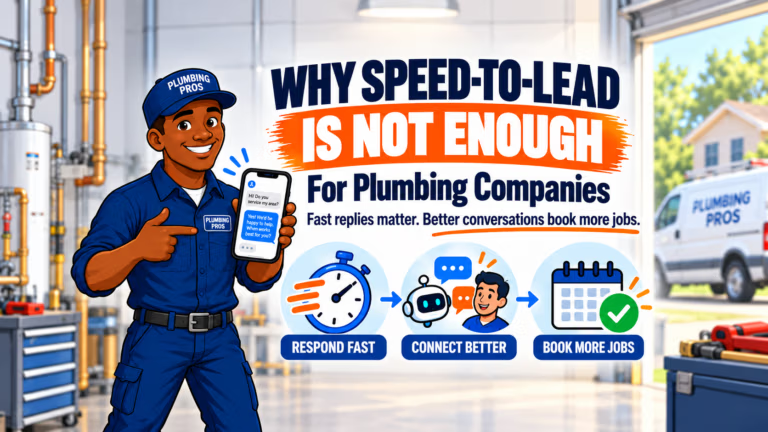
Calling or texting quickly is no longer enough. When every contractor responds with the same message — “When can we come to your house and provide an estimate?” — the companies become interchangeable.
Live video allows the contractor to create a human connection while competitors are still trying to schedule a visit.
A video consultation helps the contractor determine:
The objective is not to eliminate every onsite visit. It is to ensure that the company only makes the trips that are worth making.
James says LiveSwitch sees virtual close rates around 48% across many users and markets. He also shares the example of a contractor who closes approximately 60% of onsite opportunities and 62% of virtual opportunities.
Even when close rates are similar, virtual estimates can be considerably more profitable because the contractor is not spending labor, fuel, and vehicle costs pursuing every opportunity.
Paul’s toilet-shopping experience revealed a common problem. Every company responded quickly, but no one built a relationship, offered meaningful consultation, or followed up after submitting the proposal.
James believes technology can remove much of the administrative work surrounding an estimate, giving contractors more time to do what AI cannot do well: connect, consult, and sell.
James contrasts a handwritten estimate on an envelope with an AI-generated, customer-ready proposal created from a short video. A professional, detailed, and easy-to-understand proposal builds confidence and can justify a higher price.
Customers are not only evaluating the technical work. They are evaluating how organized, trustworthy, and professional the contractor appears.
LiveSwitch can use video and spoken descriptions to assess a project, identify details the contractor may not have mentioned, and create an estimate or proposal.
However, James warns contractors not to blindly trust AI. A knowledgeable person still needs to review the output, correct errors, and approve the final recommendation.
Contractors can reconnect with homeowners through video, share their screen, explain the proposal, and answer questions face-to-face. The conversation can then be recorded and shared with a spouse, partner, or other decision-maker.
Simply following up already provides an advantage in a market where many contractors send an estimate and never call again.
A contractor can place a branded QR code on a water heater, under a toilet, or on another installed product. When the homeowner needs help, they scan the code and submit a video instead of searching Google for another plumber.
The same approach can be used in direct mail. A homeowner could scan a code, follow guided instructions, and record the problems they want addressed. LiveSwitch’s AI can review the submission and notify the contractor of the opportunity.
“People still buy from people.”
“Race to the face is faster than speed to lead.”
“You are in a race to get your face there, but you are not in a race to the bottom.”
“A picture is worth a thousand words, but a video is worth ten thousand.”
“I’ve made you the Iron Man suit. I still need Tony Stark.”
“The face is the closer.”
LiveSwitch is a live-video and AI platform that helps home service companies conduct virtual consultations, qualify leads, document jobs, create estimates, and follow up with customers. The homeowner can join by tapping a text-message link without downloading an app.
“Race to face” means establishing a face-to-face video connection with a prospective customer before competitors can visit the property. It takes speed to lead one step further by creating an immediate human connection and allowing the contractor to see the problem remotely.
Some straightforward jobs can be estimated remotely, while larger or more complicated projects may still require an onsite inspection. Video helps the plumber evaluate the problem, determine whether the job is a good fit, and decide whether a truck roll is necessary.
According to James, LiveSwitch integrates with ServiceTitan, Housecall Pro, and Jobber. Contractors can access its live-video capabilities through the systems they already use to manage customers and jobs.
No. AI can review video, assess urgency, organize project details, and help prepare estimates, but it cannot perform the physical work or replace the trust created by a skilled salesperson. James recommends treating AI as a copilot whose output must still be reviewed by a knowledgeable person.
Paul Benton: If you’re a plumber or a friend in the trades, you’re in the right place. Today our guest is James Hatfield. He is president of LiveSwitch Ambassadors, a network of home service business owners, consultants, and industry educators. He is also the co-founder of LiveSwitch, which enables contractors to do video estimates, um, a pretty powerful technology.
Paul Benton: Previously, James was co-founder of Sageworks, a nationally known financial technology company later acquired by a successful private equity purchase James is an entrepreneur and a product developer, and he helps home service companies use live video to respond faster, provide virtual estimates, document jobs, and reduce unnecessary service calls.
Paul Benton: And at $6 a gallon in California, that’s pretty powerful. I noticed, James, that on your website you’re touting $4 a gallon. Come to California, please. Welcome to the table.
James Hatfield: Paul, thanks for having me. I’m on the other side of the country here in North Carolina. We just hit $4, and that’s a big deal for us, but $6, my heart goes out to you.
Paul Benton: Yeah, it is pa- it is painful. I’m riding my bicycle more, I can tell you. James, you know, you have a fascinating backstory, and I would really appreciate it if you would share it because I think that really sets up the arc. Tell us-
James Hatfield: Yeah …
Paul Benton: how’d you get started, and what are you doing now?
James Hatfield: Well, my father built the house I was born in.
James Hatfield: My grandfather built his house after having to leave high school at 16 because his dad died young, and he became the man of the house. And so I’m around a bunch of fellas that were good with their hands. So my grandfather’s biggest dream for me, you can’t make this stuff up, was to go and paint the highways.
James Hatfield: Literally get the machine that paints the highways, and I’ll never want for food. So we come from very humble background and humble dreams. So when I got out of schooling, said, “Hey, Grandfather, I can’t afford the machine that paints the highway, but I can paint a house head to toe or commercial.” So I ended up being a contractor for residential, commercial painting, multiple crews.
James Hatfield: Did that. I thought I’d do that till the day I die or fell off a ladder and die. And my story changed when I went to my bookkeeper or my accountant. They’d start speaking English to me, and I didn’t know what they were saying. I was like, “That’s probably not good as I’m trying to hit payroll and, you know, grow my company.”
James Hatfield: So I decided to humble myself and go back to school while I ran my company. And so I went back to business school, started learning the language of business and accounting, uh, and that’s where I met my current business partner. We’ve been together 23 years. And he was going and finishing at a little school called Duke University, finishing his MBA alongside a guy you might not have heard the name of, Tim Cook, who just recently stepped down from Apple Computer.
James Hatfield: And when I met my business partner, he could take… He was working on a little thing called AI, but this was 23 years ago. We didn’t use those words back then. Took my income statement and balance sheet, and we put it through the program that he created, and it could tell me in plain language as a business owner how I was doing.
James Hatfield: And I said, “You are solving a problem that I have. I absolutely love this.” And he said, “Do you think you could sell it?” Said, “Well, first problem, I don’t own a computer. I do everything with carbon copy sheets,” you remember the pink, yellow, white sheets? “I have a Nextel walkie-talkie, and I play with paint guns and water guns.”
James Hatfield: I have no idea. But when I believe in something, I like to throw my weight behind it, and I really believed in what he had, ’cause he was really solving my problem while I was going back to, to business school. And we took that company from nothing to Inc 500 for three years, and we sold it to private equity.
James Hatfield: It’s a $6 billion company and runs all of the banks in North America. So that worked out quite nicely, to say the least. After that exit, uh, we get into philanthropy, ’cause that’s what you do when you have a big exit, right? So I went and started churches. My business partner started Inmates and Entrepreneurs, where we go into the jails and we teach men and women how to run a business, ’cause people don’t like to hire people with a record, and we’re big believers in second chances.
James Hatfield: And that turned into an ABC television show called Free Enterprise. Didn’t have that on my bingo card, Paul. And what happens after you sell your business, and if you’re a builder, you can only chase a little white golf ball, and the, the boat can only get so much bigger. I need something to wake up to. I’m a builder.
James Hatfield: I like to work and build things. So we went and we bought… We had a lot of capital, so we went and bought a company. We found a company, 16-year-old company in Vancouver, British Columbia, of all places. Uh, person who started the company there is still with us. But we did take the company over, and I started working with our engineers.
James Hatfield: And it happened to me again, Paul. Started talking to these engineers, and they’d speak English. I was like, “I don’t understand a word these guys are saying. What did we buy?” We were stupid enough to buy another company and do this again. I was like, “What are we doing? Oh my gosh.” Took me two years to understand the language.
James Hatfield: And we do stuff with video, live streaming video, and we’re one of the only companies in the world to do it. And, you know, business partner, he’s… in- helped invent live streaming. So we do things. You’ve seen our stuff. Uh, we did the Super Bowl the last four years. We go to an MLB ballpark and scan a QR code they put you on the jumbotron.
James Hatfield: That’s our stuff. I did the Super Bowl. You know, anything with live video. So what happened, and how you and I… Why, why am I, why am I on this podcast, right? What is he doing here? He doesn’t sound like one of us. Except for he used to paint houses and be a contractor, right? So what happened is the chief of police in Washington, D.C.
James Hatfield: reached out to us to reinvent our nation’s 911 phone call, of all things, right? So the whole idea was how do we get into your camera, now that the citizens have three to five cameras in their pocket, how do we get into that camera and stream it to the police car, fire truck, or emergency medical? So I woke, four years ago, I woke up at 2:00 in the morning when all my best ideas come.
James Hatfield: It’s really not a great time to have your best ideas, but I hop out of the bed and I’m like, “I got it. I know how we’re doing this.” The, your phone in your pocket has three channels on it. One of the channels is called telephony, when you make a phone call, when you call 911. So while you’re on 911, I can go to another channel while you’re talking and send you an SMS text message, and that gets to put a link that you can tap on and allow me into your data channel, and now I can stream that video point to point anywhere in the world, in this case, from the citizen’s phone.
James Hatfield: And it has to be idiot-proof, right? So it had to be so easy, no time to download anything, click it, so there’s nothing to think about. You just click the link and you’re on, and you can stream it to the police car, fire truck, emergency medical. It’s called situational awareness, so they can see what they’re driving into.
James Hatfield: The chief loved it, and I just had a simple question: “Well, who else could use this no app, you see what I see technology?” And I met this guy taking care of the NFL Tennessee Titans football team. 20 years in the FBI. CT is his name. He looks at me. I’m showing him all my emergency stuff, and he goes, “James, I got the dumbest question.”
James Hatfield: He’s like, “My arena here in Nashville is enormous.” He’s like, “Can I just send this text across the arena so my guy can show me what’s going on so I don’t have to hop in my little golf cart? ‘Cause that would help me a lot.” I was like, “Oh, this is like my Nextel walkie-talkie.” I lived on that thing. I lived on my Nex- I don’t even know what happened to the thing, but I loved my little Nextel.
James Hatfield: Like, this is this generation’s Nextel. And lo and behold, through happenstance, it could have been anybody, but I met this very serious guy in the moving industry, involved, you know, moving boxes, moving families, moving businesses, and I’m showing him my stuff. Same story I’m telling you now, what I was telling him.
James Hatfield: And he goes, “James, buddy, you are sitting on liquid gold.” What do you mean? He’s like, “Well, you know how I’m gonna use this as a mover is sometimes I put… The most expensive thing I do is put one of my hourly wage guys in one of my vehicles, burning up my fuel, driving all over town, and when people find out how much it costs to move their family, sometimes they decline and they go rent a U-Haul.
James Hatfield: Well, that free estimate is not free for me as a business owner. I do it ’cause I want the business.” He’s like, “What I’m gonna do with this is I’ll send them a text and they can show me, and if they’re kicking tires, I don’t drive out. Or some of these jobs are really small, like little apartments, like I can bid that in my sleep.
James Hatfield: I’ll just bid it, you know, from my office here and not drive out. And the third one is like, ooh, they got the money. I can give them a little idea, but I’m gonna drive out. So it doesn’t eliminate all the trips or anything.” And I said, “Will you pay me American money? ‘Cause I love selling usernames and passwords.”
James Hatfield: And he said, “Oh, yeah.” And that was three and a half years ago. And now fast-forward the clock, I’m in all the trades, I’m in all countries all over the world, and I wrapped this thing in AI last year. And we can talk about that in a little bit, but that’s kind of how our paths collided, and it’s been a very humbling journey.
Paul Benton: So James, what brought us together was, so we do marketing for plumbing companies, and, uh, the challenge that marketers have is we deliver leads and they don’t convert. And when we saw that pattern, a pain point among our clients and prospects, um, I thought there has to be a better way, and I heard about LiveSwitch.
Paul Benton: You have coined or advanced this concept of race to face. Marketers talk about speed to lead, but you’ve taken that one step farther into race to face. What do you mean by that? And that seems to be a good starting point here about what you’re delivering. That’s where the value begins.
James Hatfield: Yeah. People still buy from people.
James Hatfield: As scared as everyone is around AI taking our jobs, don’t worry about it. AI isn’t gonna turn the wrench. But people do like to buy from people. Now, we’re gonna use AI in all the right ways. We’ll talk about that in a little bit, but race to the face is faster than speed to lead. And you know how I know this is because when that lead comes in and you call and you do a little discovery, you ask questions, you can’t see and they can’t explain very well what they’re looking at.
James Hatfield: So you schedule a time and you say, “Hey, I’ll be out there in Wedns- I’ll be out there in a couple days, on Wednesday.” All right? So you schedule the time, they agree, and then you call, and maybe sometimes you call out Wednesday morning, say, “I’m headed out there.” So you send the little text messages, and the person’s like, “Actually, don’t bother.
James Hatfield: I found somebody.” Already. Well, you did not lose ’cause of your reputation. You didn’t sell well enough. You were slow. But that’s speed to lead in today’s world. How fast can that lead come in? You talk to the person, schedule it, and get out there. When that call comes in, “Do you mind if I just send you a text message and you show me what’s going on?”
James Hatfield: Now, you’re gonna see them and they’re gonna see you, and everyone’s kinda conditioned to these FaceTime calls as, you know, it’s not a FaceTime call, but it, it warms up, right? Like, oh, that’s a serious person. The trust goes higher from a phone to a video. And then we have all kinds of things built in, whereas like you can…
James Hatfield: If they’re terrible with technology, I mean, remember, we had to build this for 911 when someone’s compromised. So you can have it send a message to help them flip their camera. We have a laser guidance system to laser guide them around, and you can talk about what you’re doing, connect with them, and see the problem.
James Hatfield: And some of these things you’ve seen a million times. You can just give them a ballpark, ’cause now all people want, thank you Amazon Prime for ruining us all, the Prime-ification of the trades is here. How many stars do you have? How much is this and when can you be here? And do you look trustworthy? I’ll let you in the house.
James Hatfield: And convenience. It is so convenient not to wait around for you, open the door for you, have you come in, give me the bid, have you follow up. It’s slow
Paul Benton: So to put this in perspective, I recently, uh, was in the market for a toilet replacement and, um, I did a Yelp Request a Quote. And as I’ve, uh, shared before, before I was back in my chair, my phone was already ringing with an AI, an outbound AI.
Paul Benton: And then when I talked to each of the four companies, they all responded within one minute, but the message on all of them was identical. It was, uh, “When can we be at your house to give you an estimate?” Some charged for the estimate. Others, it was free. But I said, “That’s not good enough. I’m a, I’m an old school guy.
Paul Benton: I like to talk on the phone. I like to get to know people.” And I called all four of these guys, and it was like a bear fight to get through. I couldn’t get anybody to talk to me. So from my chair, immediately everybody was commodified because nobody wanted to create that connection. And I went through the reverse auction, and they were all the same.
Paul Benton: Basically, they, all they did was deliver a PDF, um, proposal, which I then quickly put into ChatGPT, and it told me which was the best answer. But nowhere on along the way was a relationship started. That’s where you are cutting new ground. So you’re saying when that call comes in, you wanna get a human being connected, and then in the home on video.
Paul Benton: So whereas the other guys are still scrambling to dispatch, you’re already in the home. Is that about right?
James Hatfield: That’s about right. So the argument will go the other way is, “Well, Paul, I don’t have time to do all these video calls with people. Can’t afford to do that. I don’t have time to do that.” Okay. Well, you don’t have to do it.
James Hatfield: They have people you can hire to do that. Well, James, that’s another salary. Well, what about somebody not in the US? Because virtual assistants have come a long way. I just hosted a virtual conference with a moving company owner, eight-figure moving company in Seattle. 35 sales reps. He’s doing great money, you know, eight figure, and 35 of his sales reps are in South Africa.
James Hatfield: The whole audience listening, their minds are blown ’cause there’s some myths around that, right? But the speed, and with plumbing, 24/7, sometimes you wanna know if it’s a puddle or a flood, right? They call in, it’s after hours. They, “It’s DEFCON 5 over here, Paul. Come out here.” You drive… You get out your bed or one of your guys do.
James Hatfield: They drive over and just a leaky little toilet on the, on the floor. Or call up, “Paul, no big deal. I mean, it’s not a… You don’t worry about it.” You, and, and you get over there in the morning, six inches of water in the basement. Like, you know, I coulda helped you out here, right? So getting your eyes, whether it’s your own eyes or the eyes of one of your team members in the office or even virtually overseas, to take a quick look Allows you a ton of information, ’cause these videos are all recorded.
James Hatfield: You can share them with the technician, and you don’t have to be even a plumber, ’cause we have AI watching the whole thing, and AI can determine the urgency of the issue. AI w- listens to the whole thing, auto-runs. You put your rates in. You put… It, it can pull rates, lic- license everything. Your, your up charge, your materials, and urgency.
James Hatfield: If your person can just say, “Hey, can you show me what’s going on there? Describe it,” they can focus on selling and not being the expert. That’s your job. Or if you’re running everything, you need to be everything, right? But we also have some self-serve options. So now your AI agent can actually send a text link.
James Hatfield: The person can hit the video, and no person on the other end. The person can describe the video and, and show the toilets that need to be replaced. AI can watch it, review it, and service, like, “Hey, this is a real one. They’re worth your call.” The reason that people don’t go out anymore, they’ve been burned a lot.
James Hatfield: They’ve done a lot of… They’re not free estimates. They’re people using you for free consulting. But it’s your dime. It’s your back. It’s your… So now you wanna arm yourself with technology that makes you convenient, covers your assets, right? And it also does a lot of other things if they can point their video.
James Hatfield: Have you ever gone and fixed somebody’s toilet for them to turn around and blame you for marks on the wall that you didn’t do? Well, now you have a video. Sh- Look, the marks were there from your camera even before I got out. I will not be a nonprofit today. It starts to add up to where it just, it, it makes all the sense in the world.
James Hatfield: Because now everything’s recorded, you can analyze your salesperson. AI can analyze it. Go ahead, Paul. You got a thought.
Paul Benton: No, no. I was gonna say, take… Maybe James, you can take us through the choreography. Uh, because there’s a, an art. It’s not just a platform. There’s a little bit of art that you can learn to get into that, uh, selling mode.
Paul Benton: So can you walk us through what are the steps you advise contractors to do to get into the home virtually? Ta- take us through that.
James Hatfield: So there’s a few things to think about as we take in the, get into the home virtually. First, you gotta be willing, for yourself or someone on your team, to get on the camera.
James Hatfield: That’s usually the hardest part of the whole thing. Are you willing to race to the face? You’re willing to drive out and go through hills and valleys and burn up gas for them to show the face when you do an estimate. You’re already spending a ton of money on this and a ton of time, and you’re showing up to places.
James Hatfield: Have you ever parked in a driveway and you already knew before you were getting into the house, you’re like, “Oh boy, here we go”? You knew from the driveway And everyone’s probably like, “Oh, yeah,” ’cause I’ve done it. I’ve been, I’ve done it. I’ve been in the chair, I’ve been in the truck, I’ve done it. So you get to decide, and I’ll give you a little…
James Hatfield: And, and this hits the plumbers, too, right? Restoration, right? Big storm comes through, hurricane. You know, I’m in Asheville, so Hurricane Helene came in. Now, if you… The dirty secret in restoration, when these things come in, they’re looking for the best jobs and they’re cherry-picking ’cause there’s so much demand So you wanna get to a place that you’re so convenient and that you’re…
James Hatfield: Now, if you need every business walk and you need every business walk and you need to win everything, well then, you still need this ’cause you wanna, you wanna be the fast-paced, close the race, right? But maybe your book of business is a little thicker than others. Good, good for you. Now what we wanna talk about, and I wanna challenge you, is only work with the people that you wanna work with on the jobs that are make the most sense for your top and bottom line.
James Hatfield: You know? Maybe you’re not doing the little toilet fixes or toilet installs, right? May- and maybe, maybe you need to and you have to. Maybe you’re only taking on larger jobs that you know your buy box, ’cause now you can see everything. So it starts to allow you as a business owner to make different decisions, like, “Do I need everybody in this office or can I have an overseas person?”
James Hatfield: You know, “Do I wanna service a wider serviceable rate- radius area?” Maybe there’s only neighborhoods that you love, businesses that you love, and you didn’t like driving out to do the estimate. You loved getting the work ’cause they had the money and they were bigger jobs. Well, now you can market with Paul or whoever, you know, to those neighborhoods that you love that might be a little bit farther drive, but you’re estimating it here, so you’re only driving out when the business has been won for the money that you want.
James Hatfield: Get to start making some strategic decisions.
Paul Benton: So here’s, uh, uh, how have you overcome this, um, mental map that is, I think, still dominant among home service contractors, which is that my probability of making a sale is so much higher if I’ve crossed the threshold than if I’ve talked to the customer remotely, and therefore I don’t wanna give price, I don’t wanna give consultation, I don’t wanna talk about anything until they see me smiling at them across their threshold.
Paul Benton: That’s, was what I experienced with my, uh, toilet purchase, and I can say for a non-emergency situation, that assumption is demonstrably false. I had no loyalty just because somebody was standing in my, uh, i- in my bathroom six inches away from my toothbrush, and I had, uh, no greater propensity to buy from them because they went through the choreography about asking me where they can park and if they can put booties on and all of that.
Paul Benton: And yet, I… You know, you tell me w- w- why is it that the industry still believes that and isn’t just more believing in doing business over the phone and video?
James Hatfield: You gotta come taste and see And know that it’s good. I’ve had– I’ve been doing this for four years. The company’s 16 years old. I’ve had owner after owner after owner say, “James, we went, we always went out, to now we only drive out when we have to.”
James Hatfield: And here’s the thing, forget all that. That is a very expensive thing for you to do. You might think, “Oh, well, I’m losing out on my business c- I’m losing out on business.” I’m like, “No, no, no, you still will win And now, you know, you are– But you’re doing this so– It’s so expensive, and it’s such a waste of your time.
James Hatfield: I mean, the best compliment I ever got from a customer was a single dad. He’s a solo entrepreneur. He hangs TVs, and he hangs speakers in homes. And he started using our stuff, and he’s been using it for a while. And I had him come speak to my team just about his experience. He said, “James, the number one thing I love about your product, I get two hours back with my two-year-old daughter every single day, ’cause I don’t have to drive around town.”
James Hatfield: I had an electrician. He said, “James, I let my electric license lapse ’cause I just sit in this chair, and now I do eight bids a day.” He’s been doing this for three and a half years. He’s like, “My win rate’s forty-eight percent on the nose.” And he speaks at conferences all over. He’s a very serious guy. He was an award winner at Breakthrough Academy.
James Hatfield: He’s on a rampage. Google now, this last year, added options for your customers to choose if you do virtual estimates. So you are not even being selected because you don’t go through this motion. You’re none the wiser. But now you’re taking on a segment of the market that demands… This isn’t something that we just got up this week or a month ago.
James Hatfield: We’re in year four. And we’re all over the world. And there’s a reason I’ve been on 150 podcasts this last year. This is… You don’t have to adopt it, just like you didn’t have to adopt a whole lot of other things until you did, and then you’re like, “What took me so long to do this?” That’s usually what happens.
Paul Benton: And, and James, you mentioned 48%. Do you have, um, some experience with what the closing rates are virtually versus in person?
James Hatfield: Oh, yeah. Yeah, absolutely. It’s rock solid for around certain parts of the country, certain amounts of competition. But around that 48% virtual is a good number. That’s lots of, lots of data backed.
James Hatfield: All right? And for some folks, I’ve got some owners that A/B tested, they know all their data stone cold, and they’ll say… I have, like, owner, um, he’s in Chicago area. He’s a c- a contractor. He said, “James, when I go on site, I close at 60%. When I go virtual, I close at 62%.”
Paul Benton: So even if it’s the same, you- you’re saving money because you’re not wasting it on the 40% that’s going, that’s getting lost.
James Hatfield: And his salespeople all became virtual salespeople. All that gas money, time, and the salespeople, they, once they adopt it and they’re willing to put their fa- camera, face on the camera, it’s very convenient, and they can work from anywhere.
Paul Benton: But let me say something controversial and ask you to knock it down or affirm it.
Paul Benton: Um, I believe part of the challenge in home service selling is that the, there i- there is no selling going on. It is a efficiency race to who can generate the estimate the fastest and drop it off. But beyond that, nobody gets… Or it’s not widespread, at least not in plumbing, nobody really gets into what we’re, what we do every day in B2B sales, which is form a relationship, do a discovery, do a consultation, make sure you have your follow-ups, follow up in person.
Paul Benton: At least based on what I experienced here in, uh, the Bay Area with private equity, uh, companies represented, I think it’s a pretty representative experience recently. How many calls do you think I got after getting five estimates for my toilet replacement? How, how many phone calls did I get that said, “Sir, um, would you like to buy from me today?”
James Hatfield: Zero.
Paul Benton: Zero. And so what do you think is going on there? And then I’ll ask you what LiveSwitch can do to fix it.
James Hatfield: This is in between the ears of the contractors. It has nothing to do with technology. You are in a race to get your face there, but I didn’t say you’re in a race to the bottom of who’s the cheapest.
James Hatfield: I have had so many contractors raise their rates because they are also… As an example, in my own home just last week, we had to go get our driveway resurfaced. The guy wrote the estimate on an envelope with blue ink. On an envelope. He’s like, “I’m so sorry, I wrote an estimate.” Thanks. I whip out my phone, because I have onsite stuff too.
James Hatfield: We’ve been talking virtual estimate, but I have onsite. I whip out my app, I take a 40-second video. I say, “Hey, just talk to this thing for 40 seconds. Tell it what you’re gonna do.” He said, “Yep, 930 square foot driveway. We need to fill in the cracks and do a couple coats.” I hit stop. I ran a general contractor AI report, which took another 40 seconds.
James Hatfield: Then I told the AI, “Make this customer ready,” which took another 30 seconds. Then I hit the share button and put my wife’s phone number in, which took another 10 seconds. So I… And faster than you can write it on your envelope and do your old school way, and we held it side by side. One was a one-page beautifully written document.
James Hatfield: The other was an envelope in blue ink. I bet I can put another few hundred dollars or more on the document Customers also vote with their who, who they trust. How much trust did that envelope with blue ink create compared to something that was convenient, fast, knowledgeable, thoughtful, signable, detailed enough, not too de- you can make crazy detailed, and in less time?
James Hatfield: While I was standing, maybe you never adopt, you know, virtual estimating. You’re never… It’s fine. I had a plumber in my home two weeks ago. I said, “Hey, before you install this sink, talk to this video for 30 seconds. Tell it what you’re gonna do.” Same motion, same button, same make it customer ready. That plumber was so taken.
James Hatfield: First, he had to pick his jaw up off the floor. He texted me four times after he left, and the last text he says, he’s like, “James, would you ever hire somebody like me to come and sell your stuff?” He couldn’t stop. This guy’s been doing this for 20 years.
Paul Benton: So let me push on this a little bit. Who is teaching the selling, though, rather than just the estimating?
Paul Benton: The act of selling and the act of estimating, I would suggest, are two different things.
James Hatfield: Very different things. They haven’t had the time to try to practice that. They’re so busy running from job to job to job to job and having to rely on their estimating skills so they make sure they make margin and don’t become a nonprofit, that the selling has just been They do enough volume and they race to the bottom.
James Hatfield: You know, they, they, they can get the money right there. They’re, they’re not getting a chance to practice that. So you got… to do that, you take everything else away. I’ll strip you away from the driving out. I’m gonna strip away all of the… The AI do that, so then you get to do the thing that AI cannot do well, sell, and sell it for more.
Paul Benton: So what I really like about your platform is it’s flexible. So if I want to talk to a customer, I can get on the phone and then I can say, “Do you mind if we meet in your boiler room in right now? I’m just gonna send you a text. Click this link and you’ll have an instant video connection with me. You don’t have to download FaceTime or any app.
Paul Benton: I’ll just see you in a second.” That race to face, uh, almost could be said is race to connection. So in the follow-up after the estimate, in my case, nobody wants to sell me a toilet, um, and it just might be that it’s just too low a margin. Although I had one plumber with a straight face present to me a quote for a $27,000 toilet that I did not ask for, but it sure made his $3,000 toilet seem more valuable.
Paul Benton: You could, in follow-up mode… Do you do this, uh, or encourage it? You could call the homeowner back and say, “Hey, um, I wanted to show you something,” and now you’re back in video, and making a sale face to face is easier, less transactional than making it, “Hey, can I just take the order?” What are you, uh… What’s been your experience with that?
James Hatfield: Yeah, so for follow-up, again, you send a text message, they tap it. You can share your screen, walk through the bid, talk about what you’re gonna be doing. Again, increasing. Now you’re the… For only… You had zero follow-ups, so you’re already winning by being one of five to follow up, and then all of it gets recorded.
James Hatfield: So if you have some customers like, “I really need to talk to my partner, spouse, you know, I need to think about this,” everything, “Hey, I’m… Don’t worry, I’m gonna send you this video of us talking that you can share.” So using these videos, and I have guys that do a self– we have a self-recorded video where you can say, “Hey.”
James Hatfield: So sometimes we have a automated thing where you can put QR codes up on the water heater, under the toilets, where now a customer, you’re claiming your property. I don’t want to have someone… Once I’ve won business from your, from you, whether it’s the re-resident or a commercial, I never want them looking up plumber, Googling plumber again.
James Hatfield: So now you leave up a QR code where that they can scan at any time right on the wa- with your name and phone number, where they can scan the QR code, take a quick video saying, “Here’s all the stuff I need done.” Go– AI reviews it, pings you like an email. You review it, call them back. “Yep, I’ve already reviewed everything.
James Hatfield: Here’s what we’re looking at for a ballpark.” And now you’re super convenient, and it’s self-serve, and you can send them another vi-video if they need to see or a self record a video of yourself saying, “Hey, I’m James.” Like this would be touchless. So l- they take their video. They take a recording. Your– The plumber reviews it.
James Hatfield: The plumber records a video and right there and just says, “Hey, I’m James, your plumber. I looked through your video. It looks like you need this, this, and this. I just wanted to say thank you for the opportunity to win. Here’s a, a ballpark estimate for you.” Um, or, “Hey, I need to come out and do a more detailed.
James Hatfield: You have a lot harder work that I need to look at.” Y- And, and you can hit… You can text it to them or email them. You’re, you’re putting, again, more opportunities to get in your face that you’re willing to drive over hills and valleys because your face is the… You’re right. The face is the closer. You’re just– Your methods of driving in a truck, your methods are ancient.
James Hatfield: You’re, you’re, you’re ri-riding on horseback when we have cars. You know, you’re– got candles, and we got electricity You know? You’re writing your, your estimate out with AI. Go ahead.
Paul Benton: No, you said something really important, which means you could do a direct mail campaign with an offer that says, “Mr., Mr.
Paul Benton: Homeowner, um, $200 off any problem that you have in your house right now. Scan this QR code, send us a video, and through AI it will be able to estimate it, and we’ll give you $200 off that project right now.” And you’re basically getting the homeowner, uh, to walk across the threshold from their mailbox with their mobile phone out saying, “Yeah, you know, darn, I do have that problem.
Paul Benton: I’ve got this, this leak,” or that knocking sound or what, what have you. Is that… Are you finding contractors are j- are, are combining this with offers in interesting ways?
James Hatfield: Oh, my, yes. And they have it to where they’re like, “Hey, put this sticker, you know, on your water heater if you ever need us in the future.”
James Hatfield: And when they scan the QR code and put their information in, we even have a guided instruction. So again, you could be sleeping in your bed, you’re at the dinner table, the person scans your marketing document, walks around and starts doing the honey-do list, but we have it to where you can put in instructions.
James Hatfield: Like step one, show me their first problem and tell me, speak nice and slow. Step two, show me… Like, they can just follow the bouncing ball. We have this for all the trades. And you can write out your own steps that you like to see from your customers, and it just makes it very simple for them to do the things while you haven’t even left the dinner table.
James Hatfield: And then you have the AI review it, so now you’ve got video that you can watch at 2X speed. You’ve got the AI output. You’re calling, you’re convenient, and you’re taking your marketing flyer, and we say we’re… turn your marketing flyer or your stickers into technology. And claim that prop, claim that property
Paul Benton: That’s, um, powerful.
Paul Benton: Can we switch gears slightly and talk about tactics- Yeah … that LiveSwitch and the video estimates can overcome? So a big issue is price. The reason why people want to be in the, uh, contractors wanna be in the home is that, A, they’re fearful, and you’ve covered this already, um, that they won’t know what is going on, and therefore they don’t wanna give a price until they’ve seen it.
Paul Benton: Now, the platform can, through video, give you an AI, give you some way of estimating and knowing those costs ahead of time. But the other reason is that plumbers are banking on the idea that once I’m across the threshold, you’re past the point of no return. Do you want to see me leave with your, um, malfunctioning toilet or do you want that toilet fixed?
Paul Benton: And the question is, what does LiveSwitch do to help plumbers navigate price better for themselves? Because I don’t think either of those are good answers for the homeowner or the plumber. That’s why the conversion rates are so low across the industry.
James Hatfield: You’ve gotta look at it as a two-step punch, one-two punch, okay?
James Hatfield: The first punch is determining even if you wanna drive out, right? When I get on that video call with someone, they’re showing me their home. I see them. I’m evaluating them as a plumber, that they’re worth that job trip, and I- I’m gonna start putting my buy box together, and I’m gonna choose. Now, if you’re in a place where you gotta take everything walking and breathing, still you wanna see, and sometimes it’s so small you literally can bid it right there, right?
James Hatfield: And win it right there. So then when you drive out, you’re doing the work. But it’s a larger job. Maybe it’s more complicated. You can’t tell from the knocking. But you can tell, wow, that’s a potential customer that I want. You’re determining they’re worth the trip. So then you drive out. Again, this is not eliminating all trips in the truck.
James Hatfield: That’s– It’s determining what trips are worth it, right? So then you drive out, you’re gonna take out your app, and you’re gonna hit record while you talk. Now, a lot– You’ve seen a lot of these contractors getting these, um, voice recording things that dictate and tran- And that’s very cute. That is very cute, but that is also very old technology.
James Hatfield: Now you’ve got the most powerful technology in your pocket, which is your phone, and now with video and you talking, feeding the largest AI in the world, you can tell it very complicated things. If you’re a commercial plumber, go for it. Give it the most complicated, ’cause when an expert like yourself is talking, and you have AI videoing it, it’ll confirm things that you say, and the video’s watching, it can infer things you didn’t say.
James Hatfield: Like when we did one for the plumber I was telling you about that wanted a job here, it started showing stuff he didn’t even say, ’cause a picture’s worth a thousand words, but a video’s worth ten thousand. So when you’re walking around, you talk to it like, “Hey, it’s about ten foot of run here. I’m gonna be doing this here.
James Hatfield: I’m running this type of pipe here. I’m gonna be fixing this here. I’m hearing a knocking.” My wife, who is not handy, videoed our toilet who wa- that wasn’t working. My son came to him, said, “It’s not working.” So she took out Live Switch, said she didn’t know. She’s like, “It’s this, it’s that. We’ve had this.” Well, the AI walked her step by step how to fix it, and in fact, it was a really super cold night that night before, and it told her how to blow dry the certain area, and she unfroze the pipe, and she was so proud.
James Hatfield: That’s when I knew I had a real believer, right? Is that she fixed her own toilet. So now you’ve got a co-pilot. I’ve made you the Iron Man suit. I still need Tony Stark. You… I always say my AI comes with a warning. You do not blind trust anything that comes out of it. Although you are talking video, it’s very powerful.
James Hatfield: You want to review it really quick. That’s really… One, job, you gotta sell it. Two, you gotta make sure it’s spot on, right? But it’s, it’s that much faster because you’re feeding it, and you can do it all on property. Just like I was telling you the other day when the guy came by and he hit record. We hit the button.
James Hatfield: You can just hit the contractor button or the plumbing button, and out she pops all while you’re standing. You don’t even have to leave the site. You then share it while you review it. You talk to the AI. “Ooh, I don’t agree with that. I don’t agree with that.” Rerun it. Hit the share button with the customer.
James Hatfield: Make it customer ready, all while you’re still on property, and they’re watching. You know they’re watching you, right? And like, “Wow, what is this guy doing?” Like, whoa, you know. You’re, you’re looking very forward-thinking, and when they see the outputs… This is why some of my guys can charge more, which for some of us might be like, “Charge more?
James Hatfield: I can barely get what I’m charging.” You might not know inherently why you’re not getting max price. It might be because you’re writing your bid on an envelope with blue ink.
Paul Benton: I did talk with a forward-thinking, uh, solar contractor earlier this week, and I asked him has he ever considered virtual, and I think he’s a believer already.
Paul Benton: He said not only does he do that, but he doesn’t do any estimating of a solar install anymore in person. Everyone, he said… I thought that was powerful. Uh, he doesn’t dispatch until he has the money in the bank, and he said, “I can estimate with satellites and with technology.” And I, then I asked him, “Well, what’s your closing rate?”
Paul Benton: And of course he might have boasted a bit, but he said, uh, “We’re closing 90, 90% or better of the leads that are coming in, and we do that without a truck roll to estimate.” I thought that was amazing. Even if that’s half right, that’s still amazing.
James Hatfield: It’s true. Because, and, but it’s true. It’s so true. I’ve, I’ve, I have thousands and thousands of customers all over the world.
James Hatfield: It’s true in Australia, it’s true all over the UK, true all over North America. We’re one of the nation’s fastest growing softwares in the country for a reason. Just bought my second building in Salt Lake City. Downtown, we turned an old chocolate factory into a, a software… Yeah. Mayor was in. Yeah, it’s been awesome.
James Hatfield: It’s very humbling. It’s because it works, and my renewal rate’s through the roof. You’re… It’s one of those things that’s like when the iPhone first came out, right? We didn’t know what we were looking at, and now everybody… You practically get one when you’re born, right? It’s the same thing here, and this is what’s the most telling.
James Hatfield: It’s not even the most telling that we got business owners that do it. At my last Christmas party, when I had all my staff there and their spouses, I played videos, not of my customer, but my customer’s customer telling the contractor, “This is so convenient. Why doesn’t every- You must, this must save you so much time.”
James Hatfield: Like, it’s person after per- It’s the customer experience. And that alone, when you’re willing to show your face, you’re willing to do this, you’re convenient, that’s your sales edge. It’s, it’s the motion. You currently think your sales edge is that when you cross the threshold. It’s not true. It, it, it’s been true for a couple decades, but it’s changed now to where you’re still the one walking through the front threshold, you’re just doing it through the phone.
James Hatfield: And it is… And the customers love it. Now, are you gonna have a few customers that won’t do this, or can’t figure it out, or, you know, they’re AI averse? Sure, but you better determine they’re still worth the truck roll, ’cause if they don’t wanna do that and they don’t have a smartphone Again, you wanna service your community, you wanna take care of everybody
Paul Benton: As we come in for landing here, James, maybe you could share…
Paul Benton: Well, first of all, how big are you- LiveSwitch has been or, um, in its current four years?
James Hatfield: So we’re a 16-year-old company. This was birthed out of a chief of police 911 calling us four years ago. I came up with that, then we started, and this is now our flagship. Four years later, I mean, we still have companies come to us and we, like, power…
James Hatfield: Like I said, during the COVID, we powered the NBA Bubble, powered WWE wrestling, all that stuff, but we still do that, but we’ve actually tucked that away. We still do it, but this is our flagship. I have repurposed all my computer scientists, all my team. I’ve got tons of people walking through my door every month, a new team.
James Hatfield: We’re growing so fast that it’s one of those things that it’s just, it’s been super humbling to watch.
Paul Benton: So you launched LiveSwitch about one year, uh, j- right around the same time that ChatGPT came on the scene. Can you tell us how many contractors do you have on the platform now?
James Hatfield: Lost count. Thousands and thousands of ti…
James Hatfield: I mean, every day we get more and more. It’s, uh, thousands and thousands. It’s insane. Of all sizes, from Chuck in a truck to franchises, huge franchises, like big companies, like ones if I started naming, oh, yeah, you know, and in the plumbing space as well.
Paul Benton: Sure thing. And y- and you integrate with Service Ti-Titan, HouseCall?
James Hatfield: ServiceTitan, HouseCall Pro, Job- Yep, we’re under the hood of all of them. So you can access everything I’m talking about right through ServiceTitan, Jobber, HouseCall Pro, like we power this. You haven’t seen live video because it’s just hard. It’s my space. I own… I don’t need to make another CRM, we got plenty of those.
James Hatfield: But I do power them, uh, with the live video and you can just access it right through your system of record, yeah.
Paul Benton: And what, where do you see, where do you see things four years from now? I mean, it, it’s, uh, and I, I say that openly. With AI, with, with how the trades are moving with LifeSwitch, what does four years look like?
Paul Benton: I mean, six months was, uh, ago is unrecognizable, but where are you guessing four years from today? What will the, what will the trade landscape look like?
James Hatfield: The thing we just launched is real-time AI. So in certain industries, not all yet, I’m working on it, you can literally send a text, person can walk around, it starts pulling, in real time, pulling all your permits with your rates, with your local knowledge, with your up charge, with your materials, and it’s pulling it right there for you to be able to give an exact bid.
James Hatfield: Then it’s gonna now forward the clock. Okay, that’s already today. Fast-forward the clock, now I can take all of the, your materials and start populating where you, your carts, your virtual carts, right? We can start, uh, from there for large deals, helping you originate loans so you can get that work done, right?
James Hatfield: And you’re now putting in QR codes where people are, you’re claiming property, and now people are able to scan, take video, auto get their… And so now you’re, you’re sa- If you wanna keep fast-forwarding stuff as you’re seeing autonomous driving You forgot a tool? Well, your robo truck will now deliver that for you.
James Hatfield: You might have some robot assistants. Some of your staff may actually be robots, all right, delivering your tools. Okay. Efficiencies will happen quickly. AI will not take your job, even though I just might have scared you with robots. We’re still quite a ways away, but if I’m fast-forwarding four years from now, you may see your first…
James Hatfield: You’ll definitely have the robot delivery services for your… that you’ll have. Your, your vehicle, right, will, will serve as that first. Tesla’s proving that out, uh, as we’re seeing, and Waymo. Not just Tesla, but other… Google and Tesla. Um, but these robots are coming next. But there’s all kinds of sensors and things in these phones already as well.
James Hatfield: You got LIDAR, so measurements won’t be an issue. We’re gonna have more wearables on your face to where these… You’ll have videos, uh, cameras in your frames. You’re already seeing this. But they will be your co-pilot as you’re turning the wrench and doing the work. It’s gonna ping you and watch this while you’re working to tell you where you’re, you’re missing on code, or, “Oh, hey, make sure to tighten this up.”
James Hatfield: You’re gonna have that. The co-pilot’s gonna continue to advance through phone, through wearables, through, through these pieces, ’cause I can connect all of these into our system. But I’m on this thing called an adoption, adoption curve. So, like, one step at a time. First thing I want you to do is take the phone from your ear, and I want you to put it in front of your face.
James Hatfield: The– I got, I got 12 inches to change the industry right now. All the rest is, we’ll get there in due time. And when, next time you have me on every year, it’ll be something along those lines. But one phase at a time, Paul, before we have anyone fall out of their chair.
Paul Benton: Well, thank you, James. Thank you for being a guest on the Plumber Marketing Success Podcast.
Paul Benton: Thank you for being at the table.
James Hatfield: Thank you for having me.
Questions or want to learn more?