Call or Text
Host: Paul Benton
Guest: Andrew Shotland
Questions?
About Guest: Andrew Shotland
CEO
Local SEO Guide
Andrew Shotland is the founder and CEO of Local SEO Guide, which he launched in 2006. Before founding the company, he helped launch Insider Pages, an early local search platform that was later acquired by Citysearch. Andrew has spent nearly two decades studying local search and helping businesses improve their visibility. Local SEO Guide works at the intersection of traditional SEO, Google Maps, local business data and the emerging world of AI-powered search.
About Host: Paul Benton
President
PipeWrench Marketing
Paul Benton is the founder of PipeWrench Marketing, a marketing agency dedicated exclusively to helping family-owned plumbing companies grow through better lead generation, local search visibility, artificial intelligence, and customer acquisition systems. Through the Plumber Marketing Success Podcast, Paul interviews leading experts from inside and outside the plumbing industry to uncover practical strategies that help contractors generate more calls, book more jobs, and build more valuable businesses.
Connect on LinkedIn
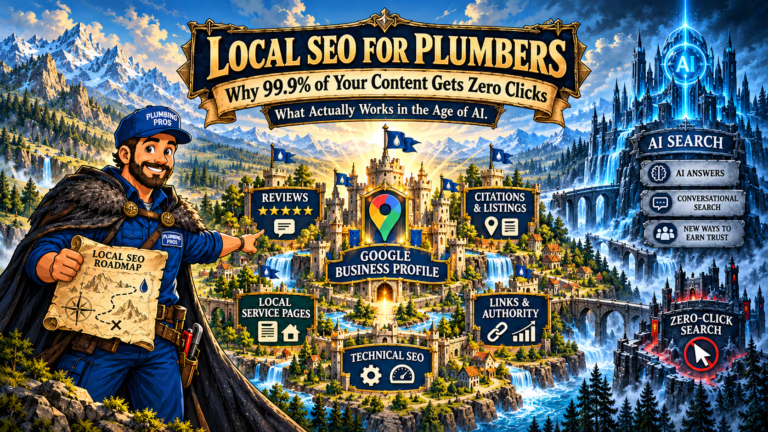
Many plumbing companies invest thousands of dollars in SEO content that generates little or no traffic, leads or revenue.
In this episode of the Plumber Marketing Success Podcast, Paul Benton speaks with Andrew Shotland, founder and CEO of Local SEO Guide, about what actually works in local SEO — and which commonly recommended tactics may be wasting a plumbing company’s money.
Andrew explains why generic articles such as “How to Unclog a Toilet” are unlikely to outperform national websites, major directories and established YouTube channels. Even when a plumbing company ranks for a broad informational search, the visitor may live hundreds or thousands of miles outside its service area.
The better opportunity is to strengthen the content and signals that directly connect the business with its local market. That includes service pages, location pages, Google Business Profile optimization, customer reviews, local media coverage, YouTube videos, business listings and locally relevant content.
The conversation also explores how ChatGPT and other AI platforms discover and recommend local businesses. Andrew shares recent experiments involving AI-generated pages, business directory descriptions and competitive comparison content — along with practical ways plumbers can prepare for the next generation of local search.
The best local SEO strategy is not necessarily the one that produces the most content. It is the one that makes a plumbing company more relevant, credible and visible in the markets it actually serves.
Before paying an agency to create another hundred blog posts, plumbing company owners should ask:
If Andrew had $100,000 to invest in a local company’s marketing, he would not devote most of it to producing generic blog posts.
Instead, he would consider investing in:
Mentions from local newspapers, community organizations, charities and other trusted local websites can help establish the company’s connection to its market. These mentions may also have an outsized influence on AI visibility.
Plumbing companies should consistently ask satisfied customers for honest reviews. Reviews can improve consumer trust and correlate with visibility across Google and AI-powered search experiences.
Service pages, location pages, comparison pages and genuinely useful local resources are more likely to support revenue-producing searches than broad informational articles.
YouTube is one of the world’s largest search engines and an important source cited by AI systems. Instructional and educational videos may give plumbing companies a better opportunity to reach customers than generic written content.
When local PR does not generate enough authoritative mentions and links, strategic link building may still be needed to strengthen the website.
Despite the rapid growth of ChatGPT, Claude and other AI platforms, Andrew believes plumbers should continue prioritizing their Google Business Profiles.
Your GBP category, location, reviews and linked website page can all influence where the company appears in Google Maps.
One of Andrew’s simplest recommendations is to examine the page connected to the Google Business Profile. The homepage is not automatically the best choice. A more relevant service or location page may give Google a stronger signal about what the company should rank for.
Andrew recommends using Google’s Programmable Search Engine to search only the pages on your own website. The page Google considers most relevant for an important keyword may be the strongest page to test as the GBP destination.
Andrew does not see a meaningful practical difference between AEO, GEO and LLM optimization. These terms generally describe the effort to make a company visible within AI-generated answers and recommendations.
Google and ChatGPT do not rely on identical sources.
Google can use information from Google Business Profiles and Google reviews. ChatGPT may rely more heavily on sources such as:
This makes accurate and complete business listings increasingly valuable. Each listing becomes another page that helps AI systems understand the company’s services, locations and reputation.
Andrew describes an experiment in which business descriptions were updated across multiple listings for 20 locations. Those locations subsequently experienced a substantial increase in ChatGPT visibility, while the company’s other locations did not experience the same increase.
Although one experiment does not establish a universal rule, it provides a compelling reason for local businesses to take control of their listings and improve the information they contain.
“Do you do what I need you to do? How much do you cost? Are you any good?”
That is what most prospective plumbing customers want to determine when visiting a website. Every important page should help them reach those answers quickly.
Yes, but blogging should not automatically be the center of a plumbing company’s SEO strategy. Broad articles about unclogging toilets or maintaining water heaters must compete against large national websites, directories and established media brands. A plumber should prioritize content that supports specific services, locations and customer decisions.
The homepage, service pages and location pages are generally more important than generic blog posts. These pages tell Google and potential customers what the company does, where it works and why someone should hire it. They should contain specific, useful and current information rather than thin or duplicated copy.
Many target highly competitive informational searches dominated by large websites. They may also attract visitors who live outside the company’s service area. Publishing more articles does not automatically create local relevance or qualified traffic.
Andrew recommends emphasizing local PR, review generation, service and location content, YouTube and authoritative links. The exact allocation depends on the company’s current visibility, competition, market and existing website strength.
Yes. Online coverage from local media, community organizations, charities and other trusted websites can connect a company with its geographic market. These mentions may generate links, strengthen authority and help AI platforms associate the business with its location and services.
Andrew does not believe AI authorship alone is the deciding factor. Google is more concerned with whether content is useful and satisfies the searcher. AI-assisted content should still be reviewed, edited, fact-checked and enhanced with the company’s genuine expertise and experience before publication.
In practical terms, there is little difference. The terms refer to improving visibility within AI-generated answers and recommendations. Andrew uses AEO, or answer engine optimization, but believes businesses should focus more on the work than on the label.
ChatGPT can draw information from search engines, directories, review platforms, media coverage and other websites. Bing, Brave Search, Yelp and BBB may contribute signals that influence which businesses appear. A company needs consistent information across multiple credible sources to improve its eligibility for AI recommendations.
Yes. Andrew considers the Google Business Profile more important for plumbers than focusing on Claude or another individual AI platform. The GBP remains central to Google Maps visibility, calls and local customer discovery. Accurate categories, reviews, services and linked pages continue to matter.
This tactic may violate Google’s rules and carries risk. Andrew has not seen evidence that it works in every case or that penalties are consistently enforced, but that does not make it safe. A business owner should understand that Google could take action against the profile and that recovery may not be guaranteed.
Paul Benton: If you’re a plumber or a friend in the trades, you’re in the right place today. Andrew Shotland is at the table. He is one of the most respected voices in local SEO and the founder and CEO of Local SEO Guide, which he launched in 2006. Previously, Andrew helped launch something long ago you might remember called Insider Pages, an early local search platform that was later acquired by City Search.
Paul Benton: Since then, he has spent nearly two decades in SEO working for large clients as well as small, and some of the larger ones you might have heard of include Walmart, Dotcom, AutoNation, and for plumbers, Our Service Whale, a familiar brand in plumbing. Today, Andrew and his team work at the intersection of local SEO, Google Maps and the rapidly emerging world of AI search.
Paul Benton: Andrew, I’m so glad to be with you here at the table.
Andrew Shotland: Thank you for having me, Paul, and hello to all the plumbers out there
Paul Benton: So Andrew, you, um, you spend a, an awful lot of time researching and, um, for people who don’t know, they can go to the Local SEO Guide blog. Those are well-written research, very often research-oriented, um, reports.
Paul Benton: And from those pages we’ve noticed, um, you’ve studied hundreds of thousands of local businesses, and I would love to ask you as the first question, what is the biggest single waste of money that, uh, local businesses, uh, spend on SEO because they think it, it matters more than it really does? You, you would, you would know this well, you’ve tested every tool out there.
Andrew Shotland: Um, probably going to my blog is probably the biggest waste of money. Um, uh, I haven’t done a very good job of keeping it up to date lately. Um, um, you could probably see more of my latest musings on, on my LinkedIn profile I think. Um, I gotta get back to blogging. Um, what’s the biggest waste of money? Hmm.
Andrew Shotland: Okay, here’s a kind of, um, here’s a kind of thing we see for, uh, a lot of local businesses. So if you’ve had an SEO agency for a while, chances are they’ve spent a lot of your money creating content, like in the case of a plumber, like how to unclog your toilet or, um, how to, how to tell when your water heater needs cleaning or something like that.
Andrew Shotland: Um, and there’s kind of nothing wrong with that content, like, that’s actually stuff your customers wanna know, but the average local guy, the odds that they’re gonna rank really well for that kind of content when sites like angie.com and, um, uh, HomeAdvisor, which Angie bought, um, and Thumbtack, uh, when all these sites and then there’s a million other sites like Wikipedia-type sites that have that content, um, and every YouTube video that’s ever been out there about this stuff, odds that you’re gonna outrank those things for that is, are slim.
Andrew Shotland: And, um, even if you rank number one for, like, how to clean your water heater, um, the odds that someone in your market is gonna see that and click on it versus someone in Alaska or in Bangladesh is kind of low. And so I’m not suggesting you shouldn’t spend money on content, you should, I just don’t think it’s the be-all and end-all of your SEO strategy.
Paul Benton: So if you don’t start with content, where do you start?
Andrew Shotland: Hmm? I’m thinking of content as articles about your, your subject, not like, but there’s all sorts of content. As an example, your homepage is content. Um, the words and images and videos and whatever you have on your homepage, that can help you rank.
Andrew Shotland: Your location pages are content, your service pages are content. Um, and so there’s all sorts of content you can, that’s perfectly appropriate, and if you think your, your customers really want to read your 10 steps to how to clean your water heater, you absolutely should do that. Um, I just find that most businesses invest in, like, ti- like, let’s make 100 articles, 100 blog posts, and 99.9% of them get zero clicks.
Andrew Shotland: And if someone goes to their website, they never go to the blog. They just want to go and say, “Oh, do you do what I need you to do? How much do you cost? Are you any good? Okay.”
Paul Benton: So let’s, let’s, let’s look at a typical budget, a typical SEO program. Let’s say you gave a plumbing company, uh, $100,000 to spend in a year.
Paul Benton: Where would you- Mm-hmm … allocate if it’s not gonna be in the production of blogs? What are the top three things where you’d wanna see that company in the, in the first year put that money to good use?
Andrew Shotland: I, I might put a little bit of that, like a small amount of that budget towards blog posts that are local in nature, like, um, resources type things.
Andrew Shotland: Um, uh, and, um, and if you have a, if you’re up against, um, some large brands all the time, maybe some comparison pages to you and that brand, um, uh, because that can rank really well. Like, uh, when someone’s looking for brand name competitors, you can show up really easily for that kind of thing. So I wouldn’t say don’t spend any money on that kind of stuff, but, um, I think if you, if, if you had $100,000, I’d probably invest half of it in, in, um, local, local PR and local marketing.
Andrew Shotland: Um, and the reason being, um, what we’re seeing with AI is mentions of your brand on media sites, particularly local media sites, tend to have an outsized influence on, um, say, your appearance in ChatGPT. Um, uh, I’d also spend some of that budget on, um, review, um, uh, I don’t know, review management I guess we call it, review solicitation.
Andrew Shotland: Uh, you definitely want to get, um, your happy customers reviewing you, and so whatever it takes to convince them to do so. Uh, we see a lot of correlation between, um, positive reviews and visibility in AI. Um, and, uh, let’s see. I would also take, um, if, if my PR is working really well or whatever I’m doing for my brand marketing, then I probably don’t need to do anything with link building, but if I can’t do, if I can’t really get the PR thing going then I’d probably need to spend some money getting some links to my website.
Andrew Shotland: Um, I’m assuming we’re starting from zero, um, if you’re, which, which a lot of local businesses usually are. Um, uh- Let’s see. What else could we– What other ways could I spend your hard-earned money? Um, uh, there’s some– there’s definitely some value in making YouTube videos. Um, YouTube is the second-largest search engine on the planet.
Andrew Shotland: It’s also the second most cited, um, domain in local AI results. So, um, so that might be a place where you do do here’s how to clean your water heater, um, and maybe you will show up. Um, so those are just a few things off the top of my head I might, I might decide to do.
Paul Benton: L- let’s, um, drill down for a second about PR.
Paul Benton: So when you said you would take, um, the budget and put it into local marketing, by marketing in this way, you mean mentions from media brands that mentions in, in the local press online, press TV? What are you talking about?
Andrew Shotland: Yeah. Uh, almost anywhere that’s– It’s gotta be online. So if it’s TV, they, they need to reprint it or republish it on their website.
Andrew Shotland: Um, so I would say anywhere your customers are is probably a good way to, to focus. So if… So as an example, it’d be great, like, if The Wall Street Journal wrote something about you, but that’s not really where your customers usually are for plumbing. I mean, some of them might be, but, um, more like the, uh, yeah, a local newspaper site.
Andrew Shotland: Um, but when you think of media, it doesn’t has- have to be, like, a newspaper, TV station. It could be, like, uh, a local organization that has a website. And so, as an example, if you sponsor, let’s say, a local, um, soup kitchen, well, maybe it might be a good idea to say, “Hey, you know, could I write something to put, publish on your website?”
Andrew Shotland: And don’t– It doesn’t have to be about water heaters. It could be about, like, why you think it’s important to help the soup kitchen, but maybe you figure out a way to tie it into what you do and mention what you do.
Paul Benton: The PR agent might be falling under SEO then. Is that fair? A PR agency, would an SEO… Would you, as a, as an SEO agency, actually bring in a PR agency to help do this work?
Andrew Shotland: Well, it’s funny. We, we work in partnership with a number of PR agencies with some clients. Um, it’s a very funny thing that’s happening in this business. There’s a lot of like now overlap in roles b- because of this AI stuff. And, um, I’m starting to feel like we’re acting a lot like a very weird version of a PR agency, um, where we’re doing all this kind of stuff on your website, stuff on your Google business profile, stuff on your local business listings, like on Yelp and yellowpages.com type things.
Andrew Shotland: And then, um, and then we’re also kind of wearing this, “Hey, like, can we get you, uh, media mentions?” Um, and so, uh, and like we have– So we have a, a full-time team member who does nothing but gets media mentions for our clients as just like part of our service. And she’s like every day– And it’s funny, she’s, she sends me stuff every day ’cause she sees like SEO stuff all the time.
Andrew Shotland: Um, so, uh Meaning, um, she monitors, uh, journalists. Um, there’s several sites. There’s HARO, Qwoted, um, there’s a few others where journalists go, “Hey, I’m writing an article about this. I need… Does anyone, is anyone an expert in water heaters?” And our person will basically ping the client and say, “Hey,” like, “we’ve got something.
Andrew Shotland: Um, do you have a quote?” And then, um, hopefully the client, client will be like, “Yeah, here’s what I think about that,” and we’ll send it back, and then the journalist might use us.
Paul Benton: Okay. That’s a great answer. Um, I mean, a clear answer. Um, let’s shift gears slightly, Andrew, and, um, what I, what I have come to appreciate, um, in your work is, uh, data.
Paul Benton: You’re a data person. Um, uh, in God we trust, everyone else bring data. I think you believe in that. And what has the data told you in your studies that you do that has just completely contradicted what conventional SEO experts are saying?
Andrew Shotland: Uh, well, I don’t know what conventional ex– SEO experts are saying.
Andrew Shotland: I don’t really try to– try not to listen to them. So, um, uh, so I’m sure they’re saying all sorts of things. Um, here’s something I figured out today, so fresh off the presses, and I think it flies in the face of what conventional SEO experts would say. So, um, I’ll have to tell you a little story. So we have a, a startup, uh, a client, so venture-backed.
Andrew Shotland: They’ve raised about twenty million dollars. And, um, so we work with all types of businesses, not just local. And, um, they, um, their CTO is something of a, a, a genius. And, um, we had a conversation one day, and he was like, “Hey, would this work?” kind of thing. And we– And I just kinda– we– this is like a five-minute conversation.
Andrew Shotland: I was like, “Oh, yeah, we did something kinda like that. This is how you do it,” that kind of thing. That was a Friday. On Monday, it– fir– like Monday at eight AM, I got a Slack message: “Hey, I launched it.” So he had just built it over the weekend and published five hundred pages of content using AI. And, um, I was like, “What?”
Andrew Shotland: Like, like, like, you shouldn’t do that. So you shouldn’t publish a ton of content on your site just using AI, um, without it being very careful ’cause Google might reject it. It could hurt your quality of your site, all that kinda stuff. Anyhow, Google looked at it, showed it. It got about a hundred clicks in a day, and then it got zero and never again got anything from Google.
Andrew Shotland: And, um, I was like, “Oh, I wish you would’ve told me you were gonna do that. We could’ve figured out a way to…” Anyhow, um, I kinda forgot it existed and, um, because he moved on to other things. And, um, about a month later, I started looking at the traffic, and actually it was getting traffic. I was like, “Where’s this traffic coming from?”
Andrew Shotland: It’s coming from, um, AI and Bing. And so what I kind of realized was, oh, wow, just because Google doesn’t like it, and Google has the most sophisticated, um, way of determining quality of a page that it wants to index, but most of the other search engines and AI systems don’t. They’re much m- they’re much more forgiving.
Andrew Shotland: And it seemed to me, I was like, “Huh This looks like the AI is kind of stupid. It just is taking this stuff and gobbling… Not stupid, but it’s just not being very discriminating. And so, um, and so what this showed me, and this is where I had the aha epiphany today, I was working on a client with, um, that had created se- so everyone, sites y- with a multi-location site, you have a location page for every location.
Andrew Shotland: And then what happens is some guys get, um, their SEO company says, “Hey, we need to build like, you have ten services. We need to build ten pages for every service for every location.” So if you have ten locations, that means you have a hundred pages, and they wanna do that for you ’cause they wanna charge you for that.
Andrew Shotland: And what they don’t know is usually Google doesn’t care about that. They only care about your location page. In some cases, it makes sense, but in 75% of the cases, it doesn’t. You’re just creating extra pages for no good reason. Um, and so we were looking at this case today, and the CEO of our client was really high on us creating hundreds of these pages.
Andrew Shotland: And they’d already had another agency create a hundred pages of like this, and they got no traffic ’cause the other agency sucked. Um, and, um, and so I was sort of talking to the client like, “I don’t think this is a good idea.” She’s like, “The CEO really likes it, like, don’t push back.” Um, and I was like, “I don’t know.”
Andrew Shotland: And then it occurred to me, I’m like, “Wait a minute. This is just like the thing that the CTO did.” And I was like, “Why don’t we publish the thousand pages this guy wants to publish? ‘Cause, hey, sure, I’ll build a thousand pages for you, but let’s block Google from seeing it and let the AI see it, ’cause the AI will eat it up.”
Andrew Shotland: And so, um, so there, there’s your tip, is go to town. Like, don’t be crazy, but go to town, but, um, uh, don’t let Google see it, but let everyone else see it and see what happens
Paul Benton: On that score, we, LinkedIn has just introduced the world to the concept, well, not the concept, to the phrase AI slop And, and the question is, that I’d like to ask, um, is the following statement true or false?
Paul Benton: Um, if something is written by AI but relevant, that can index well in Google. Google, true or false? That’s the, that’s the question, then we can continue.
Andrew Shotland: I don’t think Google cares.
Paul Benton: Which is the question, does Google care if Claude or ChatGPT wrote it? Is it the, is it the, uh, origin of the, uh, publication, does that matter?
Paul Benton: Or is it the relevance that matters?
Andrew Shotland: Um, so of course, I’m not Google, so I don’t know the exact answer, but here’s my opinion. Um, Google probably has a lot of good ways to know that your thing was written by AI. You can tell most of the time, right? Um, uh, and so it’s probably not very hard for them to tell.
Andrew Shotland: Um, but they have a lot of other data about how someone engages with the page. And so if it’s good, what do they care that it’s written with AI? It’s just, it’s, it’s content, right? It’s something that might be useful. So I think that’s the metric. Is it useful? I think the, um, I think the thing that all these systems wanna be, um, avoid is ingesting that content for its training of its AI.
Andrew Shotland: Um, so there’s– think of it as two different systems. One system is just for, “Hey, should I show this in the search result?” Which is, I think, fine. If it’s a decent AI article, why not? The other is, “Should I use this to train how my AI understands how people talk?” And that’s– it shouldn’t, because it’s not how people talk.
Andrew Shotland: That’s the AI doing it, right? And so, um, I think that’s the, what they’re trying to avoid.
Paul Benton: Okay. But is the morals of the story, if you have something to write in a blog or a press release or so on, uh, it’s into your, into Claude and asking Claude to language it for you, is that harmful to SEO just by virtue of ask- of getting Claude involved?
Andrew Shotland: I don’t think so. Um, we use Claude a lot for content ’cause the problem is no one wants now to pay us to have actual human beings write stuff. So now they’re like, “Well, we’ll pay you to have Claude write it, and then you edit it.” That’s what they’ll ask to do now. Use our brains a little bit. Um, and so I don’t think it’s a good idea to just put it through Claude and then hit Publish.
Andrew Shotland: I think you want to, um, read it, make sure it does everything you want it to do, and then add your own kind of special sauce to it. And you should even be figuring out how to add your special sauce into it with your, the way you prompt Claude. So we have, like, extremely elora- elaborate prompts for, um, for creating content, like crazy elaborate, like three pages long to write a blog post kind of thing.
Andrew Shotland: Um- And so, uh, so it’s almost, like, harder to write the prompt than it is to write the plot. And so, um, I found, honestly, like, these systems are getting pretty good, especially, like, around technical stuff. Um, like we’re work- the startup we’re working with, half the stuff we’re working on we’re not super familiar with ’cause we’re not, like, hardcore software developers.
Andrew Shotland: And, um, and the CTO, I show him stuff, he’s like, “Oh, just run it through Claude. Claude’s really good. You’d be surprised how good it is.” And so, um, so, uh, I think it… these systems keep getting better and better and better, and they can, they can almost write as well as we can. Not, not as well, but almost as well.
Paul Benton: Are you f- are you fearful or concerned about the, the EU rules that, um, make… that Claude is now saying they will watermark anything that it touches, that you u- that you produce content with? Does that give you concern?
Andrew Shotland: No, I think it’s… Like I said, I think, um, the, the search engines already can figure out what’s been created by AI, so I don’t think it…
Andrew Shotland: Like I said, I think, I think it’s really the idea of the a- reason why the Claude wants to do this is just to avoid ingesting it, right, for training.
Paul Benton: So
Andrew Shotland: that it doesn’t- ‘Cause then you get the-
Paul Benton: Yeah, so
Andrew Shotland: then it’s,
Paul Benton: um- You get this like- Yeah, like inbreeding.
Andrew Shotland: It’s totally inbreed- inbreeding. That’s exactly right It’s Friday, by the way
Paul Benton: Uh, it’s a good NA beer.
Paul Benton: So, um, let’s talk about reviews, Andrew, um, if we can shift gears. Everyone tells local businesses they need more Google reviews. What does the data say insofar as you’ve studied it, uh, that your, um, your, uh, volume of reviews start to have fewer utility? So in other words, there are companies out there that are crossing into 3,000 reviews.
Paul Benton: Um, are those reviews still valuable for ranking, or is there a, uh, marginal– do they get marginally less important as you get more of them?
Andrew Shotland: In our latest data, we did a big study with Local Falcon a month ago. Um, we looked at seven million local search queries, um, in many markets across about eight different verticals, and what we saw was up to 200 reviews, there’s a pretty dramatic, um, effect on, um, on rankings and visibility in, in Google’s AI and ChatGPT.
Andrew Shotland: After 200 reviews, it doesn’t seem to have quite the same effect, meaning it’s, it’s not like you shouldn’t get more reviews, um, but what we see is after 200 reviews, every X number of reviews helps widen the radius that you can rank in. So, um, so let’s say your first 200 reviews, you’re, you’re ranked here, and then you go, oh, you’re up to number one now.
Andrew Shotland: But you’re only number one, like right around here, and then your next 200 reviews, maybe you’re number one like that, kind of. Um, and so there is value to getting it. Um, we’ve definitely seen– this is all anecdotal now. We’ve seen, um, recency of reviews seems to have- A correlation, meaning I got 30 in the last month and my competitor got none.
Andrew Shotland: Um, all things being equal, I’m probably gonna outrank them. Um, this is some real-life info that happened a couple weeks ago, kind of blew my mind. We have a, a, a national franchise we work with, 650 locations, and we told them in January, I’m like, “You guys are not doing jack to get reviews, and we think you need to get reviews.”
Andrew Shotland: Um, their average rating across all of their locations just was always less than the people outranking them. Um, and the number of reviews and the review velocity, we, we looked at all this stuff across every location. We’re like, “Look, it just, all the data shows you’re behind.” So they made a big deal out of it to the franchisees, and they had a big push in June, I think, or May or June.
Andrew Shotland: Um, they got, um, they, let’s say they had 2,000 reviews in May. By the end of June, they had 4,000 reviews, which is the largest growth in reviews across a system like that I’ve seen ever. Um, uh, and these are all natural, not, not fake or anything like that. This may just be correlation and not causation, but it was awesome correlation.
Andrew Shotland: Their, um, GVP traffic was up, um, I forgot what the number is, like crazy. Like, I wanna say about, um, maybe 26% year over year, which is a big number when you’re talking about that many, I mean, they already were getting a lot of traffic. And so, um, so it was, uh, significant. And it was great, it was great for us because they had not really been growing up until that point, and suddenly the Google must have been like, “Okay, it’s time to rank it up.”
Paul Benton: And how wide did, did you see the, um, ranking radius go so that they w- rank in a wider area?
Andrew Shotland: Um, I’d have to look. Funny enough, these guys are very picky, and we actually have that data. Like, we report on how they’re doing, so, you know, a grid rank? We report on how they’re doing at the center, what’s the average rank at the center, what’s the average rank on what we call the inner circle, which is the, the dots right around the center, and then the outer circle.
Andrew Shotland: It’s crazy. I- the level of detail is ridiculous. Um, hopefully we never have another client that asks us to do that, ’cause I think it’s ridiculous. But we look at it, so I will get back to you with, with that. I don’t have it off the top of my head right now.
Paul Benton: All right. Awesome. Let me ask you to, the, now, it’s, since it’s late in the day, finish this sentence.
Paul Benton: Yeah. If a plumbing company isn’t ranking in the Google Map pack- Nine out of 10 times the problem is blank
Andrew Shotland: You ever watch The Match Game?
Paul Benton: That’s where I got it from. Exactly. Yeah.
Andrew Shotland: I’m like, like you, I’m now trying to think of what’s my pithy answer from, uh, uh, Jamie Farr- So what- … or JP Morgan or something.
Paul Benton: Yeah,
Andrew Shotland: so what is the most- Or Charles Nelson Reilly. I’m the, I’m the Charles Nelson Reilly of… Well.
Paul Benton: Or I can-
Andrew Shotland: Um …
Paul Benton: what is the number one reason, if you had to distill it down into one, that a business doesn’t rank in the map pack? What’s the, the main impediment, would you say?
Andrew Shotland: The main impediment. Um, so, you know, there’s, there’s, there’s a few different axes we look at.
Andrew Shotland: There’s, um, uh, what is it? Proximity. Are you close to the customer? Um, uh, prominence. Uh, are you, like, known as the best or people have heard of your brand? And then, uh, relevance. Are you categorized as a plumber? Actually, that’s the number one. That’s the number one. Do you have the right category in Google?
Andrew Shotland: We were doing a project for an HVAC company in, um, in Oregon, and they wanted to rank… They also did electrical stuff, and they were like, “Why don’t we rank for electrician?” And it was pretty obvious when you look at all the Google Business Profiles that ranked in the local pack, their primary category was electrician.
Andrew Shotland: And so I was like, “Pretty apparent you’re never gonna, just having it as a secondary category, you’re never gonna rank for it, um, or it’s unlikely.” Um, and so you either need to decide that’s your primary category and change it or just, you know, upsell your electrical work to your, um, HVAC c-clients right?
Andrew Shotland: ‘Cause you’re not gonna rank for it very well.
Paul Benton: So primary category would be the answer, is, is, um, is what you’re finding is the most common.
Andrew Shotland: There is no most common smoking gun. There’s so many… This is why idiots like me have a job. There are so many, um, there are so many potential smoking guns. Like, it’s like, uh, sometimes all we do is spend days and hours clicking on things, trying to find the needle in the haystack, and we don’t always find it, but often we do.
Andrew Shotland: And, um, so this is why it, it’s just like anyone could clean a water heater but probably wanna have a professional do it. Um, and it’s, it, it just like there’s, it could be any… If, if it’s easy, everyone would do it and be n- everyone ranked number one. And it’s, it can be easy, but figuring out what the thing is is not always easy.
Andrew Shotland: Um, but check your primary category. Um, make sure it’s what you wanna rank for. Check the people who are outran- businesses that are outranking you. Are they closer to the location you wanna rank in? Well, then you probably need to move your office, and w- I’m being serious about that. Um, uh, uh, we have plenty of examples where clients opened up a new office, uh, closer to customers, and they did really well.
Andrew Shotland: Uh, look at your website. What are the technical things going on in your website that might prevent Google from, um, ranking you? As an example, here’s another really easy one. Um, the page you link to, the URL you link to from your Google Business Profile matters. So maybe you’re linking to your homepage from your Google Business profile, but your homepage isn’t the most relevant page for whatever you wanna rank for.
Andrew Shotland: So if your homepage is called Paul Betten’s Plumbing and you wanna rank for water heater repair and you have a page called Paul Betten’s Plumbing/Water Heater Repair, then maybe it’s better to link to the water heater repair page. Um, and, um, we’ve done a ton of testing on that and it’s absolutely a thing.
Paul Benton: Let’s switch gears to A- to, um, LLM if we may. Mm-hmm. Can you give a talk to me like I’m four. What is the difference between GEO, AEO And L- and LLM optimization. There’s a word salad that’s bouncing around
Andrew Shotland: But why do you care? You’re, you’re four. Why aren’t you watching cartoons?
Paul Benton: This is true. I, um- But let’s say I’m a precocious four-year-old.
Andrew Shotland: There is no difference. Like, who cares? It… There’s a million different ways to call it. Um, I, we’re, I’m, I’ve taken to AEO, answer engine optimization, just to pick one. Um, and so it doesn’t matter what they’re called. They’re all the same.
Paul Benton: But this is, this is, um, this is important to distinction. So the, um, the, uh, uh, AI summaries that appear in Google, do you approach those in the same way as citations by ChatGPT outside of Google?
Paul Benton: Is it the same technique to address them, to maximize them?
Andrew Shotland: So far, it seems that way. I, I don’t… You know, we’re still learning, we’re still testing it and stuff, but I’d say the major difference between the platforms, so let’s just use ChatGPT and Google’s, um, but there’s several, right? Um, but those are really the ones I think where most of consumers are.
Andrew Shotland: Um, uh, the major difference is, is how they treat location, a user’s location. So they’re, it’s gonna be different. So Google might think you’re over here, and ChatGPT might think you’re over here, and so you’re gonna get different results just because of that. Um, and, um, and I’m not gonna go into the detail of how we think they’re doing it, but they’re just doing it, right?
Andrew Shotland: Um, they both use different data. As an example, Google uses Google Business Profile reviews, um, as part of its data in its AI. ChatGPT doesn’t. ChatGPT uses Yelp, BBB, TripAdvisor, probably have 500 other things. Um, uh, ChatGPT is more dependent on Bing search results and search results from the Brave browser.
Andrew Shotland: Um, Brave has something called search.brave.com, so you wanna rank well in those things, and to try to be eligible for ChatGPT. Doesn’t mean you will rank there, it just means another signal. Um, uh, but other than that, we think the way you show up in either is pretty similar, which is basically Kind of figuring out what the structure of the responses are for whatever you wanna show up in, mimicking that structure on your site.
Andrew Shotland: So if it says… If it’s like, “Hey, I wanna, um, I, I’m, I’m thinking about, uh…” Let’s say I’m having a leaky faucet And it’ll basically, “Oh, you have a leaky faucet. Well, here are the 10 reasons why you might. Um, do you wanna, um, do you want us to find a plumber for you?” And say, “Yeah.” And it’ll say, “Oh, is it an emergency plumber or is it a, uh, or would you just like a any old type of plumber?
Andrew Shotland: Um, uh, and or a plumber who’s available on Saturdays?” Well, that might be a hint, if you see that happen all the time, for you to say, “Oh, we’re available on Saturdays,” and put that on your website. Um, and use that exact language, “We are available on Saturdays.” Um, and so, so figuring out those things, figuring out how the AI, um, uh, turns conversations into its own searches.
Andrew Shotland: So the way– If I’m like, “Hey, I need a plumber,” it, um, the AI will actually do a search of its own data with its own keywords, and it’ll probably be something like, “Evaluate the plumbers in Pleasanton, California, for leaky faucets.” And so figuring out how to show up ranked for those things is, it’s called a fan, query fan-out, fan-out queries.
Andrew Shotland: Um, and then the last thing, which is really important, is you wanna be mentioned on other sites, um, as a plumber in the city who does leaky faucets. And, um, ideally, you wanna be mentioned on the same pages as other plumbers who are already mentioned in the AI. And the thinking behind that is you’re trying to kind of show the AI that you are in agreement with them.
Andrew Shotland: So if Plumber A and Plumber B are mentioned all the time, it couldn’t hurt to make a page on your site that’s like, “Here are some plumbers in my town, Plumber A, Plumber B, and me.” And, um, uh, and you’ll be much more likely to show up in AI now because AI’s like, “Oh, look, they know. They agree with us. They have Plumber A and Plumber B.”
Speaker: What do you call that, uh, as a concept? A comparison?
Andrew Shotland: Yeah, a comparison. If you look on our site, on localsseoguide.com, um, you’ll find a bunch of pages for the, um, for every city in the Bay Area. I live in the Bay Area. And, um, two years ago I made a page for every city in the Bay Area, and you’ll see it’s kind of a goofy page.
Andrew Shotland: “Hey, we’re, we do SEO in Palo Alto, California.” And scroll all the way to the bottom and you’ll see I took five SEO agencies that ranked well in Google Maps for SEO agency in Palo Alto or whatever city, and I put their name, address and phone number at the bottom. And because the idea was, hey, I want Google to know I agree with them about who the best SEO agencies are, and I wanted them to think of me as like a Yelp site.
Andrew Shotland: Like, you can, you can kind of find all sorts of SEO agencies here. And I’d say within 24 hours, most of those pages were ranking really well, and I haven’t touched them in two years, and they still rank well in AI for a lot of queries. So if you search SEO agency in Palo Alto, often I’ll show up in Google AI for it.
Andrew Shotland: Palo Alto is, like, 35 miles away from my house, and I did nothing special Well,
Paul Benton: um, that’s a good segue into this question and, uh, we, we are coming in our approach to landing here, but, um, a common question that, that, uh, plumbers have, all small businesses have, are what is the difference between white hat, gray hat, and black hat?
Paul Benton: And w- what can you advise, uh, what can you advise are the swim lanes that you wanna stick to before crossing a l- in, into a line that’ll get you in trouble? On the other hand, if you are only, uh, in white hat and others are in gray hat and do more aggressive SEO tactics that are not getting enforced, then you fall behind, so it’s a bit of a dilemma, and yet you wanna be an ethical operator.
Paul Benton: Do you have thoughts on white, gray, and black and how you should navigate that as a small, small company?
Andrew Shotland: Yeah. The way, the way I think of this is our job is to tell you w- what, what we think works and what’s possible given time, budget, and mostly your risk profile. And so I could care less if something’s white, gray, or black.
Andrew Shotland: I care about do I think it’s worth it Both like what doesn’t work and, um, doesn’t work for you from a risk point of view. And so I view my job as explaining what I think the risk is. And then what I usually say to clients is, “Hey, if you have all your money in the stock market, this, this crazy technique is for you.
Andrew Shotland: And if you have it all under your mattress, don’t do it ’cause you’ll, you won’t be able to sleep at night.” And, um, um, my favorite example of this is I have a friend who’s, um, um, orthopedic surgeon, and I said, “Hey, Bill, like how many times have you been sued in your life?” And he said, “Never.” I was like, “Never?
Andrew Shotland: How is that possible? You’re a doctor. That’s all people do is sue doctors.” And he said, “Well, every time someone asks me to do surgery, I said, I say, ‘You know what? I can make you better. I can just as easily make you worse. It’s your call if you wanna do it.’ I don’t ne-” He’s like, “I don’t need to do it, but I’ll do it if you want me to, but you just know I could totally screw you up.”
Andrew Shotland: You know, that’s a really great way to do it. Like the, the, I… As long as I’m straight with you about what the risk is and we agree up front, let’s do it, and if I can help you get… If you get suspended, and I, I can help y- I’ll try to help you get unsuspended, but I can’t guarantee it, then let’s do the thing.
Andrew Shotland: You know, there are billion-dollar businesses that got that way by being very risky. Let’s look at Uber. Uber broke how many laws before it became Uber? Like insane amount. Um, and so, you know, no one’s, no one’s like, “Oh-
Paul Benton: So here’s an example, and we’ve discussed this before, and the company will re- remain nameless.
Paul Benton: But suppose there’s a company out there called Pair Dynamics that is making its, uh, quite a splash on social media. And, uh, and this is just a pseudonym, and it is promising that we will gu- I guara- they guarantee you, uh, top placement within 30 days, uh, in the three-pack Uh, a- and you won’t pay until you are ranked.
Paul Benton: And furthermore, they don’t need access to your website, nor, um, do they need access to your Google Business Profile. And they can accomplish all of this in 30 days guaranteed. Um, and the way they do it, because it- they are open about it on their website, is they have a network of people that will, uh, at their direction, um, click on your direction button on your GBP, and that has a positive impact on your visibility.
Paul Benton: Now, i- if you look up the rules in Google, they don’t like that. They call that, um, I think ranking manipulation or click manipulation because you are directing. Now, here’s the conundrum. On paper, this practice academically by a t- is a textbook case of a violation of Google’s rules. And then on the other hand, you have the circumstance that Google doesn’t appear to enforce its rules.
Paul Benton: So what is a boy to do, to quote Frasier Cor- Crane? Um, this is, this is on paper not permissible, and yet there is no action that’s apparent to prevent it. So is that white hat, gray hat, or black hat? And that’s, that’s a tough question, but I’m curious what you… There’s no easy answer here is why I’m asking it.
Andrew Shotland: The, the good news is, the good news is, um, uh, that particular technique is not 100% guaranteed. Um, and, uh, so even if your competitors are doing it, doesn’t mean it’s working for them. They might be wasting their money. Um, but, um, but let’s say it does work. Well, um, I think, again, this is just a question of what’s your risk profile?
Andrew Shotland: And- The way I like to say it is, okay, I don’t- I haven’t heard of anyone ever getting penalized by Google by this, but there’s always a first time, and first time sucks. Um, so, uh, uh, do you wanna be the first one? If you do, if you’re up for that game, let’s do it. Be sure you have… You know, like, when, when people go to Vegas or whatever, they’re like, “Make sure you can afford, make sure you can afford to lose that money.”
Paul Benton: So the loss in this case would be your, uh, Google Business Profile could be shut down is the risk.
Andrew Shotland: Yeah, and I can’t guarantee I can get it back. Maybe I can, but, you know, it’s no guarantee.
Paul Benton: Okay, I’ve had f- I have three quick questions here- Mm-hmm … and then we’ll come in for landing. Andrew, uh, in this evolving landscape that we’re in with ChatGPT and Claude and LLM and answer engine optimization, where do you place the GBP?
Paul Benton: Is the GBP as important as ever, or is it getting replaced in importance, um, to your, a l- the, to a local business? Should a plumber worry more about Claude or more about their GBP?
Andrew Shotland: Oh, I think the GBP. Um, yeah, so we were looking at, um, we were looking at a rehab facility this morning that has about 50 locations, and, um, we saw that their traffic had been going down to their website significantly.
Andrew Shotland: Surprise, Google, and they’d had to buy a lot more traffic. Surprise, Google. Um, uh, but what had happened was we’re pretty confident their calls from their– to their Google profile or their, to their business had gone up significantly, but we couldn’t see any attribution for it because, um, because it was all happening in AI, I’m pretty confident, right?
Andrew Shotland: And there’s no way to track it right now that I got a call from AI. Um, so, uh, uh, so and I think that local businesses have a natural advantage in AI. In AI, just like in search, you’re competing against the planet for almost everything. Like, if I’m selling iPhones or whatever, I’m competing against the planet to rank for iPhone seller.
Andrew Shotland: But in local, um, there’s only so many businesses in my area that can do what I do and that are relevant. And so, uh, and so I think it’s your GBP or whatever version of, I don’t know, ChatGPT at some point, maybe they’ll have some version of a GBP. Um, uh, but, um, all those places where you can control your business profile, I think those are hugely valuable in this world of AI because, um, uh, here’s another little, little tip for you g- all.
Andrew Shotland: Uh- AI likes, like, like I talked about AI likes multiple pages. Like I said, oh, my, the CTO built the 500-page thing. Um, well, your listings, your citations are multiple pages all over the web that you can control. Um, we just did an experiment about a month ago where we updated the descriptions on all those local listings to include keywords that a, uh, client of ours wasn’t ranking for.
Andrew Shotland: It did something in Google for, like, a second. It went up like that. But I kind of forgot about it, and then this week I looked at their visibility in ChatGPT, and it had gone like that. And we had done it for 20 of their locations. They had 160 locations. The 20 are the ones that went like that. The re- 140 were kind of like that.
Andrew Shotland: So it was pretty clear, or at least it seemed highly likely that it was what we did to the descriptions that ChatGPT seemed to like. Um, so get your business listings in order, get them, control them, and start adding stuff to them is what I would recommend.
Paul Benton: So let me ask you two factoid questions, and then we’ll close, sir.
Paul Benton: Um, uh, in all your years doing SEO, without thinking about it too deeply, what is the SEO idea or tactic that you have come, uh, uh, come to see that made you think, “Hey, that is brilliant”? What has made you st- sit back and say, “Wow, that was a good idea”?
Andrew Shotland: Well, I like the easiest things, um, just simple. Like, I still think this is probably the most brilliant thing I ever did I think, or, well, if we’re talking about what I did, but I’m sure there’s other people who’ve done more, many more of.
Andrew Shotland: Um, so like I said before, um, the page you link to from your Google business profile is, um, is im- important. Well, how did I figure that out? I, so I live in Pleasanton, California. I have always ranked number one for SEO agency in Pleasanton, California, in Google Maps. One day, I logged on, and I saw some, some dude outrank me.
Andrew Shotland: Like, who the hell is that joker? Like, what, how, how dare they outrank me in my town, in, like, in my house? And I was like, “Okay, what can I do? What can I do?” And I was like, I took my, my Google business profile, and I linked it, instead of to my homepage, I linked it to his homepage. And within five seconds, I outranked him.
Andrew Shotland: Um, and, uh, and I had a fake listing, a moving company listing that we had created in Southern California to, to, um, test stuff with, and it was ranking number two for moving company in city. And so I took that one, and I, I did the same thing to, like, I think it’s called Meatball Movers. I, I clicked it, linked it to their homepage.
Andrew Shotland: Same thing happened, and that one, no one searches for SEO agency in Pleasanton so it doesn’t matter. But in that one, it was a pretty decent city in Ca- Southern California, and I started getting calls for, on our fake listing for people looking for a mover. Um, uh, so, um, I thought that was pretty brilliant.
Paul Benton: And what would you call that as a, in, in just a phrase?
Andrew Shotland: Well, it’s not, it’s not, it’s not that, um, I’m linking to a competitor, although that was the fun part. Um, it’s that I’m linking to a more relevant page, uh, uh, m- well, something that Google thinks is more relevant for whatever the subject is.
Paul Benton: And then they take you along then somehow.
Andrew Shotland: Yeah, so that’s why find the most relevant page for your query on your site, and, um, uh, and then link to that from your Google business profile. And here’s how you do that. Um, uh, gonna get a little technical. There’s such a thing called a programmable search engine in Google. Type programmable search engine.
Andrew Shotland: That will take you to a page where you can make a Google search engine of your website, meaning just the pages on your site. You can create that in about five seconds and then search it and search the keyword in your programmable search engine of your website. Whatever the page that shows up number one, that’s the most relevant page to Google, and that’s the one you wanna use.
Paul Benton: That’s fantastic. Andrew, I think we should end there on this, this very, uh-
Andrew Shotland: Yeah …
Paul Benton: uh, interesting idea. And, uh, thank you for being at the table, and we’ll see everybody in the next episode of the Plumber Marketing Success Podcast. Thank you, sir.
Andrew Shotland: Happy plumbing.
Questions or want to learn more?