Call or Text
Call or Text
Host: Paul Benton
Guest: Juan Carlos Velasco
Questions?
About Guest: Juan Carlos Velasco
Founder
Scale My Profits
Juan Carlos is the founder of Scale My Profits, where he helps plumbing, HVAC, electrical, and other home-service owners build more profitable businesses that can run without them.
About Host: Paul Benton
President
PipeWrench Marketing
Paul Benton is the founder of PipeWrench Marketing, a marketing agency dedicated exclusively to helping family-owned plumbing companies grow through better lead generation, local search visibility, artificial intelligence, and customer acquisition systems.Through the Plumber Marketing Success Podcast, Paul interviews leading experts from inside and outside the plumbing industry to uncover practical strategies that help contractors generate more calls, book more jobs, and build more valuable businesses.
Connect on LinkedIn
Plumbing business profitability takes more than growing revenue. In this episode of the Plumber Marketing Success Podcast, Paul Benton talks with Juan Carlos Velasco about improving margins, recovering lost revenue, and building a company that can operate without its owner.
What makes a plumbing company valuable when the owner isn’t there?
Juan Carlos Velasco built a multi-trade home-services company to nearly $8 million in annual revenue. But when he tried to sell it, the first offer was just $1 for the assets, plus a job running the company. The experience revealed a hard truth: strong revenue doesn’t automatically make a business transferable.
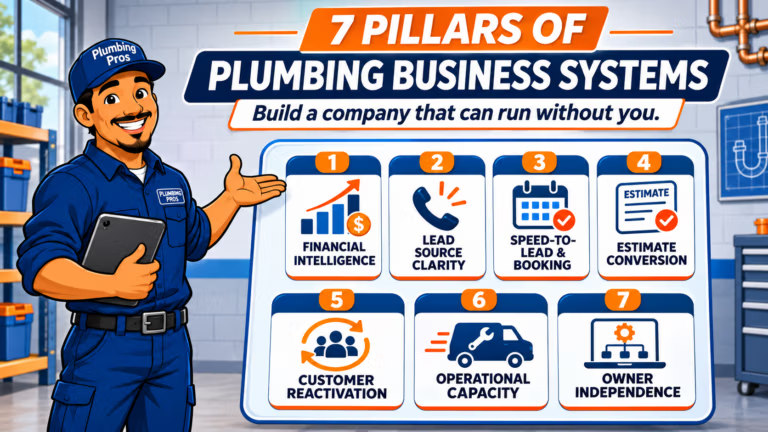
In this episode, Juan Carlos explains the seven pillars he uses to help plumbing and home-service owners strengthen profitability, build systems, and reduce the company’s dependence on its owner.
See how much your business still depends on you:
https://scalemyprofits.com/owner-dependency-score/
The offer was for the company’s assets, along with a job for Juan Carlos to keep running the business. The buyer saw that too much of the company depended on Juan Carlos personally. The revenue was there, but the business wasn’t yet transferable.
They are financial intelligence, lead source clarity, speed-to-lead and booking, estimate conversion, customer reactivation, operational capacity, and owner independence. Together, they help owners see where profit is being lost and build systems to address it.
It means looking beyond an employee’s hourly wage. Owners also need to account for payroll burden, overhead, vehicles, insurance, and other operating expenses when pricing work. Juan Carlos shared an example of a company that was using an operating cost of $149 per hour when its actual cost was about $350.
Juan Carlos recommends looking at open estimates, missed calls, and past customers. In one example, he estimated that structured follow-up might close 15–30% of $100,000 in open estimates. He also modeled how missed calls and customer reactivation could produce additional revenue, depending on booking rates, ticket size, and customer response.
5. How can an owner build a business that operates without them?
Document how decisions should be made, build a capable team, and give people clear responsibility instead of routing every decision through the owner. Juan Carlos recommends testing the systems by stepping away for an extended period, such as six weeks, without relying on the phone to manage daily operations.
Paul Benton: If you’re a plumber or a friend in the trade, you’re in the right place today. At the table is Juan Carlos Velasco. He built a multi-trade home service company, including plumbing, electrical, and HVAC, doing nearly $8 million in annual revenue, which he later sold to Comfort Systems USA. He has expertise in both residential and commercial, and he has an MBA in finance.
Paul Benton: Today, as founder of Scale My Profits, he helps plumbing and trades operators recover lost revenue, improve margins, and build businesses that can thrive without them. Today, we’re going to learn about the pitfalls and the opportunities in growing a successful plumbing company. Juan Carlos, welcome to the Plumber Marketing Success Podcast.
Paul Benton: Good to be with you.
Juan Carlos Velasco: Likewise, Paul. Thank you for having me
Paul Benton: So Juan Carlos, you have a very interesting ignition point, uh, into your consultancy and into helping other tradesmen, uh, and tradespeople. Um, you built up this great big company, and you were shocked to learn that, uh, it wasn’t the offer you accepted, but you were, uh, shocked that with an $8 million annual revenue, somebody said, “I’ll take it off your hands for a dollar.”
Paul Benton: What was going on there? And that then set you into your journey, uh, to get an MBA in finance and start teaching tradespeople how to avoid the mistakes you made. Um, tell us about that. How’d you get started, and what’s the source of that story?
Juan Carlos Velasco: Yeah, Paul. No, yeah, thank you, um, for asking the question ’cause I think it’s something I never experienced I was going to experience when building the company.
Juan Carlos Velasco: Um, so it was my brother and I, um, had decided to, uh, build a mechanical company. Uh, uh, he was a tradesman. Uh, he was the master plumber. And, um, you know, he reached out to me one day, he’s like, “Hey, let’s build this company together.” I’m like, “Let’s do it,” right? And so two brothers up in Colorado. It was kinda, you know, like the mix of everything was working well for us in our favor, you know.
Juan Carlos Velasco: Uh, plus a lot of hard work, a lot of s- uh, sweat equity. So we built the business within about four to five years to about $8 million in revenue. Um, you know, had 8% net, uh, margin on it, you know. We had 26 employees. Um, like you mentioned, we did plumbing, um, HVAC. We did electrical, commercial, residential. You know, we were, you know, 13 trucks in, right?
Juan Carlos Velasco: Uh, we were doing pretty well. Um, at least we thought so, right? And then, um, you know, life event happens. Uh, he’s in a motorcycle accident p- and passes away, right? And then I had that personal emotional side, and then I had, you know, this whole other, um, you know, now thing that came on me, which was a company and all the employees that I had to deal with.
Juan Carlos Velasco: So at some point I said, “You know, I don’t wanna deal with it,” right? Uh, “Let, let me go out and see if I can, you know, sell the company,” ’cause we built it, you know, pretty strong. You know, we had, you know, 20, you know, $250,000 in the bank, right? We had employees, we had jobs. So I find this company up in Denver, um, pretty large, you know, uh, organization, and I said, “Hey, um, you know, I have this company up here in the mountains.
Juan Carlos Velasco: Um, we’re doing pretty well. You know, I would love to see if, you know, you guys are interested in acquiring it.” They said, “Sir, you know, s- send us your P&Ls, pr- you know, balance sheets.” You know, we had QuickBooks, you know. So I, I send it to them, and then, uh, he sets a meeting with me, uh, a, a week later, their, their CFO.
Juan Carlos Velasco: So I’m sitting at my desk, right? And I still remember to this, to this day, I had my pen and my paper staring at my P&L. And then he says, “Juan,” he says, “uh, we reviewed all your financials,” right? He says, “We’ll give you $1 as an asset sale, but we’ll hire you to run it.” And then, you know, it was like one of those moments that are engraved in your mind forever.
Juan Carlos Velasco: Um, and I write down that, you know, dollar sign and the one, right? And I was kinda speechless. I even told him, “Hey, why don’t you come out? We’ll take you to our jobs,” right? “Uh, we’ll give you a tour.” Uh, he said, “Juan,” this is exactly what he said, “What is on paper is what I can measure,” right? Then he said, “You know, you are the company, Juan,” right?
Juan Carlos Velasco: “Your brother was a company. Now you are. If we pull you out, it’s not the same business,” right? And then he hung up, and I was just there frozen in time. You know, I was like, “What the heck did…” First of all, I didn’t know what an asset sale was, right? Um, so I couldn’t put those two, two things together. But- What he saw that I didn’t, Paul, which, you know, this is, this was a huge learning lesson for me, was that the numbers were fine, right?
Juan Carlos Velasco: But the transferability wasn’t. That was the key, right? So, so, so the, the buyer, you know, really doesn’t pay for, you know, that, those extra late nights, right? Um, they, they pay for that future confidence. They pay for a system, something that will run without them, you know, putting too much effort into it, right?
Juan Carlos Velasco: Specifically with all the, you know, hard work that you put into it, the value that you put into it, you wanna be able to get it back. So they don’t buy a job, what I realized, is they wanna buy a real business, if that makes sense.
Paul Benton: And so that’s a… I see here on the website, at scalemyprofits.com, you have take the free owner dependency score test, and that’s the essence.
Paul Benton: So you couldn’t build asset value because you were the company, and if they paid you, um, a few million dollars and, uh, you were hit by the bus the next day, they had no asset because you were the company. So that’s what set you then to, onto, onto your journey to help other com- company owners learn how they need to build their companies so that they have something to sell.
Paul Benton: And it’s not just on the top line of the P&L. You have to have a depth of management.
Juan Carlos Velasco: Yeah. When, you know, 100%, a- and, and we kinda tend, like when we grew it, you know, we had, you know, f- four to five, uh, staff members in the office, right? You know, we had our, um, you know, supervisors in the field. You know, we had a service manager.
Juan Carlos Velasco: You can have those positions, but if certain decisions still run through you, you know, and obviously you’re the owner, right? I mean, you’re, you, you’re still going to be able to, you know, make those decisions, but it’s that independence that we never really gave out, right? Uh, it is sometimes it’s control.
Juan Carlos Velasco: And when I realized, like, you know, it’s the systems, and sometimes it’s not the, like, the actual mechanical systems like a CRM. We had CRMs. You know, we had scheduling softwares, right? But it’s the systems behind it. You know, like, it’s that decision tree. You know? Um, it’s that org chart. You know? We didn’t have an org chart.
Juan Carlos Velasco: It was up here, right? Um, you know, if this person left, then we just put him back in place, right? So it’s, it’s really what these larger corporations think of, uh, and what they look for when purchasing, purchasing a- an asset, you know? Um- Mm-hmm … and then what, what we did, you know, like, you know, what I did. So I was like, “What the heck is an as- a asset sale?”
Juan Carlos Velasco: You know? So I went back to school. I went back to school to get my MBA in finance ’cause I’m like, “I gotta figure this out. There’s no way that I will let this go,” right? What, what we built, you know, for the five years. And, you know, my brother, you know, that was his dream, right? Uh, mine too, and I’m like, “So I had to rebuild this.”
Juan Carlos Velasco: So then what I did is I rebuilt under systems. You know, it took me a while, uh, to find the person that ended up being the general manager. So when I turned over the keys over, that’s exactly what it was, right? Like, I had to turn over a system where it’s like, there’s the keys, you can run it. And then that, that’s when I sold it afterwards, right?
Juan Carlos Velasco: Um, but everything had to be, you know, it’s the playbook, you know?
Paul Benton: And this systems thinking actually led you to, uh, build seven, seven financial or seven- several, seven core operational pillars That you’re coaching, um, your clients to think about in order to build a system that can operate with asset value apart from them.
Paul Benton: So many guys are great, um, on their own, and swashbuckling, um, and great operators with their own two hands, but a company is more than that. That’s a team. So do you wanna take us through… And what I propose we do is let’s go through your, um, pillars for financial success and f- and, and independence, and then I have, because of your MBA in finance and you’re an operator, I would love to ask you some pretty rubber meets the road financial questions, if I may.
Paul Benton: Does that sound good?
Juan Carlos Velasco: Sounds great. Yeah, absolutely.
Paul Benton: So you wanna take us through what are the, what are the seven pillars, um, for a plumbing company that it needs to build in order to have good- Yeah … um, asset value when it sells?
Juan Carlos Velasco: Absolutely, 100%. So, so the, the very first one, um, is what I learned, right? You know, sitting at the desk when they offered me a dollar.
Juan Carlos Velasco: It’s, it’s a fin- financial intelligence, I call it. Now, this goes, you know, I mean, you, you know, you, you have to know your actual labor costs, right? And profitability by job type, um, by department, right? And then you even step it down further, you know, per truck, per tech, right? Now, the, the great thing is there are systems now that can help you with that, right?
Juan Carlos Velasco: But it’s the foundation. So financial intelligence is so important because it’s not just what’s on paper, that’s what I learned, but also what’s behind it, right? Like you mentioned something earlier, you know, we tend to look at the top line, right? Mm. And then, like, the bottom line, but then what’s in between is, is very important, you know?
Juan Carlos Velasco: Um, sometimes what I see, like, biggest mistakes on the financial intelligence side is, um, you know, we price off c- you know, off competitors, right, i- instead of the true cost per billable hour. Ev- every company’s different depending on how many trucks, your location, your rent, your insurance. You know, there’s all these factors that we didn’t see, right?
Juan Carlos Velasco: Um, and, and, and it doesn’t show right away. You know, like, you know, once that job is done and you collect that check, it, it won’t show there. It’s weeks later or, like, maybe even months later, like, on your P&L or in your checking account, right? So the finance, eh, financial intelligence is so important.
Juan Carlos Velasco: Looking at the top line revenue, bottom, but then what’s in between. What’s almost, like, behind, you know, what, what, what we all see. Um, which is knowing your overhead costs, you know, knowing your operating costs per hour, right? That one’s a really important one, and it can fluctuate. Um, and that’s the key one.
Juan Carlos Velasco: Um, so I’ll, I’ll pause there. I don’t know if you have any questions on, on that financial, but, you know, that’s a key one for sure.
Paul Benton: So, uh, there’s a well-known saying out there, Peter Drucker, “You can’t manage what you don’t measure.” So if you don’t know these metrics, you can’t know if it’s coming to bite you.
Paul Benton: It’s hard to get to that level of detail, but the good news is, with the advent of AI, the CRM systems are onboarding AI. And in a short period of time, meaning months if not a couple of years max, you’ll be able to ask by prompt, “What is my profitability per tech? Who’s making money? Who’s burning money?”
Paul Benton: And that will be hugely empowering. How did you do it, or how, without that AI, how do you get that information? Well- You gotta … You, you basically have to have a really solid accounting department.
Juan Carlos Velasco: Correct. Um, and, and you’re absolutely right. So I almost tell people there is no excuse for not to know your numbers anymore, right?
Juan Carlos Velasco: Um, when w- when we grew it, that’s why I went back to school to get my MBA in finance, right? And then Excel became my best friend, right? You know, Excel is just a fancy calculator, but now we have AI. Now we have intelligence that can actually grab your numbers, right? Um, but you’re absolutely right. Um, we do have the tools now.
Juan Carlos Velasco: Um, what I tell everybody, you know, when we go through this puller, it’s not that for you to be an accountant. You don’t have to get your MBA in finance. You don’t have to be a bookkeeper. The most important thing is asking those right questions, right? Um, you know, what is your gross margin overall? What is your gross margin per job?
Juan Carlos Velasco: You know, what is your variable cost, right? Um- As an operator, we know this by instinct, you know. Uh, you know, we know that, you know, we can price this job. It’s gonna cost me this much. You know, we know we, you know, we know roughly, you know, like what the profitability is by instinct. But however, what happens is, um, sometimes it’s somewhat reactive.
Juan Carlos Velasco: I caught myself doing that, right? Just to fill the board, maybe, you know, we put this, but we don’t look at the long-term, uh, impact of it, right? You know, did, you know, did my marketing spend increase this month, right? But I’m pricing it l- you know, as, you know, uh, this way. Um, or did, you know, did my tech price it incorrectly?
Juan Carlos Velasco: Or, you know, how many callbacks did we have this week that I have to make up for, you know, like going forward? But you’re right though, so you hit on something very, very important. We have the tools now just to understand the questions that we have to ask. We need to figure out what questions we need to ask for to be able to get those responses to know where the financial health is o- of our businesses
Paul Benton: So your second pillar is very close to my heart.
Paul Benton: So, uh, you are an operator, I am a marketer, and lead source cla- clarity is bedeviling clients A to Z. And even on ServiceTitan, um, ServiceTitan is a great system, but you have to know how to use it. It’s very often as clear as pea soup if you’re not setting it up properly. And if you don’t know where your leads are coming from and going, um, your marketers have no idea if they’re doing a good job or not.
Paul Benton: How are you handling that, uh, for your clients?
Juan Carlos Velasco: Yeah, 100%. So you bring up a really good point. Um, it’s the, where are your leads coming from, right? Like, that’s the very first step, you know, um, the first step in any marketing. And what I see a lot of is, you know, a, a lot of operators, you know, it’s, um, you know, my ROAS, my return on ad spend, isn’t exactly where it should be, right?
Juan Carlos Velasco: Um, so what do they do? You know, they just increase the leads, right? Like you mentioned, like you, you do need to know where your leads are coming from, right? Because they… And, and nowadays it’s very different, right? They could be coming from anywhere, you know, like as you know. So, you know, so, so you have to have this multi-touch system, right?
Juan Carlos Velasco: Is it possible to track? You know, we’ve had conversations and y- y- you know, and you do it for your clients, and it’s very important to know where everything’s coming from. But however, also you need to kind of understand, you know, treat the lead, um, like a cost per lead instead of profit per job, right? Um, because not all leads are going to close once you go step by step.
Juan Carlos Velasco: The, the cost per lead looks fine sometimes while the revenue drops, right? It’s one or the other, right? So sometimes we see the revenue drop, and then what do we do is we increase leads, but we’re- we don’t know which source it’s coming from, right? Um, and it’s very important to track even more now, um- Because you wanna have a system behind it as well, you know?
Paul Benton: ROAS, return on ad spend, is not only a function of what, um, a marketing channel like Yelp or Google will charge per lead, but it’s also a function of how much business do you close. So if your marketer is sending you, um, 100 leads and you’re only closing two of them, uh, you need to ask, I think, why. And, um, the, the common complaint is, “Oh, it’s the lead channel.”
Paul Benton: But another question would be, are you following up with those leads? Are you asking for the order? Is there sales? We’ll get to that a little later, but, um, it’s a formula, and a formula has multiple variables. It’s not just, it’s not just the, the channel. D- would you agree?
Juan Carlos Velasco: 100%. So one of the conversations…
Juan Carlos Velasco: And, you know, and, you know, and I was guilty of this as well. You know, like, we were guilty of this. It, it’s, you know, let’s try this lead source, right? And then exactly what you said, it’s not producing X amount, or my, you know, return on ad spend. So I’m gonna throw, throw that one away. I’m gonna focus on something else, right?
Juan Carlos Velasco: And then I’ll run it. Marketing isn’t working, so I’m gonna switch over. I see this every single day, right, you know, when I talk to operators because, you know, I, I was, I was exactly doing the same thing. Um, but to your point, it, it is that, you know, lead to, you know, not only from lead to book, right, but then book to, you know, actual project, and then to getting paid.
Juan Carlos Velasco: You know, like, there’s several steps. Um, so 100%, the conversion rate, sometimes we focus too much on the, on the conversion, meaning from, like, you know, lead to, um, you know, booked, or, like, lead to sale, right? Th- that’s great. Absolutely. But once we dive in more, and then you start asking, you know, “What’s your lead to, you know, actual, um, you know, conversation, you know, with your CSR?
Juan Carlos Velasco: And then from that conversation, how many of those book?” Once you start dicing it up, then you will find that p- it’s possible, you know, you are not following up on the leads, right? Maybe it’s, um, you know, that, that, that conversation that your CSRs are having, right? Um, or it’s that speed to lead, you know?
Juan Carlos Velasco: Um, so 100%, it’s, there, there’s a lot more between just getting the lead and then, and, and then closing it.
Paul Benton: Your third pillar, Juan Carlos, is speed to lead and booking. That’s what we were just… That’s a nice… What’s the next step there?
Juan Carlos Velasco: Yeah. What-
Paul Benton: What are you usually finding that you’re fixing?
Juan Carlos Velasco: Yeah. So, so there is obviously, it’s, it’s really important, especially, like, if you have a team, right?
Juan Carlos Velasco: Um, you know, you, you have to improve their response time Has this always been in effect? 100%, right? Um, and then you gotta ask the questions, you know, um, you know, like on the call handling and on the booking rates. Now, we just did an analysis, uh, with another partner, a, uh, national call center 4:00 PM is where the majority of lost opportunities are, right?
Juan Carlos Velasco: Um, and this is across, like, thousands of calls. Um, so at four, at 4:00 PM, th- you know, that is a spike. And, and what I mean by that is, you know, if those calls are coming in, you know, you have to have that response time, right? Like, you have to have a backup system as well. Um, so the speed- Mm-hmm … to lead, and it’s even more now because, you know, a- as a society, I think we’re, we’re, uh, you know, we, we want it now, we want it fast, right?
Juan Carlos Velasco: Um, you know, we want something, we order it, and it’s at, at our door sometimes, like, within hours or less. Um, this industry is no different. You know, if my AC’s making noises and I don’t know what the heck’s going on, I’m gonna call, and I want a response. I want to speak to someone, right? Um, and then y- you know, as well also from speed to lead, the way…
Juan Carlos Velasco: O- one of the things that you can do is that you need to listen. First of all, you need to record your phone calls, you know, have some sort of system where… And, and, and like you mentioned earlier, AI, right? A lot of this is not produce more work. We actually have the tools to make it easier for ourselves as an operator, right?
Juan Carlos Velasco: Um, so track those calls, right? And s- see how you can improve on them. Um, and the speed to lead now, I mean, you know, you can have AI as a backup. I still feel, um, you know, people still wanna hear a voice on the other side of the phone, right? Um, but you wanna watch that segment of time wh- when the calls are coming in to have a system, and then you, you need to measure it, and then get feedback as well, you know.
Paul Benton: That takes us into your fourth pillar, estimate conversion.
Juan Carlos Velasco: Oh my.
Paul Benton: Let me give a little just setup here. So we are, v- as marketers, we’re very much in, uh, advising our clients in how essential speed to lead is. When that lead first comes in, in a, in any m- major market today with m- private equity operators, you’re going to finish a, um, a, uh, request to quote, and before you’re…
Paul Benton: you, you sit back in your chair, your phone is already gonna start ringing. So it’s a horse race. And therefore, if you are an operator, and you’re thinking speed to lead doesn’t matter, it means that if you’re not in that race yourself, four, five, six other companies will have gotten there before you if you don’t have the system in place to play that game.
Paul Benton: But now, where is the vulnerability on the private equity side? Private equity doesn’t necessarily, like in a sales cadence, follow up with closing deals, and that’s estimate conversion. They’re really good at getting the initial job booked, but how good are they actually at following up to closing those estimates?
Paul Benton: Recently on a project that I, I was on in my own home, I had to play that in reverse. I had to call, um, the, uh, plumbing companies to ask, uh, if I could get my estimate, and then ask if they could sell me my project. I was, as the homeowner, had to do that. It wasn’t the other way around, and I think that’s an…
Paul Benton: That, th- if that reality is widespread, which I think it is, that’s a huge opportunity, and estimate conversion is, is, uh, the fourth thing that you are really counseling your clients on. Um, what’s the opportunity you see to, uh, get more value out of that?
Juan Carlos Velasco: My gosh. So you said it perfect. Um, I, I think it’s, um…
Juan Carlos Velasco: There’s this term, it’s called recency, uh, recency bias, right? It’s what we focus on now, but we forget about the past and the future, and that’s a perfect segue for, like, uh, estimates, right? Because when you focus so much on getting leads, right, you get the lead and then y- you know, your tech goes to the, uh, house, and then you, you create an estimate.
Juan Carlos Velasco: I don’t know how many times, I can’t even count them at this point. I was just talking to an operator today, um, has over close to $600,000 of open estimates in the system. Now mind you, there is an automation, but they have to, you know, decline that estimate so it, you know, creates the automation, and then, you know, and then it follows up on it.
Juan Carlos Velasco: That is probably one of the lowest hanging fruit for any, any operator, right? It’s the estimate conversion. Now, there… I think there’s, um, a- a- and I was guilty as well, right? Like we would hand out estimates nonstop, but we’re kind of hoping sometimes that the homeowner will come back and just, you know, magically say yes.
Juan Carlos Velasco: It’s not gonna happen. It’s even less now. Exactly what, to your point and kind of, you know, your, um, your test that you did. Um, there’s a lot of people behind you giving them estimates as well, right? Um, so you have to beat them first essentially. Um, and it’s not just letting that estimate sit there, right?
Juan Carlos Velasco: Um, you have to follow up. Um, you use technology to follow up. You have some human touches behind it. Um, and I think now there’s a huge advantage with operators. And again, I wanna get your opinion too, Paul, because obviously, I mean, everyone’s going to systems, which is great, right? You, we wanna become more efficient.
Juan Carlos Velasco: But the one that’s actually, you know, if, you know, like if you call five different people, right? Um, and you get five different estimates, and then you might have some emails or some texts on some, or one, one operator might call me, right? And say, “Hey, hey, Juan. You know, I saw you got an estimate. You know, it’s been a couple weeks, you know, have you…”
Juan Carlos Velasco: Who am I going to make that connection more? Because that person cares and picked up the phone. Again, I wanted to get your opinion there ’cause you did that test, right? Um, and I think there’s a huge advantage right now with operators where, you know, if they take that extra step.
Paul Benton: I think it, it, within the topic of estimate conversion, what do you think?
Paul Benton: I think the home service Plumbing, HVAC, but generally have conditioned the marketplace and themselves to be principally in the business of dropping off price quotes. That’s a different mindset than a sa- a conventional salesperson has, which is to close the estimates that have been dropped off, and I think there’s a huge upside opportunity if, uh, there were a small shift in that mindset because, um, dropping off the estimate is not…
Paul Benton: You can’t go to lunch on an estimate. You, you, you need to close business. What do you, what can you advise that… I mean, there are speed to lead technologies, uh, that typically, for example, ServiceTitan, and there’s a, there’s a company called Chirp and Hatch, great technologies that are going to follow up with email and text to basically remind the customer, “Hey, you have an open estimate.
Paul Benton: I’m checking back in with you.” But that’s not sales. Sales is the person picking up the phone and saying, “What can I do to make a deal today?” What has happened there in your… You, you’re in the trenches every day. How many of your guys are actually going in the sales direction rather than the automation direction?
Juan Carlos Velasco: S- That is an amazing question, ’cause, ’cause I think that has been, um… When I was an operator, we had, you know, sales, right? Um, and, and sales comfort advisor, you know, whatever the, like, the term is. I think there has been a separation, exactly what you said, you know, like the tech, I’m just dropping them, you know, drop an estimate, drop an estimate.
Juan Carlos Velasco: Um, I see this all the time. Um, again, even if, you know, the owner himself drops off, uh, a estimate, and then they go to the next thing, right? Not to their fault to themselves. I mean, they have a company to run, right? Um, and to your point, there is a lot of tools out there, but I think that’s a very good separation, exactly what you said, is, um, dropping off an estimate versus sales.
Juan Carlos Velasco: And, a- and sales, I mean, it’s to identify what their issue is, you know, and, you know, how, how can we make this better for you, right? I mean, if you think about it, like, y- you know, we all have a problem when we get an estimate. I mean, it’s not easy to pick up the phone and invite someone into your house, right, to look at your system, and they’re probing and they’re prodding and they’re asking questions.
Juan Carlos Velasco: I mean, there’s commitment there with the homeowner, right? Even if they’re shopping around. So it’s just a matter of understanding where, m- you know, th- where they’re at and then meeting them somewhere, right? So I think you bring up a really good point, and I think that separation has been bigger. And I think that, like, I was talking to an operator today.
Juan Carlos Velasco: We won almost $600,000 sitting in open estimates. And once we reviewed them, a lot of them were exactly that. You know, they were just service calls, and they gave an estimate, and they walked away, right? Uh, you know, and then they pile up. The majority of them were under, I think, like, you know, maybe, you know, 1,800, you know, like 2,500 average, right?
Juan Carlos Velasco: Uh, but they pile up. Um, maybe that one’s not as important as the es- uh, you know, to them as the install, you know, $20,000 install, but they add up. Also, to your point- Mm-hmm … I think with the follow-up of, you know, a- an actual true, you know, uh, you know… And, and the salesperson job or responsibility is to identify what are your needs and how can we meet you halfway, or w- whatever position that is, right?
Juan Carlos Velasco: You know, how can we help you? Um, so I think that distinction that you brought up I think is very, very very important, um, to be able to, you know, help converting some of those estimates, ’cause I think they’re just left open. Um, and any system that you go in, I mean, you know, most operators, they have that flashy number.
Juan Carlos Velasco: I mean, a- and I wish, like, Service Titan or HouseCall Pro would have, like, some sort of alarm, you know, for when your service estimates are open. You know, like some sort of flashing something where it would just, it’ll kinda cause people to kinda take action on that.
Paul Benton: In, in your experience, how long is the life of an estimate before you should say that puppy is dead?
Juan Carlos Velasco: Um, well, this, that’s a really good question. If, ideally after 30 days, right? Like after 30 days it’s… I mean, you know, depending if it’s a service call. I mean, if, you know, my system is making noises or if my, you know, whatever it is, ideally y- you know, or if it’s your plumbing, right, if y- if it’s your water heater leaking, how long is that homeowner actually gonna sit and wait to, for that thing to blow up, right?
Juan Carlos Velasco: Or, or if they have a leak in the wall, right? It, they’re, they’re gonna get it fixed pretty quick. Um, after 30 days they’re done, but the problem is then they start building up, right? Then you have these, you know, over 120 days. And so, um, you know, a- anything over 30 days, right? But you wanna have a system that continues touching them.
Juan Carlos Velasco: ‘Cause you still have a percentage of, of people that might not replace their water heater or fix that leak in the slab or something like that- Mm-hmm … just because, right? Uh, so technically, and, and you know, I get a lot of pushback, and I was the same way. After 30 days, you know, y- you gotta have some sorta system that’s taking care of those.
Juan Carlos Velasco: Um, and they’re probably done.
Paul Benton: What percentage of that 600,000, your, your client with 600,000, how many of that w- of those were over 30 days? Do you remember?
Juan Carlos Velasco: Yeah. That was probably like, I think 75 to 80%. We’re over- Over 30 days … over 30 days Yeah, 100%. And it’s, it’s the psychology of turning those off, right?
Juan Carlos Velasco: Uh, there’s something. But, you know, we have a system in place, right, uh, for him now. Uh, so all he has to do is decline it, and then the system takes care of it.
Paul Benton: Let me ask a metric question. So within the 30 days, if w- i- if those over the 30 days basically are like the dead parrot in Monty Th- Python, they are deceased even if the operator doesn’t believe it-
Juan Carlos Velasco: Right
Paul Benton: um, the first 30 days could turn to business. What percentage of estimates in the zero to 30-day column i- uh, should a good operator, if, if he or she is doing good work, what should they close?
Juan Carlos Velasco: Yeah, I would
Paul Benton: say about- As top, as a top performer …
Juan Carlos Velasco: about 15% to 30%. Um, 15% to 30%, uh, with a proper follow-up. Now, you know, and I’ll probably get pushback on this, not just calling them and say, “Hey, you know, you have an open estimate, you know.
Juan Carlos Velasco: What are your thoughts?” Y- have a conversation, exactly what you said, right? Um, you know, a- and there, there might be some training involved, right, you know, which whoever’s following up on the estimates. Uh, but I would say fif- 15% to 30%, uh, y- you know, you can, you know, you… With, with a proper follow-up system, of course, right?
Juan Carlos Velasco: And proper conversation.
Paul Benton: Almost two out of every three estimates that you’re called out on are not gonna close. That’s a tough, that’s a brutal psychology.
Juan Carlos Velasco: It, it, it’s very brutal. That’s why what you said earlier, it’s about when you’re there, not just dropping off an estimate. Y- because once you leave, you know, we all know this, like, you know, the, the chances of closing that is not very high with the numbers exactly which what you just said.
Juan Carlos Velasco: So when the opportunity is there, like, you know, and sales, that’s what it is, right? Like, wh- when you’re in the room, right? Uh, th- that’s your best opportunity there to close it. Um, after you leave, uh, and I think there’s psychology ’cause we had the same thing. It’s like, you know, if I have those numbers on the board, I mean, it, it’s hard work, right, uh, to give an estimate sometimes.
Juan Carlos Velasco: You paid for that estimate. You know, you paid your tech or your own time, you know. Um, so yeah, so i- it’s a very hard number to swallow. That’s why, um, I think we have to realize once we’re on site, you know, that’s where the real, uh, work has to be done, you know, essentially.
Paul Benton: So the, uh, next one, the fifth is customer reactivation, and I wanna ask you this.
Paul Benton: I, uh, um, operators are going to say to themselves, uh, there are t- two ways of looking at this. Which one is the correct one? Uh, one is if a customer bought from me within the last 90 days, they are an existing customer And another way of looking at this is if they are a repeat customer, and an existing customer and a repeat customer are two different things.
Paul Benton: So we often are encountering, particularly in Yelp, that a, uh, when, when we… Yelp is a great channel. It delivers, uh, reliably, uh, five times ROAS. But then, uh, often we’ll get challenged, and the client of ours will say, “Well, that customer is an existing customer.” And our sometimes unstated question would be, “Well, why are they dating around in Yelp if they’re your customer?”
Paul Benton: So customer reactivation, I would love to know from you as an operator, is there an important difference between, um, a past customer or re- sorry, a repeat customer and an existing customer, and you’re not an existing customer unless you’re in a me- in a, in a membership. Do you think that’s right or wrong?
Juan Carlos Velasco: That’s right. Um, so I’ve had this conversation with other operators, and even with my partner and my brother at the time, right? Um, we, we feel, you know, ’cause I was guilty of this too, is when they call me and we do a service call and I have their number in my system, they’re our customer. They are not leaving, right?
Juan Carlos Velasco: I had this, uh, uh, uh, it was a discussion, um, about client reactivation with a operator. He said, “One,” he says, “Once I have a customer, it, they’re never, they’re never going to shop around. They only use me once every two years, you know, once every year Well, that’s a myth, right? From my experience from the business, from my own businesses, and then, you know, even from the ones that I touch, so it’s…
Juan Carlos Velasco: You’re absolutely right. A, a customer that has, um, you know, that, that has a membership or cust- uh, agreement, right? Um, those are true existing clients. Those are yours because it’s top of mind, right? If you have a client under a preventive maintenance agreement, if they have a plumbing issue or whatever issue it is, who are they gonna call first?
Juan Carlos Velasco: I mean, th- they’re in a membership, so they’re gonna call you, right? That’s a true customer. And like you said, and I love your… You know, if they’re dating around in Yelp because then, you know, they’re looking for other options, right? Uh, so a repeat customer, I believe it’s two or more jobs, right? They’re, they’re, they’re loyal, but they’re not locked in, right?
Juan Carlos Velasco: Um, a one-time, they might know your name, but they’re not loyal. And then you got the shoppers, exactly to your point. They’re either in, you know, Yelp, or they’re looking at Angie for quotes. Uh, they’re, they’re comparing pricing. And I kinda went into it in reverse ’cause everyone’s objective goal is to put them in some sort of membership, some sort of, some sort of comfort club, right?
Juan Carlos Velasco: Um, those are true customers because if they have an issue, they’re not going to go outside and call someone else. You know, they’re not gonna go to Yelp, right? And you bring up a really good point, and I learned this the hard way when I tried to sell my company, is your MRR. You know, what’s your monthly recurring revenue or annual revenue, right?
Juan Carlos Velasco: And that’s a way- Mm-hmm … where you can build value in your company as well. We think just because they’re in our da- That’s what I thought. We had a lot of customers in our database, and I thought, you know, “Hey, you know, we got thousands of customers that, that we’ve serviced. This is value.” And no, it’s not.
Juan Carlos Velasco: Um, it’s with the, with agreements, right? Uh, but to your point, yeah, 100%. I think, um, that is the goal to build, uh, a company is to truly have a loyal customer base, and I think right now it’s the most important that you can build with client reactivation. It’s one of the most missed, um, with the operators that I work with.
Juan Carlos Velasco: It’s set up, and they usually get in combination marketing ’cause you have to have marketing. Like, you have to have those channels because, you know, you can also, um, you know, just, you know, if you just work your nurturing, um, you know, you just nurture your own clients, it only gets you so much, right? And then you want growth, so you wanna bring in new customers.
Juan Carlos Velasco: It’s the chain. You can’t just focus on one. Um, but, uh, client reactivation is probably one of the other lowest hanging fruit that you can do as an operator. Um, you know, plus bring in new customers, and then, you know, and then your customer value increases.
Paul Benton: And, and by customer reactivation, you mean emailing, texting, and postcards to your existing customers- Yeah
Paul Benton: or marketing to them specifically in social media, but basically staying in front of them. And here’s a question. The two schools of thought, uh, do you want to be Mainly sending them offers, or do you wanna be sending them non-offers, informational kind of content? And our clients have two different schools of thought on that
Juan Carlos Velasco: To your point, uh, yes.
Juan Carlos Velasco: Um, offers are great, right? You know, to be able to introduce them, maybe it’s like the membership, maybe it’s a tune-up, it could be seasonal. Um, but it, it’s almost like to your point of, like, dating, you know? Uh, you know, um, or even just having a friend, right? Um, it- the more c- the more contact points you have with that, they’ll forget about you less, right?
Juan Carlos Velasco: Um, of course, you always have those customers that… Or those friends, right, that will, no matter what, you could contact them once a year, they always come back to you. That’s very few, right? You know, I have, like, one or two, right? Um, but everyone else, it’s, like, it’s those constant touch points. Why? G- going back to, like, the dating analogy, which I love, it’s like, you know, I mean, if I’m dating, you know, when I was dating my wife, uh, you know, like, at a, you know, like, we were at a club or something, and I step away, you’re gonna have other suitors that are gonna come talk to her.
Juan Carlos Velasco: So you have other companies talking to your own client. They’re seeing other ads, they’re seeing other offers. Um, so to your point, it’s not always an offer. It could be just education. You know, “Hey,” um, you know, you send a mass email to your clients. You know, it’s gonna be, you know, um, you know, I’m in Florida, so you know, “It’s gonna be 100 degrees with 80% humidity coming up,” right?
Juan Carlos Velasco: Um, “Have you checked your filters yet?” You know, or, um, you know, you know, “We got a huge thunderstorm,” you know, “There’s a lot of wind,” right? You know, “Ha- have, have you checked your condenser unit outside for intake of leaves or whatnot,” right? Um, it’s all these little touch points, then, then you become i- in their mind, their best friend in their field, right?
Juan Carlos Velasco: Or, or even in plumbing, right? You know, like, you know, “When’s the last time that you looked underneath your sink?” Right? You know, um, you know, is that, you know, did you know, um… And this, you know, obviously, like, in plumbing, even, like, a runny toilet can be very, very expensive, like, in water, right? Um, and there’s some math to it, I forgot about it.
Juan Carlos Velasco: But what if you send them that, you know, and then they’re gonna look at their runny toilet, you know, like, if they have one. So it’s education, and then combined with an offer. I always like to do, and, and I would love to get, get your opinion, I mean, it’s, you know, you know, you give two, three pieces of, uh, education, and then you give them an offer, right?
Juan Carlos Velasco: Um, because you don’t know where they’re at in that stage. What do you think on that? Like, on-
Paul Benton: No, I think you’re right. I, I, I think that your content should be Um, two, two thirds education and one compelling offer. So don’t give a default offer of $50 off something unless you think that the $50, or you know that the $50 is actually gonna move the needle or move…
Paul Benton: motivate somebody. But just throwing away an offer at somebody, in a way, cheapens… If you are always offering a $50 discount, then they’ve come to build that into the average, so there’s, “You’re always giving me $100 off.” You gotta do something compelling, and I would agree with you. The content should be good and educational, and not just, let’s say, AI slop.
Paul Benton: It has, it has to be good quality con- content.
Juan Carlos Velasco: 100%. And, and, and, and to add to your point, like, on the content, I, I get a lot of pushback from operators, ’cause they say, “Oh, you know, like, we can’t email. We can only email once a month.” I mean, with the newsletter. Th- that’s great, but one thing that we do now is, is we absorb content like you wouldn’t believe, right?
Juan Carlos Velasco: We’re on TikTok, we’re on Facebook, we’re on this, we’re on that, we’re on YouTube. Content is what people love right now. So why not create your database? Why don’t you become that content for them? And you’re just… And it doesn’t have to be just, you know, like, check your running toilet. You know what I mean?
Juan Carlos Velasco: You know, you can provide some other value as well, you know, kinda to your point, like two thirds being value. Um, so I think there’s this myth of like, “Oh, if, if, if I send them too many emails, I’m gonna bother them.” But guess what? I get a bunch of emails, and I don’t read them all. But the psychology is, if I see, um, you know, Juan’s Plumbing, you know, send me an email, oh, maybe I’ll open it, may- maybe I don’t.
Juan Carlos Velasco: Maybe I get another one two weeks later, and then I notice that my, you know, toilet’s running or my s- my, uh, faucet. Oh my God, I just saw that email from, from Juan’s Plumbing. It’s a psychology behind it. It’s just those touch points, right? Um, we’re not invading anything. If, if someone doesn’t like it, they’re on- they’re gonna unsubscribe.
Juan Carlos Velasco: That’s… And that’s okay, right? Um, so I, I think there’s a myth of, like, we don’t wanna bother our customers. We love content. We love knowledge, right? That’s what, you know, AI is all … We, you know, what don’t we AI anymore? We love information now.
Paul Benton: I think as a benchmark out there, so for if, if, if you’re feeling conservative, that maybe only once a month or max twice a month.
Paul Benton: And I can tell you that’s ultra-conservative. The email marketers out there will… Some of them are saying you should be touching your database 17 times a month. I can’t even get my mind around that. That’s a lot of content. So if you’re afraid of bothering a customer, just know that there are conventional thinkers out there that are comfortable with doing it 17 times a month, so you can afford to do it a couple times a month and not cross the line.
Juan Carlos Velasco: So to our point, so imagine like I was dating my wife still, right? Or, you know, and, and I leave her at a club. You have 17, you have se- I have 17 other suitors that are trying to talk to my wife, trying to steal her away from me. It’s no different, right? Like, to your point. So you, you know, you wanna be part of that into your customer, you know?
Juan Carlos Velasco: Um, Mm-hmm … you know, and just kinda making a joke about it, you know, about my wife. But, you know, you have other people trying to take that customer away from you, and whoever gets the most attention, to your point, you know, it’s, they’re gonna be top of mind when they have that issue.
Paul Benton: Well, there are two more pillars that we should talk about, and then I wanna get into some financial questions.
Paul Benton: But the next one is important if dry, but, uh, it’s very important because it’s the gears and the engine that run. It’s operational capacity. So you’re scheduling dispatch and revenue per tu- per truck. How are you teaching your clients how to track that?
Juan Carlos Velasco: Yeah, 100%. So, so one thing that I, you know, we looked at as an operator was just our board, right?
Juan Carlos Velasco: You know, like, our board, if it was filled, if it wasn’t. You know, like, if we got there at 6:00 AM and our board, there were gaps, we’re like, you know, we’re, we’re strategizing, right? Uh, to be able to fill it. Sometimes that becomes an issue be- me- meaning because we just try to fill the board. Um, n- and again, now with technology, it’s a lot easier to, you know, to fill a schedule up, right?
Juan Carlos Velasco: One example is if you have maintenance clubs or you have comfort clubs, you know, whatever you call them, if you have memberships, those are the… Those are, and we do the same thing, those were good ways of you’re taking care of your existing customers to fill the board. But sometimes, like, the s- like, the need to fill the, your board becomes challenging because then you start forgetting the one of the m- most important thing is revenue per truck, right?
Juan Carlos Velasco: So if I send a truck out, you know, if they’re doing two or three jobs or six or seven, I, I wanna be knowing how much revenue they’re bringing in per job, right? Like, that’s the key. Of course, it’s always gonna fluctuate. One day you might y- you know, you might have a full schedule for that truck and then it, you know, like, it goes out the window, and that’s fine.
Juan Carlos Velasco: What we normally see is, uh, th- there’s always gaps in the middle is dispatch, right? Your dispatch, whatever you use, is so important. That’s why sometimes owner-operators, uh, sometimes they are the dispatcher. They might have, like, a call center, but that call center might not be in tuned with, um, the revenue per truck versus, uh, scheduling.
Juan Carlos Velasco: I see this all the time where they might be scheduling low priority calls just to fill the board, right? Dispatch, uh, versus, you know, taking priority. And, and, and it depends who it is, right? Like, you ha- if you have a third party, it’s very important to, you know, have them know what your priority list is, you know.
Juan Carlos Velasco: Focus on revenue per truck, you know, or revenue per day, revenue per tech, however you wanna call it. So it, it is something that I tell them. Go- go ahead, Paul.
Paul Benton: No. How, how many jobs a day are you, uh, in a, in a home, uh, in a residential plumbing business, how many, how many jobs a day should you be planning for if you’re doing it right per truck?
Juan Carlos Velasco: Yes. Per truck. So that’s a really good question. So let’s say residential. I mean, um, maybe, you know, in a ideal world you would wanna have five to six, and that seems high, but what’s gonna happen is sometimes you’re gonna have either no-shows or, or cancellations, right? There’s this, there’s this kinda challenge.
Juan Carlos Velasco: Mine says, like, if I fill my schedule too much, um, I don’t have opportunities that come in between And, I mean, it’s, it’s a trade, right? Like, I mean, we would have sometimes… So we were in Colorado, uh, and it was a very touristic area. Sometimes we had seven, eight jobs booked, right? Like in peak season. Some of them would drop.
Juan Carlos Velasco: Of course, you know, we were after hours. And then you also… That, that’s a very important question to the pr- to the tech or to the truck, right? ‘Cause we had technicians that were just so good. I mean, you know, we sent them to a water heater, they could f- flip that sucker out like in an hour and a half, right?
Juan Carlos Velasco: Um, and there were other ones that were a little bit slower. So then that becomes also is designating and understanding who you’re sending out to these jobs. Um, and that goes back to dispatch. Um, so, you know, you, you can, you know, you can have two or three jobs and be very profitable as well. Um, so to your point, it can vary, but it does depend per job, right?
Juan Carlos Velasco: But, uh, and that’s understanding, you know, dispatch understanding who they’re sending out there, right? And so that’s… Yeah, so that’s a… I mean, it’s, it’s, it, it’s a moving target, but it is based on that, uh, you know, dispatch really knowing the technician and relating that to what they can do.
Paul Benton: How, um, far ahead should you be planning when you need to expand your trucks?
Paul Benton: You know, you don’t, you, you, you can’t go to the market on Tuesday and that night pick up a new truck, can you? It… You gotta outfit it and design it. How far in advance are you, are you planning growth in adding trucks?
Juan Carlos Velasco: That’s a really good question. Um, I like to like look at it in quarters, but, like, seasonality.
Juan Carlos Velasco: You know, like, every, every market has seasonality, and it’s gonna be different, right? Um, so I always like to project, you know, at least two or three quarters down, you know, further. Um, like right now, I have my operators, you know, projecting, you know, a Q1 and, and Q2 already, right? Based on historicals, right?
Juan Carlos Velasco: And then based on what we’re doing right now. Like, ’cause what I mentioned earlier, e- everything’s kind of reactive, right? You know, like what we do today, you know, the leads that we get today, like the marketing that we do today, we feel it’s gonna impact right now, but it’s, it’s actually just gonna impact two or three months down the road.
Juan Carlos Velasco: So to your point, you know, usually two or three quarters down the road, you wanna start planning for it. It’s scary though. Um, we just helped an operator, you know, get another truck, and it was like, “I don’t have jobs.” I’m like, “Well, let’s…” You know, it, it, it’s kinda one of those things where it’s like, um, the chicken or the egg, right?
Juan Carlos Velasco: Um, and when we first started working with him, he, you know, he, he only had a handful of, uh, install crews, and then we hired more, and all of a sudden the jobs started coming, right? ‘Cause then, you know, sales started kicking up, and we get more motivation, and we do more marketing and things like that. So usually two or three quarters down the road you wanna be looking at it.
Juan Carlos Velasco: You know, you know, that’s a good, like, rule of thumb.
Paul Benton: So that, that’s a long runway.
Juan Carlos Velasco: It is. A- and, and, uh, uh, and there’s a lot of pushback on that, but that’s how we re- we should be thinking. But it’s, it’s based on what we do now, right? Um, you know, like they will use your services, planning on what are we doing Q1, Q2.
Juan Carlos Velasco: It’s very… It’s normally very reactive, right? Like, “I need leads today because my board is empty tomorrow.” Well, okay, fine.
Paul Benton: Needs to be planned. If you’re gonna buy new trucks, you also have to be planning your marketing two or three quarters ahead- For sure … as well, or kind of know what your budget is gonna be.
Paul Benton: Um, okay, your last pillar is, is perhaps the most important one- Yeah … which is, I know you can s- w- a way of asking that is, Mr. Plumber, can you go on a six-week trek in the Amazon without your cellphone and come back and find your company didn’t notice you were gone? Owner independence, how are you building that?
Paul Benton: And that’s everyone’s dream, to be able to go on a long vacation and not take your cellphone.
Juan Carlos Velasco: 100%. Um, and those six weeks, um, you know, we say 60 days, but six weeks is just enough time as well. Um, that’s the first question, right? Uh, and but most important is leaving your phone, right? Um, it’s where you can step back and you have peoples in place, right?
Juan Carlos Velasco: And, and, and you have that decision tree, and you have your organization tree, where, you know, you might be available only if the whole company’s burning, right? You have other peoples to make those decisions. It’s very hard. Like, when I did it, um- It was control, right? And I realize this psychology wise w- you know, when I was k- you know, kind of prepping it, it, it’s that control.
Juan Carlos Velasco: Uh, because it’s my baby, right, it’s my company. They can’t make that decision like I can. Well, it’s not gonna be the same, right? But it’s… Uh, so versus, you know, analyze if you can step away, you know. And I’m not talking about one or two weeks. I mean, that’s kinda easy to be honest with you, right? ‘Cause you’re gonna build issues within two weeks, you come back and you put the fires away, right?
Juan Carlos Velasco: Um, it’s, you know, leaving for six weeks or 60 days, um, you know, going to another country, right? Um, and then having th- the, that decision tree, right, you know, where you have your systems, you know. Um, I’ll give you an example. So be- before I sold it, I did a test myself. And so we took a couple months, we, we went to Hawaii, went to Vegas.
Juan Carlos Velasco: Now, did things happen? Absolutely. A guy started a garage on fire when I was gone, right? You know, you know, we f- we flooded a, uh, a, a cabin up in the mountains ’cause the guy, you know, cleared the drain, the pipes were frozen. He opens the handle, and he forgets to close it. And of course, the house heated up.
Juan Carlos Velasco: Flooded the whole cabin, right? Things are gonna happen, right? But there, I had things in place where they got taken care of, and that’s part of the business, and that’s part of the risk as well. Uh, but owner dependency is, i- is key. When, when I sold it to Comfort Systems, it was like l- literally there are the keys.
Juan Carlos Velasco: I had the perfect person in place. That wasn’t easy, and I’m not saying this is easy at all. I had to go through like six people to find the one person that took over the company. He was a, um, he was a journeyman commercial plumber. I paid for his master’s license. I, I paid him to school, right? Because I saw his potential, and then he ended up being in charge when I turned the keys over and I stepped away.
Juan Carlos Velasco: I had nothing to do with that company when I sold it. Uh, it’s not easy, but it, it’s 100% possible.
Paul Benton: Juan Carlos, let’s go through some quick financial questions. So this is really where the rubber meets the road. Yep. And, um, let me ask you, um, profit. So you’ve got gross profit and bottom line profit. Gross profit is your revenue minus your cost of goods sold, um, before your overhead.
Paul Benton: And then your bottom line profit is what is in the bank at, at, uh, at Christmas time for you to spend on gifts. What percentage of your top line revenue, in best practice, should a good operator and of a, of a plumbing company make in terms of percentages?
Juan Carlos Velasco: Yeah. Well, so, so that’s a really good question. So, um- Your net operating margin, right?
Juan Carlos Velasco: Um
Paul Benton: Mm-hmm …
Juan Carlos Velasco: a-a-anywhere between 10 to 15 is, I will say, is that, um, it’s solid, right? We try to push, like, 20 plus, right? Net operating margin is you’re, like, best in class. Mm-hmm. Right? Um, so anywhere- Mm … between, you know, 10 to about 20. Now, sometimes a factor goes in when we look at these P&Ls is if the owner’s salary’s in there, ’cause sometimes they don’t pay themselves until out of that net operating margin.
Juan Carlos Velasco: That’s a huge mistake, right? Your salary needs to be a line item on your, uh, operating expenses, right? Um, so 10 to 15 net operating margin is solid. Uh, 20% plus, you’re best in class. Now, gross margin, this is what we see, uh, sometimes gets skewed. Uh, needs to be 50% plus, right, to get there. Um, r-rule of thumb, if you’re about 35, about 35% gross margin, uh, you’re either gonna be break even or you’re losing.
Juan Carlos Velasco: Depends on the industry, but that’s pretty average. About 35% gross profit, um, you’re break even, you’re close to zero, or you’re losing money, you know, depending on how much operating expenses you have. Um, and that’s hard to do sometimes, right? Because prices are just increasing.
Paul Benton: 35% gross profit means, uh, I sell a water heater For $10,000, let’s say- Yeah
Juan Carlos Velasco: just
Paul Benton: th- that’s more than a water heater necessarily would cost, but $10,000. That’s gonna… From that I’m gonna subtract what? I’m gonna subtract the cost of the water heater from my supplier-
Juan Carlos Velasco: Right …
Paul Benton: and the cost of m- the, the cost of the-
Juan Carlos Velasco: Labor …
Paul Benton: labor cost to install it.
Juan Carlos Velasco: Yeah.
Paul Benton: Do I also subtract the cost of operating the, the van as well, or is that overhead?
Juan Carlos Velasco: That’s a great question. Well, that’s overhead, but in the actual, um, estimate creation, that has to factor in. So when you’re creating that estimate for that water heater, you need to know your operating cost, ’cause that technician, even if you’re paying that plumber 25, $30 an hour, that’s not your true cost of operation, right?
Juan Carlos Velasco: So if that, uh, um, m- plumber is there installing the water heater, you need to know your overall cost of operation, right? It’s not 25 or $30 or whatnot. The, you know, that’s not it. So when you create that estimate for, let’s say, $10,000, you have to factor your overhead as part of that estimate. Now, to your point, gross margin, right, that’s when you get the $10,000 and then you subtract, let’s say, you know, $7,500…
Juan Carlos Velasco: Well, I mean, you know, most likely it’s not, but just, like in this example, your labor and then your, uh, material cost, right? And if you have 3,500 left, which is 35%, that means most likely by the time you deduct all your operating expenses, it’s gonna be zero. I mean, that’s just a rule of thumb, um, in my experience.
Juan Carlos Velasco: That’s why you want it to be about 50%, right? But when- Right … you give it… But when you’re giving that estimate, you have to cal- you, you have to calculate that, um, operating, uh, cost per hour. I, I had an operator that told me, started working with him, and he’s like, “I’m, we’re bleeding money. We’re bleeding money.”
Juan Carlos Velasco: I’m like, “I get it.” So he, he was charging $149 as an operating cost. But with whatever he… You know, he, he was running this company a little different. His operating cost was actually factored. Once we calculated, it’s very simple math, and we have a calculator on our website, it was, like, $350. So no wonder he was bleeding money, ’cause every job that he was going out to, he was using $150 as his operating cost per hour, but it was 350.
Juan Carlos Velasco: So he was almost, like, 50% lower. So he was… Of course, he was losing. But now he adjusted his pricing. He’s making more money now, right? Um, you know, he’s growing now. But that’s where the biggest factor usually comes in, so that’s a really good point, um, is you gotta know your operating cost.
Paul Benton: And so if I pl- i- if, uh, if the plumbing company owner pays his plumber, uh, $40 an hour, which in some parts of the country-
Juan Carlos Velasco: Yeah
Paul Benton: uh, that’s, uh, is, is, will be paid, um, what should he be billing him out for?
Juan Carlos Velasco: So, so that’s a great question. So usually we think of, okay, so if, if it’s $40 an hour, then you can add on another 20% for, like, ta- payroll taxes and insurance. You know, maybe 25, right?
Paul Benton: The full burden. Mm-hmm.
Juan Carlos Velasco: The full burden. But that, it, it can’t stop there because then if you have office staff, right, then y- those aren’t…
Juan Carlos Velasco: Th- they’re not billable. Your rent isn’t billable. The car insurance or your, um, vehicle insurance, uh, or not only billable, but, um, they can’t… It, it’s not producing, right? So that has to be rolled in to that hourly fee, whatever that is, right? And it depends on your, uh, number of trucks that you have. So, you know, let’s say if it’s 40, you know, 60, th- that’s what that cost of that one plumber is.
Juan Carlos Velasco: But now you have to roll in, you know, how much are you paying for insurance, you know, what’s your rent, um, you know, you know, y- your office staff. That all has to be rolled in, um, into it. A- and it’s, you know… And, and it depends on the company ’cause you, you need to know what your overall, uh, operating cost is.
Juan Carlos Velasco: Some p- you know, some of them are 20,000, some are 10. So that has to be factored in. Uh, so that does vary. Um, and it, and it’s a real simple… Like I said, on the website, we, we have a simple calculator. You put in your overall hourly cost… I’m sorry, your overall operating monthly cost- Mm-hmm … and then how many trucks you have, um, and then it’ll give you that cost, right?
Juan Carlos Velasco: And how many employees. Um, and then you just put the job in there, and then it tells you that automatically. Um, but so that’ll vary depending on, on the truck ’cause we have some operators that, you know, they don’t pay rent. They’re all mobile. You know, they d- you know, and that’s possible nowadays, right?
Juan Carlos Velasco: You don’t have to pay rent. I mean, you know, it, you know, there’s other ways to do it, like, depends, you know, how you wanna scale, but, um, but yeah. So it depends on your, uh, monthly operating cost, uh-
Paul Benton: Let’s go through an actual example
Juan Carlos Velasco: Mm-hmm
Paul Benton: And this really showcases the value that you as a, uh, operator consultant, you’ve been in the trenches, can help, uh, clients understand what’s recoverable.
Paul Benton: L- Let’s just go through a live example. Let’s say you, you’re, you’re working with a client who’s got $100,000 in open estimates. He’s missing 20 calls a month, and he has 500 past customers, uh, that hasn’t, that haven’t heard from him in half a year or more. How would you estimate, uh, is the value that could be unlocked there?
Paul Benton: Estimate the recoverable revenue and test those assumptions. Where would we begin if you were in that situation?
Juan Carlos Velasco: 100%. And that’s a great example ’cause I’m sure, I mean, it’s probably more, it’s more common. Uh, so let’s say you have 100,000 open estimates, right? So, so the, the first thing you wanna do is you kinda wanna s- sort them, or sort them by age, right?
Juan Carlos Velasco: So you wanna look at, you know, um, you know, less than 30 like we were talking about. You know, 30 to 90, 90 plus, right? And you wanna kill the dead ones, right? ‘Cause we wanna deal with the real numbers. Um, it’s usually smaller than the report, like we mentioned, but it’s still worth going after, right? So out of the $100,000, I would say between 15 to 30% that you close with the structured follow-up system, right?
Juan Carlos Velasco: Um, so then that’s the lowest hanging fruit, right, like we mentioned earlier. So that’s about 15,000 to 30,000. One time fast, right? Proper follow-up. So not just a text and a email, right? I mean, like we were talking about, having a conversation, you know, sales. Um, so there’s 15, 30,000. The 20 missed calls per month, right?
Juan Carlos Velasco: Uh, you pull the call log, right? Uh, of course, you know, you wanna strip the spam, vendors, you know, existing customers, and then what’s real left is like the lost demand. So let’s say out of the 20 missed calls, um, 60% would book, right? Let’s say average ticket is 450, right? Um, reoccurring, um, that’s 5,400 per month, right?
Juan Carlos Velasco: And that’s $65,000 per year. I mean, that’s a pretty good chunk, right? Um, and again, if it’s reoccurring, you know, obviously, you know, like you wanna get them in a membership. Um, and then the other one is if you have 500 past customers So let’s say 3 to 8%, which is pretty average, respond to reactivation, right?
Juan Carlos Velasco: Um, and again, you wanna give them in a sequence, you know, where, you know, you get more and more and more touch points. But out of the first campaign, it’s not abnormal to get at least, you know, 7 to 18,000 off that, o- off your 500 past customers. We do this all the time. I mean, it’s the… I mean, it’s amazing the response, um, that we get.
Juan Carlos Velasco: Now, you do– obviously, the objective is you wanna get some memberships in there, right? Not just call back, right? Um, you know, train your, you know, y- y- your, your guys if you guys are doing like a plumbing check, um, or even just offer them like a membership, uh, so that way it becomes reoccurring because that’s what we want now.
Juan Carlos Velasco: Like, I, I mean, it’s a perfect example of like Amazon, right? Like Prime, I was against it when it first started, but we love Prime, right? Like, it, it, it’s that convenience of just knowing that you can order something and you get sometimes… And now it’s sometimes you get free shipping. Not on everything. So, but we’re still paying for it.
Juan Carlos Velasco: I f- I kind of forget that we’re paying for Prime now, right? But I know Amazon is there. Same thing with your clients. If they’re in a membership, it’s comfort knowing that you’re there for them, right? And then if they– And then if you’re sending them touch points, that’s even better. So I would say if we total that, those up, it’s about 83 to about 113,000 out of 100,000, uh, 100,000 open estimates, you could get 15 to 30.
Juan Carlos Velasco: Um, 20 missed calls if you strip, you know, all the, you know, uh, you know, all the other stuff, and you get at least 60% booked, uh, like 5,400 per month. And 500 past customers, um, you know, 3 to 8% response, you know, that’s about 7,000 to 18,000. And that’s one that I would highly, you know, obviously, you know, uh…
Juan Carlos Velasco: And I think, you know, you have the perfect tools for it for, you know, for a client reactivation system, right? But yeah, so I think the easiest where to start, the fast cash, uh, look at your 30 days open estimates, ’cause they’re already warm, right? Start there first. Uh, do a follow-up system. And then in parallel, um, you know, fix those missed calls, ’cause they’re bleeding every month.
Juan Carlos Velasco: And then third, do the reactivation, uh, once follow-up exists, um, to be able to, you know, re- reactivate them.
Paul Benton: Well, I think that’s a perfect place to end here. Juan Carlos, this is the essence of the consulting work you do, and in our show notes, um, we, we, uh, are listing your contact information. But this is the kind of work you do for clients, um, for the operators that don’t know how to think this through.
Paul Benton: That’s your specialty and expertise. Um, Juan Carlos, uh, thank you for being here at the Plumber Marketing Success Podcast, and we’ll see everybody in the next episode.
Questions or want to learn more?