Call or Text
Call or Text
Host: Paul Benton
Guest: John Reay
Questions?
About Guest: John Reay
Founder
Elite Advisors Consulting
John Reay is the founder of Elite Advisors Consulting, where he helps plumbing and other home service companies turn missed calls and unsold estimates into booked work. He brings nearly 30 years of experience building systems across software, fire and life safety operations, and real estate. His approach starts by finding where a business is losing work, then using AI and automation to help the team follow through consistently.
About Host: Paul Benton
President
PipeWrench Marketing
Paul Benton is the founder of PipeWrench Marketing, a marketing agency dedicated exclusively to helping family-owned plumbing companies grow through better lead generation, local search visibility, artificial intelligence, and customer acquisition systems.Through the Plumber Marketing Success Podcast, Paul interviews leading experts from inside and outside the plumbing industry to uncover practical strategies that help contractors generate more calls, book more jobs, and build more valuable businesses.
Connect on LinkedIn
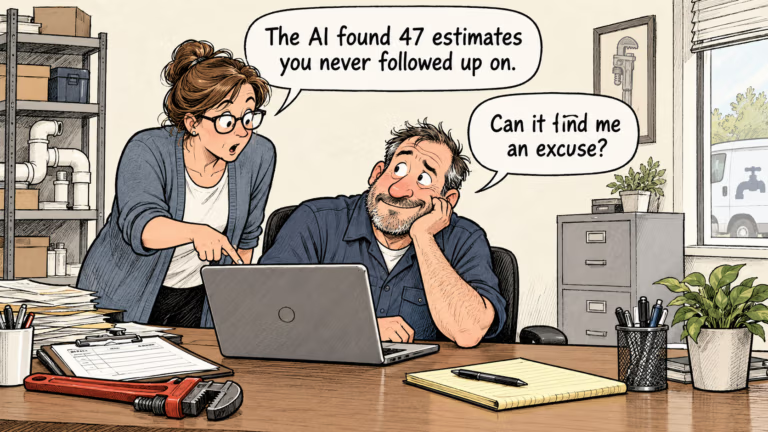
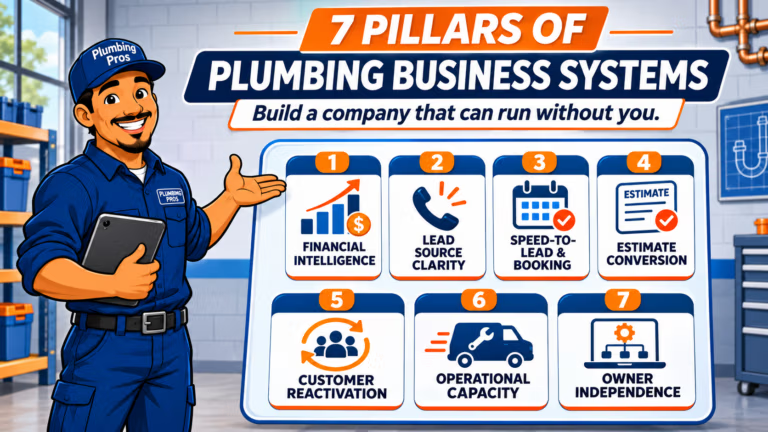
AI systems for plumbers can help teams follow up on unsold estimates, prepare quote options, fill schedule gaps, give customers preliminary price ranges, and track profit by job type. In this episode, John Reay of Elite Advisors Consulting lays out five practical uses for AI and explains why companies should start with the business problem they want to solve, then choose the tools.
Paul Benton: If you’re a plumber or a friend in the trades, you’re in the right place today. John Ray is at the table. He is founder of Elite Advisors Consulting. He has had an impressive and varied career rooted in both the trades and software. He built software used at the Kennedy Space Center and at Skywalker Sound, advanced from fire alarm technician to national accounts leadership at a Fortune 500 company, and grew a real estate team from 20 agents into a mega team using systems he himself built.
Paul Benton: Today, he helps home service companies capture more of the work they’ve already paid for, and implements AI systems to save time, money, and make owners happier people. John, welcome to the table. Good to be with you today.
John Reay: Thanks so much for having me on, Paul. I appreciate it. Yeah, it’s, it’s one of those things, we’ve been keeping up with your show for some time and, uh, it’s, it’s an honor to be on.
Paul Benton: Awesome, John. So we are going to get super practical today, and thank you for that. Um, you, you build AI systems that plumbing companies can implement.
John Reay: Yeah.
Paul Benton: And I’d really like to start out by getting very focused. What are the five things you would recommend a plumbing company implement in 90 days with respect to AI?
Paul Benton: And you’ve done this before for home service companies.
John Reay: Yeah, absolutely.
Paul Benton: What are those five things?
John Reay: Yeah. So the… I think the biggest thing that everybody gets hung up on is they start looking at what AI or what tool do they need to use, and I would say let’s snart– let’s not start with the tools. Let’s look at what we’re actually trying to accomplish.
John Reay: So I, I put together a hit list of five areas that most of the ar- most of the owners deal with, so that way they can kind of get something tangible they can really put to good use right now. The biggest one that we come up with all the time, I hear it time and again, is the fact that their estimates or their quotes have really not got a clear yes or no.
John Reay: I mean, most owners, they, they don’t mind an estimate that doesn’t come through, but what they don’t like is either having a maybe or a just a little later and having that uncertainty in it, and that- To me, that’s really where a lot of that uncertainty in the books comes from, is you don’t have a very clear idea of where all your estimates are gonna go.
John Reay: So first one we usually look at is to make sure that every estimate either books or it has a clear no, and then that way you know you’re getting a certain amount of conversion coming through. And because let’s face it, you’ve already paid the marketing money. You’ve already call- had the call happen, and you’ve landed it.
John Reay: Now you just need to get it onto the schedule.
Paul Benton: What’s the system that you, you do? So there’s, there is, um So quote follow-up is what you’re thinking of most.
John Reay: Yeah.
Paul Benton: In my case, I, I had a little project at the house, and, uh, it ended up being five quotes. All of them were more or less the same. They came out of ServiceTitan or one of these great software programs.
Paul Benton: They were delivered in my presence, yeah, from an iPad and emailed over. And, uh, I then didn’t read a single one of them, uh, which I think is telling. I’m a reader, as you can tell from the books behind me, but-
John Reay: Yeah …
Paul Benton: I didn’t read a single one of them. Why? Because I combined them all and dropped them into ChatGPT, and then I asked ChatGPT to rank order them on the h- the best value deal.
Paul Benton: Okay. To your point, how many people followed up with me? Out of the five companies- Hmm … not a single one called me, and only one texted me, and that was, like, 10 days after.
John Reay: See, and that’s-
Paul Benton: You fixed that problem.
John Reay: That’s so interesting. Yes, we do. The… I think the biggest common mistake we see in a lot of shops is that they, they feel like when they don’t get an answer right away or they don’t get the job right away, that they just, they lost the opportunity and that’s really it.
John Reay: And I see a lot of reasons as to why that happens. Sometimes the, the office manager thinks the salesperson’s still got it, or the tech thinks that the office is gonna handle it, and what we find is in, in reality is neither one has the, has the clear ownership of it, and so it gets dropped. What we normally re- recommend happening, or to put together, especially with ChatGPT, but you can do it with any of the major, uh, AI platforms out there, is to pull together a list of all your, your last 90 days of, of estimates that are not sold, and have it go through and take a look at each of the job types and what the actual value is on it, and go through and create…
John Reay: You can have it go through and create actually personalized text messages for each one of those. That’s one use we’ve seen on it. Now, the system side of it is in ChatGPT or Claude or some of these others, you can actually go through then and have it set up where when a new, when a new invoice or a new, rather a new estimate goes out, you can ask it to, uh, either send the prompts automatically Or, you know, in a certain timeframe, or you can have it then prompt your sales staff so that they don’t lose track of that as well.
John Reay: And a lot of the good software out there has these options available. Most often, though, they don’t implement it. So that’s really been the first thing is to go back through and triage your last 90 days. That’s where your closest money to the door is really gonna be But then also you can develop systems that will help keep your staff in front of that as well, so that that way the quotes don’t get dropped by the wayside because, uh, I mean, as you’ve seen here with the, you know, your project at the house, very few actually make that follow-up effort.
John Reay: They just work onto the next one and they just take the, we call it the easy money. A- and, you know, and there’s really no extra effort done past sending them the initial quote and, and, uh… And you said something interesting though, because you’re right. I think, I think a lot of people don’t read their email like they used to.
John Reay: And so I think the other thing that a lot of these technologies allow us to do is to be able to go through and actually text message the customers in, you know, in real time directly from the software, and I think that’s critical that we get… We really get into a practice of using that because I, I think most, even times when you call friends or family, you text them first and say, “Hey, you know, is it a good time to talk?”
John Reay: And then you pick up the phone and call. And so, uh, we’re kind of programmed these days to go towards text messaging first.
Paul Benton: Yeah. Um, to your point, there were five plumbers who came, and of the five, I probably got two or three documents from each one, and some of these documents were up to 15 pages long.
John Reay: Wow.
Paul Benton: So if you do all the math, I was dealing with something like 40 pages as a homeowner to make a decision. And in a world in which people don’t read past the first line of an email, our plumber, plumbers would, uh, benefit to consider that, uh, their document is only one of many, and it’s very hard for, uh, on the receiving end to make sense of 40 pages.
Paul Benton: So that’s why much of that is now gonna be run through Claude and on the receiving side, Claude and ChatGPT anyway. The question though is on the follow-up, many performing companies, uh, now are using, uh, Housecall Pro and ServiceTitan that have some follow-up cadence. But you, you add in addition to that, agents.
Paul Benton: What is it that an agentic solution that you put in adds that you can’t get right out of Housecall Pro?
John Reay: Housecall Pro will give you the basics, but I think that there is also a level that you need to go a little bit deeper on. And the fact that most of the software I’ve seen out there is very good at sending follow-ups.
John Reay: It’s not very personalized, it’s boilerplate, and it’s very form letter. It feels like a form letter. It’s not like you or I would talk to one another. And what I know is that’s where a lot of the agentic solutions come from is, uh, it comes from a point of having that background, that rapport, or you can tell it to, to talk as a peer-to-peer, like you’re talking to your buddy, you know, at the pool table or while you’re watching a game instead of, instead of the formal stuff, because w- we’ve been formalized so much now.
John Reay: It, it’s… It really, it makes it feel impersonal. It’s interesting though, because the other thing I’ve noticed is a lot of these form letters, they don’t really make it, uh, an easy yes for the customer. It’s, it’s just not.
Paul Benton: Um, it, it, it was… That’s exactly my experience, and a question is, can you build an agent?
Paul Benton: Do you foresee that as something that can be done that could do a little negotiation? So my, uh, experience was nobody followed up except one 10 days later by text once. Nobody picked up the phone or, or emailed me multiple times Could an agent actually start to have a program conversation just to where if I texted back some questions, it could immediately answer?
Paul Benton: The default is we’ll get, uh, the, to the one text that I, uh, from a ServiceTitan operator was, “We’ll get that over to your, uh, service tech, and he’ll get back to you,” and he never did. Can an agent actually… Would you trust it to actually start having a conversation with program parameters, or is that too risky today?
John Reay: Today, in this day and age now, there is a lot of, a lot of things that the agents can actually do. When they’re given the proper parameters or the g- proper guardrails, then you will be able to get that type of a thing done. So that if there’s a, a certain function that is a $1,200 to $1,800 replacement, whatever that might be, if it’s a water heater or a, you know, a, a leaking faucet, whatever that case might be, whatever that frame, price range is that you as the owner are comfortable with, you can do that.
John Reay: Uh, the better solution I’ve usually seen is to, is to give them a price range for a typical replacement and then just assure them that when the technician gets there, they’ll confirm the actual price before any work is commenced. That way you’re not having to just say, “Hey, we’ll have somebody call and follow up with you,” and they never do.
Paul Benton: John, let’s move on to the second, um, AI implementation you can do.
John Reay: Absolutely. I think this one kind of dovetails really nicely into it because when the technician comes in and they make their, uh, their presentation to the homeowner about what that specific job is gonna cost, and they’re getting prices from other people, let’s be honest.
John Reay: A big roadblock that we see a lot of times is the technician usually will, will write the information out or put it into the system, and it’ll spit out the estimate, and it’s basically, it’s a one-shot deal. It’s either take it or leave it. There’s a big disconnect we see right there in the driveway. So one of the things that we’ve been implementing really closely with a lot of these technicians now is to get them to use their phone and actually make voice notes in the cab, make the voice notes specifically to that quote And then have that information submitted using the AI.
John Reay: And the AI then can come back with a, uh, you know, d- a solution to fix just the problem, a solution to fix the, the root cause of the problem, and then the best overall solution as well. And some call it good, better, best. Uh, you know, we call it problem, fix, or forever. But i- it’s the same type concept in the fact that we give them an option of three different choices and not try and shop them based on what we see in the driveway.
John Reay: So The big benefit to the business is this, is your technicians that are there, they’re gonna know the nuances of what needs to be done. They’re gonna know the materials, rough time, and if there’s any other little notes that need to be made, they can mention that there at that time too, because it, they may not be the technician coming back to fix it.
John Reay: And if one technician doesn’t relay a key critical component off to another one, now you have a disconnect and you might even have to have, uh, a technician pull off of that job and then come back later to finish it up, and the customer says, “Well, you guys were here two days ago, and now what happened?”
Paul Benton: And is there technology that is available today that you can dictate that in Spanish and get that automatically translated into English?
John Reay: You can do it in, I think it’s over 112 different languages now. So, uh, actually, it’s interesting. I know xAI or Grok has put together a lot of things, Paul, now that, uh, you can talk almost like a conversation with the actual agent, and it will, it will then complete the task, and if it has a, uh, an item that it missed that it can’t do, it’ll ask for the clarifications first.
John Reay: So i- it’s pretty capable these days, even in other languages.
Paul Benton: Okay, and number three, uh, this, what’s the next implementation you would do in 90 days?
John Reay: Yep. Next one we see is a lot of times the, the idea of the business, for the owners anyway, is to have steady income all year long, and your techs are always out, they’re always busy because you’re not making money if the truck’s not in the driveway doing a, a bit of work.
John Reay: Uh, with this time of season coming on, it obviously, that’s not always the case. So we, we have a system where they actually can go back through and dig into their, their CRM and find the, the missed items, the missed opportunities as far as service agreements and things like that that are not up to date, and they’ve done business with you before, but now they’ve let their service, uh, lapse.
John Reay: Or if they have scheduled maintenance, they can start having the AI go through and fill in the gaps in your techs’ truck rolls or your, your schedule roster, and help your, help your people to go through and actually fill out their day. So if they have a spot in the middle of the day where it’s dead- And they’re out and gonna go into that neighborhood anyway, and they’re already doing service.
John Reay: Now you can have a system that will say, “Hey, uh, we’ve got another one.” It’ll call ’em up if you want it to. Some people do, some people don’t. But it’ll allow them to go through and actually be able to then fill out their day completely. And from a revenue standpoint, if you’re given an option to get a maintenance agreement re-upped that might have lapsed and you didn’t know about it, it’ll also be able to do that as well and give them a, a payment option specifically for that right there and then too.
John Reay: So it helps to, to fill out those gaps in income and as far as your, your tech’s availability. So you figure, what, 2,000 customers? Uh, if you have 1% re-sign at a $200 plan, that’s another four grand a year just off of one simple little move.
Paul Benton: Help me understand, how does the, the system or the agent, the AI that you’re talking about-
John Reay: Mm-hmm
Paul Benton: interface with HouseCall Pro or ServiceTitan? Are we talking about an alternative to a CRM, or are we talking about an agent that goes into the CRM? You build the agent, the CRM already exists. How, how does that work?
John Reay: It depends on where the, the client’s at and what software they have in place. Most of them now have, without getting too deep into the weeds, they call ’em APIs or MCPs.
John Reay: And it really is just a way of being able to get your agent or AI system to be able to talk to and interact with the software to a certain degree. And most, most of the companies do have limits as to what they’ll let and not allow agents to actually do in their software. These days, though, we’re starting to have, and we have actually, agents that will actually operate on their own virtual computer From the cloud, just as y- as you and I would be doing sitting right in front of our computer as well.
John Reay: So it really doesn’t so matter ma- s- it really doesn’t matter so much what software they have. It’s just making sure it’s set up correctly to use it. And so you can get this done with really any software these days. There’s not a lot it can’t do. It’s not perfect, but there’s not a lot that it can’t do.
Paul Benton: Awesome. Um, I’m excited about the next one. Tell us about that, and then I have questions on it.
John Reay: So I’m guessing this one you’re alluding to is the price range up front, and, um, that’s been a big one. Yeah.
Paul Benton: Yeah. Yeah, because, uh, there is a, uh, th- there is a t- uh, really a tension between the customer and the plumber, uh, across the economy.
John Reay: Yeah.
Paul Benton: Um, and we’re seeing that play out driven a lot by the lead channel. So, uh, our, um… Yelp, for example, has kind of conditioned people, um, with their r- uh, they used to call it request a quote, and now they’re calling it, for plumbers, get pricing and availability. Yelp is a completely different chapter, but it is a highly effective channel, and it is a great customer experience.
Paul Benton: A lot of plumbers are frustrated with it for a variety of reasons. Um, but what th- it, it has created, uh, is it prompts people to ask for price. And the conventional industry position is we don’t talk about price until we are across the threshold and can negotiate a deal and close something. But we don’t want to, we don’t want to give pricing when requested, even though that’s what the channels are prompting the customer.
Paul Benton: So the customer and the plumber i- are in this absurd conflict that, uh, is created by the ad channels that really shouldn’t exist. How to resolve it? So some plumbers are now saying we have to be upfront with price. Others are saying, no, we don’t wanna be. But you’ve got an agentic solution here that can make that actually be possible in a way that works, and that’s what makes it very exciting.
Paul Benton: Tell us about that.
John Reay: So the, the big outcome that everybody’s shooting for now is the easy button. And, you know, uh, maybe I’m too old to, to relate to a lot of the people out there as to what the easy button is these days, but Amazon has trained us that we can push a button now and we can get it tomorrow and it’s not a problem.
John Reay: That’s the idea behind it. And the real thing is most shops are very hesitant about quoting prices because then they feel like they’re going to be stuck to it and if they come out and they tell them it’s more, now they’re gonna be liars and they’re gonna get, you know, bad reviews and it’s gonna trash the reputation there.
John Reay: And if they do honor the price and it is making it so that the work isn’t profitable, they’re gonna lose business or, uh, lose profit that way. So you have to be able to get that information out to the customer and be able to still protect your margin. This system does that. And the fact that you can take from any of your software, all you really need to do is take your, your job costing, your actual invoices from the vendors and where you’re buying your materials and everything from, your labor, and your actual invoices to the customer and start pairing them up and have it go back through and it will look at and can see for, uh, a faucet replacement or a water heater or whatever the job quote is, it’ll go through and it will be able to give you what your average cost is for material, for your labor and everything so you know really what your landed cost for that job is.
John Reay: And then at that point, you can then now look at the averages and create a range for your staff, and that’s what we recommend is say, you know, “Mr. and Mrs. Customer, water heaters normally run, let’s say between $1,200 and $1,800 completely installed, warrantied and all,” whatever the case may be. I, you know, I’m just using that as an example and price.
John Reay: But you give them a window. That’s an example. And you preface it with that, you know, the, the service call fee to come out and, and troubleshoot and see what actually needs done is refunded should you choose to work with us, and then the actual job will be priced out at that time. But that gives them at least a ballpark as to what’s going on And so I think that’s been the middle ground that a lot of people are more comfortable with.
John Reay: We’ve seen actually up in Orlando, we had, uh, a client of ours that started doing that, and within 12 months time, they actually had about a 29% year over year lift on their acceptance rate on the bids. So it, it actually worked out very well for them.
Paul Benton: And is the answer because, um, the plumber be protected in knowing if an agent goes in and says, um, “Pull the last 500 faucet replacements I did, and what’s the average price?”
Paul Benton: You’re pretty darn close to that, and if you then give a range plus or minus 25% of what your average is, and then you add in a statement that says subject to actual quoting on site What is powerful to my mind here is it gets you past the first objection, which is, “Are you going to come and, uh, come in at an absurdly high price and waste my time?”
Paul Benton: Uh, so, so thinks the customer. And so now you can get to y- to the preliminary yes right out of the gate, and if you get to yes faster, then you’re the one that will be invited into the home, whereas the others who say, “I can’t tell you, and I’m not available until next Thursday to come in and quote,” you’re out of the race.
Paul Benton: Uh, and your agents, by basically doing the math in a highly… L- letting math work in your favor, is what I’m hearing, can put the plumber into a p- into a position to really know what that number is and can go and, and, and bet and get ahead of the other quotes that he’s dealing with. Is that, is that what, uh-
John Reay: Yeah
Paul Benton: your plumber and, um-
John Reay: Yeah, in Orlando, yes. Yeah, that’s exactly where it is. He actually goes through weekly and, uh, reruns the math on it. He’s very precise about that, and he actually took it one step further and added his margin, and I say margin, not markup. Uh, mm, argument for another day. Yep, but margin added on top of it, and then actually uses that to update it.
John Reay: So when a supplier starts to bump their prices up, he’s made aware of it. He doesn’t have margin creep in the middle, and he’s able to then update his prices based on that. But it builds a lot of trust with the consumer right up front when they’re not that sure about the whole situation to begin with.
John Reay: That’s a layer of trust and comfort that you’ve already set up with the customer from that initial conversation, that a plumbing company that says, “Sorry, we, we won’t be able to come out until a week from now. I’m sorry you won’t have hot water, and, uh, we can’t give you any kind of prices or anything over the phone.”
John Reay: Either one of those two are not the reality they wanna hear, and it starts to then break trust. So you’ve already set yourself up way, way far in advance just to make that, that yes happen much easier.
Paul Benton: That’s awesome. And I’m also real partial to your last, your fifth implementation in 90 days. Let’s talk about that.
John Reay: Yeah.
Paul Benton: What is that one?
John Reay: So every shop wants to know every week which jobs are making them the most money and which ones are really holding them back, and most people don’t really know. Most owners, they know they’re busy, and they know there’s a lot of money moving around, but they look at the bank account after the month’s end and says, “Where’s the extra money?
John Reay: Where’s that extra profit?” So this basically takes that assessment from the job costing one step further and allows you to really hone in on where your, where your margin creep is, is killing your profit. Uh, which suppliers have been r- raising prices, uh, has copper gone up or has it gone up? Um, and that way your price book and everything stays, you know, steady.
John Reay: The biggest thing is now you have visibility on the actual profit per job. So if, uh, a cert- a hose bib on the outside of the house is not a profitable job to be doing, but you’re getting a lot of calls for it, you know you either need to raise your prices based on that, or maybe not do those jobs.
Paul Benton: I think what’s amazing is that, am I correct that if you set up an agent to be able to go into the CRM and pull this data…
Paul Benton: Um, so often I’ve had conversations with clients when we ask, because we like to know the profitability of product as marketers so that we can know what… I think prof- marketers tend to talk mostly about return on ad spend, but what we, what the, uh, plumber really wants to know is what is the profit per lead, not, is, what is the, uh, cost for that lead.
Paul Benton: That, the profit per lead is more interesting And but to get that is not easy, and so very often I will hear the phrase, “Well, I have to check with my accountant,” or, “I have to pull those numbers.” But if you can build an agent that can dive into the CRM and that the plumber can roll, roll over at 3:00 a.m.
Paul Benton: and, um, pull from their phone with a prompt, that allows all that calorie burn to go away, and now the plumber can make good decisions.
John Reay: Right.
Paul Benton: Is that something that you can build? Is that a
John Reay: reality today? It is. That is a reality today because your CRM doesn’t hold all the, the data, your bank doesn’t hold all the data, your vendor’s invoices don’t contain all the numbers you need.
John Reay: You literally, as I’m sure you know, you have to go through about three to four different sources or more sometimes to get all the actual information you need to get a fully landed cost of that job. So that, that’s the biggest hurdle is being able to have something agentic that can actually u- be used to pull the data from all those different sources consistently and constantly to keep that report accurate.
John Reay: Uh, with that, now you can actually start to have a real clar- a real level of clarity in your business as to what your actual gross margin is. And now, you know, ROAS is, is great when it comes to ads and marketing, but you know, a real shop owner wants to know for every dollar I put in, if I get $3 back out at the end of the day after everybody’s paid, tax man and myself and all, that’s the type of numbers that really mean something to an owner.
Paul Benton: You know, and, and, uh, just to be, uh, take a step back on a more philosophical point between AI and is it replacing jobs. I, I read something very interesting recently that, uh, went- that, uh, expressed, um, AI is going to, uh, eliminate the need for mechanical analysis so that people can make better judg- judgments.
Paul Benton: So AI can’t, can’t make judgments, only humans can. But if you can get your hands on the data that you need in what used to my… What used to essentially be I gotta have an appointment with my CPA next Friday, and I won’t know for a week, but you can deliver an agent that can allow that to be gotten immediately in real time, you’re now putting humans in the position of making better judg- judgments than they were before.
Paul Benton: That’s, I think, a really… That’s a real promise of AI rather than the threat that, uh, is more common, that it’s all gonna take our jobs.
John Reay: Right. It, it really it is. It’s a better way to look at it from a mental standpoint. I mean, it could go either way. I’m not gonna say it won’t. But I like to err on the fact that humans wanna survive, and we wanna do the right things with people, and so there’s two different things that come to mind when you say that.
John Reay: One, the AI is not going to replace your, your actual place at the table in your job. It will make it different, and if the leadership and the people in charge of the, the business are doing it right, they’re going to adapt to that, and they’re going to give you those tools to make you more effective in your job.
John Reay: But the other side of it, too, is that with that kind of level of clarity, the leadership and the, the ownership can actually make those types of decisions very quickly and very, very tactically because now a 30-day cash outlay or a 30-day cash, uh, cash statement, or 45 or 90, you can see what that cash forecast looks like and now you can make the decision, do I actually buy the truck?
John Reay: I mean, yeah, I can buy it this month, but if in 45 or 90 days that means I have to, uh, either lay somebody off or I have to not extend my lease on the office for the next year coming up. Those are things that you don’t get from just a, a quick look at a bank statement, and those are usually the things that your bookkeeper needs to help you with, and now you don’t have to rely on that as long as your data’s right.
Paul Benton: You have been a software developer, so can you put into lay terms what is the tech stack that you’re using, without getting too detailed, but w- w- we’re talking about a system and we’re talking about existing data that is, could be anywhere from, um, spreadsheets to a CRM, and then a system of agents. What are the agents built in and where do they live?
John Reay: I think the best way to break this down is there’s several different… When somebody says AI, there’s several different layers to that. There’s the AI that most people know, that they, they type a, a prompt into and they chat with it, and it gives them an answer And that is the layman’s terms of it, I guess, w- the best way I can give an example of is if you go into Google and you start typing in, “Where is the best hamburger in my hometown?”
John Reay: or whatever, uh, and it starts to do what’s called autocomplete at the back end. That’s all chat AI really is, is it’s a fancy autocomplete that’s taken the collective from a much bigger context, much bigger world, and says, “Oh, they’re asking about this option or this, this question. Let me put it together as to what that common outcome is, or that common response usually is.”
John Reay: It’s a lot more complex than that, but that gives you guys kind of an idea of how it starts to formulate that, and it runs before, before the AI, and I’m really trying not to get off too f- far into the weeds. Before the AI’s put out to pasture, put out to the actual world, it’s given a lot of use cases and a lot of data of trial and error, yes, no, success and fail, and it learns as it goes.
John Reay: It’s called artificial intelligence, but it’s not really intelligence. It’s just very, very well-educated guesses is the best way I can put it on the, on that level.
Paul Benton: Is it Claude? Is it OpenAI that you’re using? What are you using- Ah,
John Reay: okay …
Paul Benton: to build these agents?
John Reay: So the agents themselves a lot of times can run in Claude.
John Reay: You can use existing or what they’re called persistent agents in Claude to do exactly that, and you can schedule them to do things at a certain time, uh, a certain amount of times every day or every week. Or you can actually give it a condition where when an email is, a new email comes into my inbox, and you receive a notification from the email software or the email provider, then read the email, summarize it, and if it’s, if it’s a subscribe, unsubscribe situation that just needs to go off into newsletter file, just file it.
John Reay: Don’t notify me. And it then can take those steps, and it actually can learn and decide what the proper outcome is with the right training. So Codex or, or, uh, ChatGPT will do that. So will Grok and GrokBot and a lot of the others out there.
Paul Benton: This is detailed but important. Uh, without getting into what it costs for an agency or a consultant to build this, you, you do have fuel in the engine, which are called tokens.
Paul Benton: So somebody has to pay Claude. When these five agents in 90 days are set up, what’s the bill that Claude, roughly speaking, is gonna be sending the plumber or OpenAI or one of these LLMs? What, what, what does that have to be? How to calculate that
John Reay: So the usage and how to calculate it, it depends on what their usage rates are at the time.
John Reay: That is always changing and it, and when they develop newer models, some are built for better outcome, and some are bel- built for more efficient token usage or usage. And so what happens is that those rates vary from task to task. Um, I’ll give you an example. We had an office that we brought up last week, and we brought them into, uh, GrokBot, which is one of the new ones that a lot of people are, I’m sure, hearing a lot about.
John Reay: The initial usage was very high for that first two-week period, but then after that two weeks was done, the, the usage dropped by almost 50%. Same tasks, but it wasn’t learning the tasks anymore. It wasn’t learning to set up the connections anymore. It was just doing the work. In real world scenario, it was about a, a $600 bill overall for the month, but it also assisted in 25 different roles throughout the whole organization, from finance to executive and admin and everything.
John Reay: You compare that to, to an, a VA even, or a, a part-time hire, it’s a very good spend on the money. It’s a very good return on the money, rather.
Paul Benton: $600 for f- 25 roles is pretty amazing.
John Reay: Yeah.
Paul Benton: John Rae, thank you for being at the table today at the Plumber Marketing Success podcast. We will put in the show notes how people can reach out to you for building five agents in 90 days.
Paul Benton: And, uh, I learned a lot today. Thank you very much, sir.
Questions or want to learn more?