Danny Leibrandt is the founder of Pest Control SEO, a digital marketing agency specializing in local SEO and search visibility for home service businesses. In just a few years, Danny has built a significant online presence through podcasting, educational content, and personal branding.
Known for simplifying advanced SEO concepts, Danny helps local business owners understand how Google evaluates authority, entities, experience, and trust. His work combines practical SEO strategies with long-term brand building to help companies improve visibility across Google Search, Google Business Profiles, and emerging AI-powered search platforms.
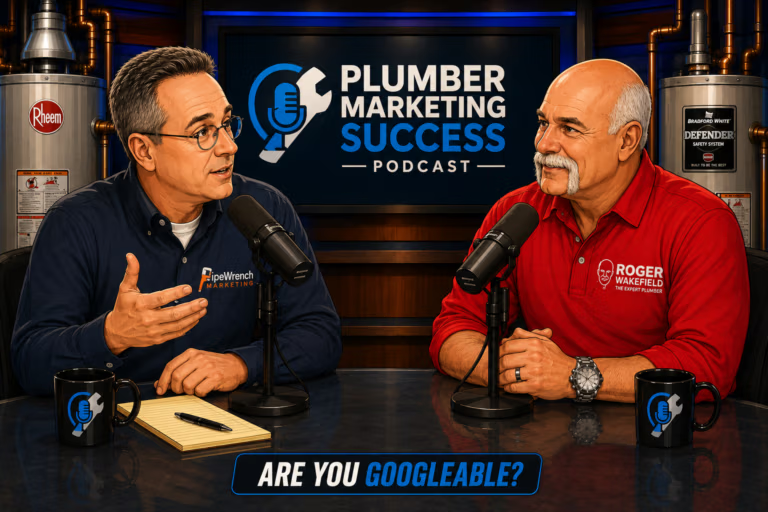
Paul Benton is the founder of PipeWrench Marketing, a marketing agency dedicated exclusively to helping family-owned plumbing companies grow through better lead generation, local search visibility, artificial intelligence, and customer acquisition systems.
Through the Plumber Marketing Success Podcast, Paul interviews leading experts from inside and outside the plumbing industry to uncover practical strategies that help contractors generate more calls, book more jobs, and build more valuable businesses.
What if your plumbing company’s biggest competitive advantage wasn’t your website, your reviews, or even your Google Business Profile—but you?
In this episode of the Plumber Marketing Success Podcast, Paul Benton sits down with SEO expert Danny Leibrandt to discuss one of the fastest-growing trends in local search: building the personal brand of the business owner.
Danny explains how Google increasingly recognizes people—not just businesses—as trusted authorities. He shares how producing a podcast, publishing educational content, and building your online presence can strengthen your company’s visibility in Google Search, Google Business Profile, AI search engines, and future search technologies.
Whether you’re a one-truck operation or managing a growing plumbing company, this episode explores how becoming the recognized local expert can help your company stand above the competition.
Google increasingly evaluates the people behind the content it ranks. Building your reputation as the owner helps establish credibility for your company and can improve how your website and content perform in search.
Lesson: Don’t hide behind your logo. Become the trusted expert your community recognizes.
Every podcast episode becomes multiple marketing assets:
Instead of creating one piece of content, you’re creating dozens.
Lesson: One hour of recording can fuel months of marketing.
Google evaluates content using four major signals:
Danny explains why simply publishing AI-generated articles is no longer enough.
Lesson: Show your real-world experience, not just your knowledge.
One of Google’s newest priorities is proving you’ve actually done the work.
For plumbing companies, that means:
These create powerful trust signals for both customers and search engines.
Lesson: Show the work—not just talk about it.
Danny explains Google’s Knowledge Panels and how consistently publishing quality content across multiple platforms helps Google recognize you as a trusted entity.
Building your personal brand helps Google understand:
Lesson: The stronger your reputation becomes, the stronger your company’s online visibility can become.
Google increasingly pulls information from:
SEO is no longer just about your website.
Lesson: Every platform contributes to your online authority.
Google wants to know who created the content.
Publishing articles, podcasts, and videos under the owner’s name rather than anonymously helps reinforce expertise and authority.
Lesson: People build trust with people—not anonymous companies.
“Google is looking for experts, authorities, and people with real experience—not just websites.”
Customers trust people more than logos. Building your personal reputation establishes credibility, differentiates your company from competitors, and can strengthen your online visibility.
EEAT stands for:
Google uses these signals to evaluate the quality and credibility of online content.
A Google Knowledge Panel is the information box that appears alongside search results for recognized people, businesses, and organizations. It summarizes trusted information Google has gathered about that entity.
Potentially, yes. By consistently publishing quality content, appearing on trusted websites and podcasts, maintaining active social profiles, and building authority over time, Google may eventually recognize you as an entity and invite you to claim your Knowledge Panel.
Yes. Podcast episodes can be repurposed into videos, articles, FAQs, social posts, and website content, creating numerous opportunities for search engines and AI platforms to discover and understand your expertise.
Start consistently creating educational content that answers customer questions. Whether through podcasts, videos, blogs, or social media, regular publishing helps establish your expertise while creating valuable assets that can be repurposed across multiple platforms.
Paul Benton: If you’re a plumbing company owner or a friend in the trades, you’re in the right place.
Today’s guest is someone I’ve been excited to speak with for a long time. Danny Leibrandt. Danny is the founder of Pest Control, SEO and a recognized expert in local search marketing
Danny Leibrandt: Paul, thank you so much for having me on the show. It’s a pleasure.
Paul Benton: So Danny, in this, episode, I thought it would be really valuable. We’d like to talk about your background because you’ve built in just two years a tremendous success in building your own, online omnipresence.
For plumbing company owners, building a local podcast can be the next evolution in building local trust. After you’ve built hundreds of reviews, you’ve joined your local, associations,, what more can a plumbing company owner do?
Podcasting is one step. For example, interview everybody that, there is in the local chamber, and then promote those interviews, [00:01:00] hyper locally on YouTube with ads so that you are everywhere and associated with the mayor, with your chamber president, and with all the other business leaders locally. That’s what many marketers are doing in developing their own brands.
And the question will become, is this something that a plumbing company, owner can do? You, I can’t think of anybody who’s better positioned than you to speak to that. And we, I thought today, if we can go through your podcasting journey, how you got started, and then if there’s time, let’s talk about you, the, other part of your expertise, which is SEO.
Does that sound good?
Danny Leibrandt: Absolutely. Yeah. No, I, I love talking about podcasting and I believe in it so much that I even started a second one.
I realized that doing SEO is super powerful. I also realized that doing it for home service businesses would be super powerful because my dad owns a flooring company. So I’ve always been equated with his company. He’s had his company for over 20 years. , Been running it for a while now. He’s, you know, he is [00:02:00] kind of just, you know, hanging out, chilling. He doesn’t really care about growing the company too much. But, , at the time at least, which was a few years ago, he was like, yeah, you know, like, we’ve just gotten no leads and I don’t know what to do. And he was actually one of the biggest flooring contractors in the us.
, And he, he was getting his leads. He had a big deal with Empire and he was the number one contractor, flooring contractor for Empire and. For whatever reason, they got new management. They’re like, dude, you’re making way too much money from us. And they cut him off and he was just like left in the desert.
He didn’t know what to do. Um, so I originally helped my dad get his SEO going, , helped him build a new website, helped him get his Google business profile going, get citations and socials and all these different things. So that was almost like my incubation project. It was like, you know, I kind of got to figure out everything there of, oh, okay, well, you know, this is what we can do on the Google Business profile.
Okay. I guess we should make some posts. Okay. I guess I’ll start watching all the top people in local SEO and I started watching guys like [00:03:00] Bradley Benner and Darren Shaw and Joy Hawkins and Luke Durand and all these different people in the industry I realized that it was, this was a great route to go down of doing something like SEO for home service local businesses because my dad and then, you know, I also know some guys in construction and I know
Paul Benton: Okay.
Danny Leibrandt: HVAC and all of them are struggling desperately
Paul Benton: thing, I’m
Danny Leibrandt: marketing, especially these older guys, 50 to 60 years old, which I’m sure is about your target market, which is plumbers.
Paul Benton: mm-hmm.
Danny Leibrandt: why I’m glad that we’re talking about home services and why, why this is relevant. So that was about two years ago or so, and around that time, like we talked about off the call is I met my mentor, Dennis Yu. Um, he reached out to me on Twitter. He saw I was posting a lot. I was growing my personal brand.
I had about 8,000 top 8,000 followers at that time. got connected, we get on a call and he’s like, you’re in Chicago, right? I was like, yeah. And he’s like, I’m going to a conference in Chicago in three days. I’d love for you to come. I was like, okay, [00:04:00] awesome. So I go to this conference with him, we hit it off and. On that call, actually, originally he was like, oh yeah, how’s that? How’s that thing you’re doing going, you know, you’re building websites for agency owners? I was like, well, actually, I’m thinking of pivoting into doing, um, SEO for home service local businesses. And he was like, dude, you totally should and I can help you.
And you know, for those that don’t know, Dennis u, he’s a super big name in the space. He’s coached a lot of agency owners. He’s super affiliated with Josh Nelson, and he has his own education program and such. So he’s helped a lot of agency owners grow from nothing to millions of
Paul Benton: And,
Danny Leibrandt: kind of
Paul Benton: and he, uh, he is also had a collaboration with Roger Wakefield, which many people in plumbing know.
Before we jump into the, the nuts and bolts of how you built your podcast, uh, you also take your podcast, your podcasting on the road. You actually went internationally and I caught a great podcast that you and Dennis did in front of the pyramids of Giza. Uh, where else have you [00:05:00] been, uh, um, in to do your onsite podcasts?
And tell us about, uh, how’d you travel to Egypt?
Danny Leibrandt: Yeah. Yeah. So the Egypt one was fun. Um, first I’ll cover where we’ve done it. Um, so that’s definitely the craziest one.
Paul Benton: Mm-hmm.
Danny Leibrandt: me and my mentor are Dennis. Um, we’re traveling, we did a big trip pretty recently. That was about, about two, three months ago. We went to London, and really actually we just booked tickets to and from London and it was 17 days apart.
So we just got to figure out whatever we want to do in the middle of that time. So we were in London and we were trying to figure out like the best places to go. Because, you know, we don’t have much time. We’re a busy entrepreneurs,
Paul Benton: Mm-hmm.
Danny Leibrandt: do? What are the best places to go? We’re like, okay, well let’s, let’s go to Athens.
So, um, we went to Athens, we saw the Acropolis and all of that crazy stuff. And then we were in Athens and were looking at the map. It was so funny ’cause you know, we work out online and we had some free time so we can kind of just pick where we want to go. So that concept is so crazy. So we go to Google Maps and I’m [00:06:00] literally, I’m just like scrolling around the globe of like, you know, where can we go? And we’re like, wait, Egypt is like only two hours away. Is that right? Because ’cause Athens is fairly south. Um, we’re like, we just go to Egypt? And we were kind of, we were almost like joking about it first, and then we actually went to Egypt, um, and we filmed a podcast in front of the pyramids,
But that’s definitely the craziest one there.
There’s nothing that even compares to that. Um, we did do one in Jerusalem, but that was just in our hotel, so you can’t even, you wouldn’t even know.
Paul Benton: And the rest are in your studio. So then to bring this back on center, you know, for,, a plumber who’s thinking about, well, how can, how can, uh, I jump into the digital age, uh, with a podcast? It doesn’t have to be that elaborate, but before we get into your advice on how to start it, talk about the why and show us the knowledge panel that you’ve achieved, and that’s a pretty big deal.
Would you mind screen sharing and take us a, taking us on a little tour [00:07:00] of what this two year effort. That you’ve put together in, in, how many episodes have you done now?
Danny Leibrandt: 51.
Paul Benton: 51. So 51 being your core production.
Before explaining how you did that, explain why you did that and what’s the motivation for a plumber? And show us what, Google, how, show us exactly how Google has rewarded you.
Danny Leibrandt: I’ll, I’ll go ahead and share my screen here. Um, forgive me one second. Okay. We’re shared and, I’ll search up my name here.
Paul Benton: Awesome.
Danny Leibrandt: Okay. Can you see this?
Paul Benton: Yep.
Danny Leibrandt: Okay. Awesome.
Paul Benton: I.
Danny Leibrandt: So this is what’s called a knowledge panel. Now this, this whole concept might seem kind of crazy and Paul, you’re telling me like, Danny, you move way too fast.
I’ll, I’ll try to go through this slow and go through this in depth. Um, so first off, Google understands things by. [00:08:00] Entities and the way that the entities relate to each other. So an entity you can think of as a noun, which a noun would be a person, place or thing. So like you can see here, Danny Leibrandt is an entity.
Paul Benton is an entity. Your company, in my company, you know, pest control, SEO,, my podcast, local Marketing Secrets, because all of those are distinct things. Danny Leibrandt is a distinct thing. Instagram is an entity that is a distinct thing. So first off, that’s what we have to understand is this is how Google understands things, is that is a collection of entities. And then the next element of that is how the entities relate to each other. So, okay, Danny Leibrandt is a person, you know, maybe, you know, he set up his LinkedIn, he set up his Instagram, YouTube, Twitter. He’s putting out content across all these platforms. Okay, well, you know, Danny Leibrandt might be a person, but. Then there’s the corroborative and, [00:09:00] um, I guess confirming information, which is information that is coming from other people. So that might be, you know, the, you can see me here. This is me on the Bright Local webinar. This is me speaking at, um, Digi Mark on Chicago. This is this third one here, me speaking on the Pest Control Millionaire podcast.
This is me on Dennis’s podcast. This is me on, all of these different shows, all of that corroborates the information on your name. Now, I know this, this might seem like kind of crazy. I have to pick the one with the picture. Um, this might feel like kind of crazy and you don’t feel like, you know, how can this apply to me?
I’ll get into all of that. So just, just kind of give me a second here. So, like I said, understands you and your company as an entity. So you potentially as a plumbing company owner, your company is an entity and you individually is an entity. Now why is that important? So Google [00:10:00] likes to, um, essentially rank websites and prefers websites.
And by the way, this also ties into large language models like Chat, BT or Google’s AI overview or Google’s new thing, which now they have AI mode. Google launched this thing called EEAT. So Google’s quality rater guidelines were originally based on EAT. We can see that here, our latest updates. Gets an E for experience. So originally it was EAT, which was expertise, authorit and trustworthiness. this is what they wanted to see in the content that they were ranking that are you actually an expert? Everything should be dependent on what Google is looking for. So when we’re looking at EAT, this is expertise, authorit and trustworthiness. Google wants to see that because [00:11:00] that’s actually what people wanna see. So when I’m thinking about, you know, the latest news in my area, and maybe there’s a hurricane or maybe something crazy happened, I want to listen to experts, I want to listen to authorities, I want to listen to people that are trustworthy.
So that’s the same thing that Google is optimizing for, is we have content that clearly demonstrate, demonstrates this and that it is clearly by experts and that you are authoritative and that you are trustworthy. And kind of the, the big unlock here is that it was EAT, have now added an E for experience. So now what they’ve done is with all of the. AI tools with all of the LLMs, with chat, BT and people generating content at a mass scale, how can Google and these other search engines make sure that they are showing quality content that isn’t just AI generated, but it does [00:12:00] actually have a person behind it.
And it’s not just like, you know, I, I remember when Chacha, BT and these other tools are just coming out, and I could, I, I, I thought it was so cool that I could generate a hundred blogs with this one tool draft horse in like five minutes. And I was like, oh, no one can beat me. The, there’s no way anyone’s el, no one, no way anyone else is doing this.
But those blogs didn’t really rank, and that’s because Google was prepared for this. So they added an E for experience, which now means that Google. Is going to prefer content that has some degree of experience, um, tied to it. So it says right here, does content also demonstrate that it was produced with some degree of experience, such as actual use of a product, having actually visited a place or communicating what a person experience? Um, and there are some situations where really what you valuable, what you value most is content produced by someone who has firsthand life experience on the topic at hand. Now this can vary depending on the industry. Like it might be harder to [00:13:00] demonstrate experience with like a software company or, um, to a degree e-commerce or something like that.
But when you have a home service, local business, like you’re a plumber, this directly applies to you. You are doing active jobs in person. So we wanna make sure that we are regularly demonstrating experience. So. There are, I guess you could say there are two ways to demonstrate it. And that is number one, talking about it.
And number two, actually showing you do the thing. So you could be talking about it on a web, uh, or on a podcast maybe, and that might be you talking about it, or that might be, that’s actually a video on the field and you go to, know, a client’s house, a customer’s house, and you are actively recording and showing, Hey, here’s what we do when, you know, one of the, the pipes leak.
I don’t, I don’t know much about plumbing, but you, you know, you get the idea that Google is looking for all this information and you might question how [00:14:00] this ties into things. Well, the, the website is actually, you know, isn’t that just text? But we can put all of these videos on the website, we can put all of these photos on the website and on the Google business profile and on the Yelp page, and now on the socials and all these other places.
So. Something else I wanna hit home, which I’m, I’m kind of gonna jump around here, so I, I apologize
Paul Benton: Mm-hmm.
Danny Leibrandt: is valuable.
Paul Benton: It is. Mm-hmm.
Danny Leibrandt: s some, something else that you need to be aware of is how much Google is pulling from socials now. So a lot of people will just only focus on the website for SEO and, okay, well, I do, I I have the right website pages.
What do I put on the website pages? That’s part of it, but there is still a lot more to that. So, something else I, I love to show, and actually I already showed this, is when you do a search for, you know, maybe it’s your name or your company, company name or whatever. By the way, I recommend everyone do this. The things that you are trying to rank on, especially your company. This would probably be [00:15:00] number one. Go search up your company on Google and see what shows up. I like, almost no one does this, but everyone’s trying to find the latest, um, SEO tool. Do I use SEMrush, aa, trs. Uh, Moz, you know? Okay. Page speed, insights, you know, meta.
SEO inspector, like, first off, let’s see what’s actually showing up. When we actually do a search for your company name, what shows up, because at the end of the day, that’s what we care about. The same way that at the end of the day, we just care about the revenue generated. Um, the first step here is really we just care about what’s showing up on Google.
So if we search up your company name and you don’t even show up, or you know, your Google business profile with your reviews doesn’t show up or barely anything else shows up. So when we do the search on me, we can see, you know, my personal websites, my LinkedIn profile, my Instagram, all my latest posts on Twitter, my Facebook, me on a podcast, me on [00:16:00] another
Paul Benton: So, so, so the, so a plumbing company owner is probably going to be asking, um, himself, I can’t get my company to rank and show, well, I’ve got 500 reviews. Um, you’ll see the, the, uh, the, the company all over the web. But what about me, the owner personally, and what would be the value in giving a, in getting a plumbing company owner himself?
The knowledge panel, and one argument is that it embeds you locally in the community. As plumbing companies grow, larger, uh, their emotional relationship with the customer gets harder to sustain because now it becomes a faceless brand if the owner. Can get a knowledge panel. Now people will associate the company with a human being, and that could be of big value.[00:17:00]
And Danny, the question is in, in your view, how would a plumbing company owner achieve what you’ve just achieved Right here on screen?
Danny Leibrandt: Well, yeah, I, I’ll actually, I’ll, I’ll tie to a different aspect of value as well, that when you look at Google’s guidelines, it is abundantly clear. ’cause I, I’ve been through most of these at this point of, I, I would try to find out, but there’s so many different ones. I, I forget the one that I’m, I’m thinking of particularly, but several of Google’s guidelines, which these are all public documents, will say that Google is looking for an expert that is creating the content.
Who is creating the content? Are they authoritative? Are they trustworthy? Are they well known in the space? Google is actively looking at the author of all of your content, and that’s, that’s honestly why Google is opting for social platforms a little bit more at least than they were. Because [00:18:00] social platforms, it’s very clear.
Like if you go on my LinkedIn page, this is clearly my LinkedIn page. Like Danny Leibrandt, 10,000 followers, he’s posting all the time, um, to create a, you know, a, a valid LinkedIn or a verified LinkedIn account, you have to show your driver’s license and it has to actually validate you as a person. So Google naturally likes actually showing these things because there is an author behind the content. So this, this is another aspect that very few people know about, is that when you are creating content for your company, whether that be on YouTube or your website, or your podcast, or your socials. There should always be an author behind the content. Now that’s kind of hard to do when you just have a random social post or a random website page. So usually what we like to do, and I know this sounds complex, but it is totally possible and you can’t do this, is repurposing from video content. And that way that clearly establishes [00:19:00] an author that we actually, you know, like me and Paul here, we’re doing, uh, a podcast. this gets turned into a YouTube video and a website page, and you can identify yourself as the author and then you can say, Hey, hey, here’s what I learned from the podcast with Danny, and you are a validated author because we actually did the podcast. You can actually watch the YouTube video and see.
It’s not like, oh, well, hey, I, you know, here’s the top things I’ve learned from Neil Patel or Alex or Mosey or whatever. Like, that’s great. let’s actually demonstrate that there’s an author and then like you’re saying, let’s build up the author profile. So now here’s kind of the consensus of what I’m saying is that when you have an ascribed author to all of your content and you build up your author profile as in your personal brand, as in your knowledge panel, like here, happens is that all of your [00:20:00] content then therefore gets boosted because Google recognizes me as an entity and now Google wants to boost all of the content that I’m making and am associated with because Google clearly understands that
Paul Benton: Yeah, but ho But hold, hold on, Danny, quick question. How long did it take you? With 52 episodes and the content you’re putting out over social to get to that knowledge panel
Danny Leibrandt: I think I already had this unlocked almost a year ago, so it, it didn’t take me too long. Now there is
Paul Benton: and,
Danny Leibrandt: there is that, um,
Paul Benton: how do you get it? Does Google just give it, sorry to interrupt. Does Google just give it to you or do you have to apply? How do you get it?
Danny Leibrandt: So you have to establish your presence across these different platforms. First off, it’s about what you say about yourself.
Paul Benton: Mm-hmm.
Danny Leibrandt: What are you saying about yourself? First off, we need [00:21:00] to have a website for all of the entities that we wanna establish.
So I’m an entity and I wanna establish the entity for myself. So I have danny lebr.com. So everyone should go and claim their personal, um, you know, claim your name as a website and build that up a little bit. so you have your personal website. Everyone should have a LinkedIn account. Everyone should have an Instagram. Everyone should have a Twitter. Everyone should have a Facebook. Everyone should have a YouTube. So first off, a lot of people know about building citations for your company. I feel like a lot of company owners know this at this point, but. You should also be establishing citations for yourself as well. So that includes all of these platforms and then anything else you
Paul Benton: So
Danny Leibrandt: up
Paul Benton: the first thing,
Danny Leibrandt: So that might be a Pinterest or a Threads or a Reddit or a
Paul Benton: mm-hmm.
Danny Leibrandt: these other different platforms, having as much corroborative information out there as possible. So my rule, my kind of two rules of thumb, two [00:22:00] rules of thumbs with citations like this is we wanna have as much information as possible and we want to have as much of the same information as possible.
Paul Benton: And so when you’ve done all that legwork, does Google as a search engine simply recognize that in totality and the knowledge panel automatically materializes? Or did you have to go through additional steps to register or, um, apply or so forth?
Danny Leibrandt: So you’ll get,
Paul Benton: Oh.
Danny Leibrandt: if you do it right, you will see a little bit of a knowledge panel pop up. Once you have built up enough of an entity that you have a good amount of followers. You’re putting out a good amount of content. You know, maybe you’re going on other people’s podcasts, maybe you’re doing pr, maybe you have a successful company. All of these things tie into your SEO and your personal brand. So this will show up. And then once this shows up, then you would click, and [00:23:00] actually I say this in this post, we can just go through it here. Um, so again, I say all these same steps. Set up your website with name.com, post somewhat consistently, get links and mentions from reputable sources. And then step number five is claim your knowledge panel when Google suggests it. So you go and these are the three steps. You search your name in Google and click the three dots, like you’ll see the three dots.
Paul Benton: So, but the, uh, so to, to put this simply then the knowledge panel is basically an affirmation by Google that you exist in an authentic way. That they trust you as, um, through your social, through your content and your videos that you’re pro, you’re producing, that you are a real person with something of authority to say, and then they reward you.
Google does with a panel so that when, um, people search under your [00:24:00] name up blasts a, an organized collage. Of all of the sources of your authority.
Danny Leibrandt: Mm-hmm.
Paul Benton: And in order to get that, they come to you. You don’t go to them, you have to put in the hard work.
Danny Leibrandt: do.
Paul Benton: Go ahead. Mm-hmm.
Danny Leibrandt: um, I, I just pulled this on the screen. You can see this right?
Paul Benton: Uhhuh, I do.
Danny Leibrandt: So it will show usually your name in bold. Once you’ve established yourself a little bit as an entity, you click on these three dots and then there’s this claim, this knowledge panel. So I guess, yeah, sure, they, they show the bolded, but you still have to claim the knowledge panel and then that’s when it really fills out.
Paul Benton: Well, you have to claim it, but in other words, you can’t request that it’s an invitation, it’s not an application. You gotta do the hard work. And then one fine day, the, the bold lettering appears and then you can, uh, you can claim it. And the advantage [00:25:00] to you and of relevance to, um. A plumbing company owner, or any business owner really is that it then allows you and your brand and your name to rise one level above your peers.
Is that fair to say?
Danny Leibrandt: I think that the main power impact in terms of building a personal brand and knowledge panel for yourself is that it boosts all of the content that you put out. So since the person listening to this, you might be the plumbing company owner. All of the content that’s published on the site should
Paul Benton: What we’re gonna do?
Danny Leibrandt: your agency or published under your new technician or new social media person, whatever.
It should be published under your name because you are the expert and the authority, like I was talking about with the EAT stuff. So everything should be published under your name, and assuming you’ve built that personal brand and knowledge panel, now, all of the content will perform better because Google trusts the author behind the content.
Paul Benton: Do you know, this is, this is key. Does Google have [00:26:00] a recognition if you, if, um, a business person wanted to make the author the name of the company rather than them personally, is that possible?
Danny Leibrandt: That’s possible, and you can do that on, you know, maybe more general pages.
Paul Benton: Mm-hmm.
Danny Leibrandt: what we’ve started to do is have an author for every single page because it’s, it makes them perform better and Google likes it more. So ideally we do that.
Paul Benton: Thank you, Danny. What we learned today from Danny Leibrandt is that building your personal brand through a podcast. It can help elevate your plumbing company’s brand above your peer group, and Google will reward you with enhanced visibility and eventually things like a knowledge panel.
Schedule a free consultation with our team and let's make things happen!