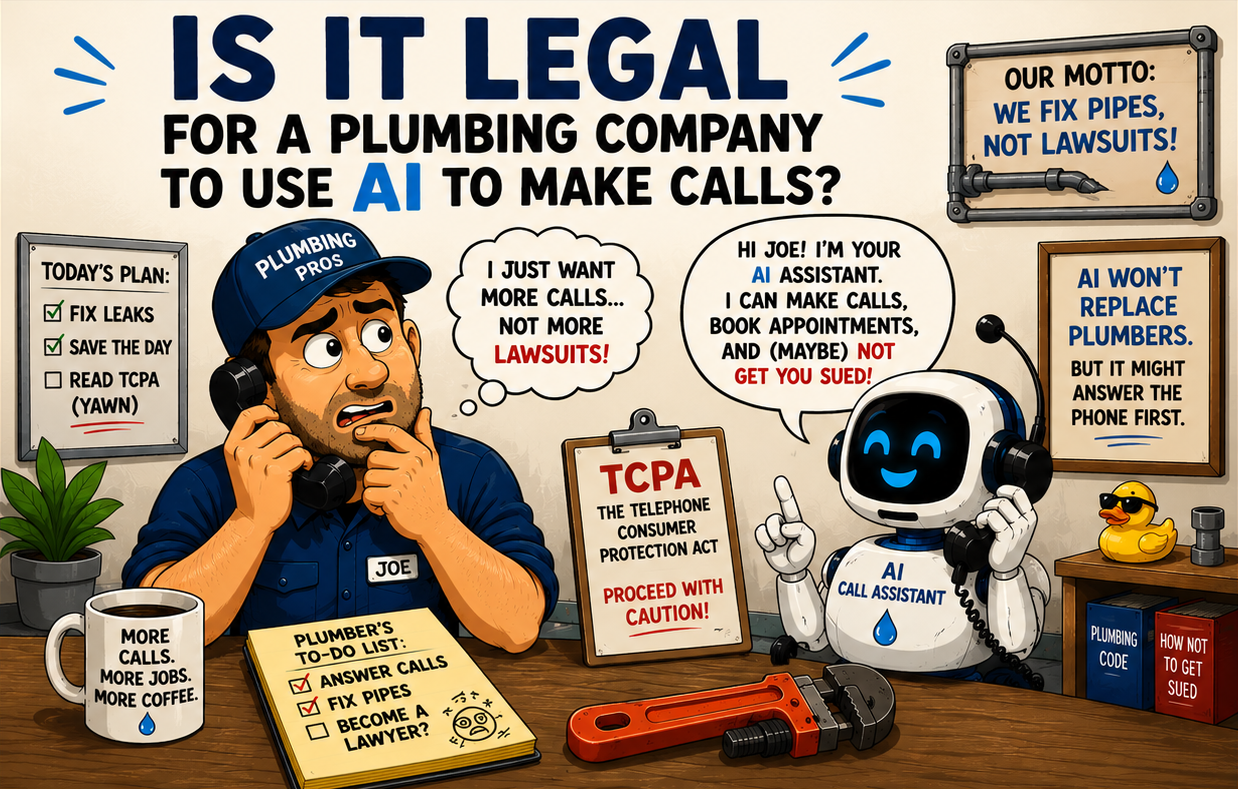
What every plumbing company should know before using AI voice, automated callbacks, and text messaging.
Artificial intelligence is changing the plumbing industry faster than almost any technology I have seen in the past decade.
Today, AI can answer your phones, qualify leads, schedule appointments, respond to text messages, and even call customers back automatically. For plumbing companies trying to improve speed to lead, it is incredibly exciting technology.
But every time I evaluate one of these new platforms, I end up asking the same question.
Is this actually legal?
The answers are often surprisingly vague.
Many software vendors are excellent at demonstrating features, but when the conversation turns to compliance, the response is usually, “You’ll need to ask your attorney.”
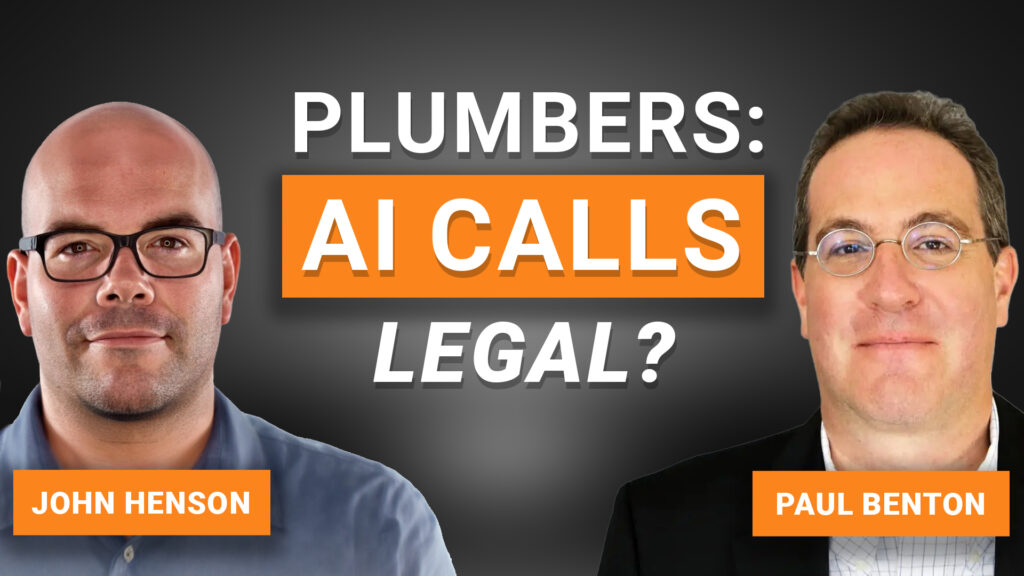
That is exactly why I invited attorney John Henson onto the Plumber Marketing Success Podcast. John is the founder of Henson Legal and previously served as Acting General Counsel at LendingTree. His practice focuses on helping companies navigate TCPA compliance, AI voice technology, lead generation, and consumer communications.
My goal was not to turn plumbing contractors into lawyers.
It was to help owners understand where the biggest risks exist so they can ask better questions before implementing AI.
Here are the biggest takeaways from our conversation.
AI Is Becoming a Competitive Advantage
Consumers have changed.
When someone has a leaking water heater or overflowing toilet, they expect an immediate response. If your office misses the call and your competitor answers, there is a good chance you just lost that customer.
That is why AI has become one of the hottest topics in home services.
Today’s systems can:
- Answer calls around the clock
- Respond instantly to web leads
- Return missed calls
- Send automated text messages
- Schedule appointments
- Qualify prospects before your CSR even picks up the phone
From a marketing perspective, this is exactly where the industry is headed.
The companies that consistently respond first generally book more jobs.
The question is not whether AI works.
The question is how to implement it responsibly.
Why the TCPA Matters
The Telephone Consumer Protection Act, better known as the TCPA, regulates how businesses communicate with consumers through phone calls and text messages.
Its purpose is straightforward.
Protect consumers from unwanted robocalls and unsolicited marketing.
For years, most plumbing companies only had to think about robocalls and text marketing.
Artificial intelligence has changed that conversation.
John explained that the FCC has clarified that AI generated voices fall under the same rules that apply to prerecorded or artificial voices.
That means an AI phone call is not always treated the same as a live CSR making the exact same call.
That surprised me, and I suspect it surprises many plumbing owners as well.
The Most Important Lesson
If you remember only one thing from this article, remember this.
There is a significant difference between an informational communication and a marketing communication.
That distinction determines what type of consent may be required.
Informational Communication
Examples include:
- Confirming appointments
- Technician arrival notifications
- Following up on an existing service request
- Requesting additional information to complete a job
Marketing Communication
Examples include:
- Seasonal promotions
- Maintenance reminders with discounts
- Upselling additional services
- Promotional AI phone calls
- Marketing text campaigns
John explained it in language every contractor can understand.
If you are discussing money the customer has already spent, you are generally continuing an existing transaction.
If you are trying to persuade them to spend more money, you have crossed into marketing.
That distinction becomes extremely important when AI enters the conversation.
Express Consent Is Not the Same as Express Written Consent
One of the biggest misconceptions I hear is this:
“The customer gave us their phone number, so we’re fine.”
Not necessarily.
According to John, there are different levels of consent.
A customer who calls your office and provides a phone number has generally given permission to contact them regarding that specific plumbing issue.
That does not automatically mean they have agreed to receive future marketing texts, promotional AI phone calls, or ongoing campaigns.
Those situations may require express written consent.
That is an important distinction because many CRMs make it very easy to place every new customer into an automated marketing sequence.
Convenient does not always mean compliant.
Can AI Call Back Missed Calls?
This was probably my favorite part of the discussion because it addresses a feature almost every AI platform promotes.
Suppose someone calls your plumbing company.
The call drops.
Can AI immediately call them back?
John’s answer was what lawyers often say.
“It depends.”
If the customer simply hangs up after a few rings, immediately calling or texting them back could create unnecessary risk.
On the other hand, if they hear your voicemail explaining that someone will contact them shortly and they indicate they would like a callback, the analysis changes.
The lesson I took away was simple.
Workflow matters.
Small changes in how software is configured can make a significant difference.
Why AI Voice Is Different
Many plumbing owners think of AI as simply another employee.
Legally, it is more complicated than that.
Because AI voice falls within what the TCPA considers regulated technology, different consent requirements may apply than if your CSR manually places the same phone call.
That does not mean AI is off limits.
It means implementation deserves careful thought.
Be Careful With Third Party Leads
Another topic we spent time discussing was Yelp.
The same principles apply to Angi and other lead generation platforms.
Customers enter their phone number expecting someone to contact them.
That certainly feels like permission.
The question becomes whether it is sufficient permission for AI driven marketing.
John’s view was that plumbing companies should be cautious about assuming a third party platform’s consent language automatically protects them.
I think that is excellent advice.
Whenever possible, understand exactly what your customers have agreed to before introducing AI into the communication process.
Not Every Lead Should Follow the Same Workflow
One of the most practical recommendations John shared was to separate leads by source.
Website leads are different from Yelp leads.
Google Business Profile leads are different from referral leads.
Why?
Because the consent language is often different.
When you control your own website, you control the forms, disclosures, and consent language.
Third party platforms operate under their own rules.
That means your AI workflow may not look exactly the same for every lead source.
From a marketing perspective, that is a smart operational practice regardless of compliance.
The Financial Risk Is Real
It is easy to dismiss compliance as something only giant corporations worry about.
That would be a mistake.
John explained that the TCPA allows consumers to bring private lawsuits and that statutory damages can reach as much as $1,500 per violating call or text.
He also shared something I found surprising.
Many TCPA cases are filed by repeat plaintiffs who actively look for violations, and home services is seeing increasing activity.
The point is not to scare plumbing companies away from AI.
The point is to encourage thoughtful implementation before scaling automation.
Five Practical Recommendations
If your company is evaluating AI, here are my recommendations after speaking with John.
- Separate service communications from marketing communications.
- Know exactly how every lead entered your CRM.
- Review the consent language associated with every lead source.
- Ask vendors how they address TCPA compliance instead of assuming they already have.
- Before activating AI voice campaigns, have an attorney familiar with TCPA review your workflow.
None of these steps prevent innovation.
They simply help you implement new technology more intelligently.
My Final Thoughts
I believe AI will become as common in plumbing offices as online scheduling and text messaging.
The companies that embrace it thoughtfully will almost certainly have an advantage.
But speed should never come at the expense of good judgment.
As marketers, our role is to help plumbing companies generate more calls, book more appointments, and grow revenue.
Legal compliance belongs with qualified attorneys.
The smartest plumbing companies will combine both.
They will adopt AI because it creates a better customer experience while making sure their systems are built on a solid legal foundation.
That is a far better strategy than trying to fix a compliance problem after it becomes a lawsuit.
Frequently Asked Questions
Is AI voice legal for plumbing companies?
Yes, in many situations. The answer depends on how AI is used, the purpose of the communication, and the consent obtained from the customer.
Does the TCPA apply to plumbing companies?
Yes. Plumbing companies that communicate with consumers by phone or text are subject to the TCPA.
What is the difference between express consent and express written consent?
Express consent generally covers communications related to an existing inquiry or transaction. Marketing communications may require express written consent.
Can AI call customers who request a plumbing quote?
Potentially. The answer depends on how the lead was generated, what the customer agreed to, and how the AI is being used.
Can every new customer automatically receive marketing texts?
No. A customer requesting plumbing service has not automatically agreed to ongoing promotional marketing.
Disclaimer: This article is for educational purposes only and is not legal advice. Every company’s circumstances are different. Consult qualified legal counsel regarding your specific TCPA compliance obligations before implementing AI calling or messaging systems.